Brewing Yeast Volume 1: Yeast Fundamentals and Propagation
Edited by Florian Kuplent and William Maca “This compendium of Bill’s and Florian’s experience and expertise will guide you in making the best decisions about all things yeast in your brewery.” —Karl Ockert, Karl Ockert Brewing Services LLC, Portland, Oregon
Brewing Yeast Volume 1: Yeast Fundamentals and Propagation
Offers a road map on processes and procedures that even a small brewery could easily implement in its day-to-day operations
Supported by extensive visual material: photographs, process diagrams, graphs, and flowcharts
Bridges theory and practice with contributions from renowned subject-matter experts
Healthy, viable yeast is essential for reliable fermentation and beer quality. Brewing Yeast, Volume 1: Yeast Fundamentals and Propagation is a comprehensive, up-to-date reference that explores how yeast functions and how brewers store, manage, and propagate yeast—the living organism behind every beer. Designed for both students and brewing professionals, the book combines clear scientific explanations with proven, real-world methods. Readers will find practical guidance on yeast selection and propagation, supported by photographs, process diagrams, and data tables. The book explains why yeast behaves as it does and how to use that knowledge to achieve consistently high-quality beer. Drawing on decades of professional and academic brewing experience, the editors and nine contributing authors connect cutting-edge research with everyday brewing practice. Topics range from yeast biology and fermentation dynamics to flavor development and process optimization. This modern brewing manual fills a long-standing gap between technical microbiology texts and practical brewing guides, offering an essential, accessible resource for anyone interested in the science—and the craft—of fermentation.
Annual Meeting Recordings
2025 Brewing Summit Rewind
Gain exclusive access to the cutting-edge research and insights shared at Brewing Summit 2025. This on-demand content library is included in registration for all attendees and will feature: Audio recordings from plenary and concurrent sessions (with author permission) Poster PDFs (with author permission)
Revisit content from World Brewing Congress 2024 with the all-new WBC Rewind, featuring:
Audio recordings from scientific sessions and technical session presentations
Slide decks from scientific sessions and technical session presentations
PDFs of posters
Photo Album featuring moments from the conference
Exclusive podcast episodes featuring one-on-one interviews with industry experts
Core Concept recordings
Hop Flavor and Aroma: Proceedings of the 2nd International Brewers Symposium
This timely book summarizes the current scientific understanding of hop flavor and aroma with contributions from the world's leading hop scientists. This book is a joint publication of ASBC and MBAA.
Hop Flavor and Aroma: Proceedings of the 2nd International Brewers Symposium
This timely book summarizes the current scientific understanding of hop flavor and aroma with contributions from the world’s leading hop scientists.
As interest in hops continues to rise and brewers approach hops in unprecedented ways, many in the brewing world are seeking the latest research and guidance to help them create better beer. This comprehensive book presents the industry’s current understanding of hop chemistry as it relates to beer flavor.
Hop Flavor and Aroma begins with a historical overview of hop flavor research and then examines thiols, a powerful class of odorants for hop aromas; hop oil characterization and recombination to create beer flavor; hop cultivation and its impact on hops and beer quality; and the genetics of breeding new hop varieties. The book also discusses the difficulties of adapting research analytical methods for QC practices and the impact of dry hopping on beer flavor and bitterness.
Hop Flavor and Aroma documents the significant scientific progress that was made during the 10 years between the 1st and 2nd International Brewers Symposia. The world’s leading hop researchers gathered at the second symposium, sharing their knowledge and summarizing their research contributions to the industry’s understanding of hop aroma and flavor. Contributors and topics were curated by editors Thomas H. Shellhammer and Scott R. Lafontaine to achieve a specific breadth and depth on hop flavor and aroma.
Many in the brewing industry—from flavor chemists and sensory scientists to hop growers and brewing raw material specialists—will be informed by this book. It will feed the interest of anyone seeking a scientific understanding of what drives hoppy aroma in beer.
Craft Brewer's Guide To Best Practices
The Craft Brewer's Guide to Best Practices Volume 1: Management, Regulation, and Brewery Design
By Karl Ockert This book provides information to help readers design, build, and run a craft brewery to consistently make high-quality beer.
The Craft Brewer's Guide to Best Practices Volume 1: Management, Regulation, and Brewery Design
The Craft Brewer’s Guide to Best Practices—written by Karl Ockert, lead editor of Master Brewers’ bestselling series Practical Handbook for the Specialty Brewer—provides information to help readers design, build, and run a craft brewery to consistently make high-quality beer. Presented in an accessible question-and-answer format, these books cover subjects and current practices relevant to craft brewers everywhere. Based on his wide-ranging experience, Ockert provides information and insights that are not found in other brewing guides and textbooks.
Volume 1: Management, Regulation, and Brewery Design provides practical, real-life answers to technical questions on an array of topics crucial for successful craft brewing:
The human, operational, and business sides of the brewery operation
The regulatory and applied concepts of personal safety
How to assemble and run a quality management program that fits your brewery
Food safety fundamentals to comply with requirements of the Food Safety Modernization Act
Key aspects of selecting a building site and constructing a hygienic operation
What to look for in selecting or designing brewing tanks and equipment
Who will benefit from reading this book?
Anyone looking to start or maintain a career in craft brewing
Personnel in manually operated craft brewpubs and breweries (although many of the concepts can be applied universally to a brewery of any size)
Brewing and malting science educators and students
Technical staff and other professionals in industries related to brewing and fermentation
The Craft Brewer’s Guide to Best Practices Volume 2: Raw Materials, Wort Production, and Fermentation
By Karl Ockert This book provides information to help readers design, build, and run a craft brewery to consistently make high-quality beer.
The Craft Brewer’s Guide to Best Practices Volume 2: Raw Materials, Wort Production, and Fermentation
The Craft Brewer’s Guide to Best Practices—written by Karl Ockert, lead editor of Master Brewers’ bestselling series Practical Handbook for the Specialty Brewer—provides information to help readers design, build, and run a craft brewery to consistently make high-quality beer. Presented in an accessible question-and-answer format, these books cover subjects and current practices relevant to craft brewers everywhere. Based on his wide-ranging experience, Ockert provides information and insights that are not found in other brewing guides and textbooks.
Volume 2: Raw Materials, Wort Production, and Fermentation provides practical, real-life answers to technical questions on an array of topics crucial for successful craft brewing:
Selecting suppliers, contracting for packaging and raw materials, and managing the supply chain
Practical applications for cleaning and sanitizing brewery tanks and equipment
Techniques and methods used in producing sweet wort in the brewhouse
Production techniques for boiled wort, including cool pooling, hot side high gravity brewing, and whirlpool hopping
In-depth discussions of both traditional and modernized methods of ale and lager fermentation and beer maturation
Who will benefit from reading this book?
Anyone looking to start or maintain a career in craft brewing
Personnel in manually operated craft brewpubs and breweries (although many of the concepts can be applied universally to a brewery of any size)
Brewing and malting science educators and students
Technical staff and other professionals in industries related to brewing and fermentation
The Craft Brewer’s Guide to Best Practices Volume 3: Dry Hopping, Sours and Funky Beer Production, Packaging, and Utilities
By Karl Ockert This book provides information to help readers design, build, and run a craft brewery to consistently make high-quality beer.
The Craft Brewer’s Guide to Best Practices Volume 3: Dry Hopping, Sours and Funky Beer Production, Packaging, and Utilities
The Craft Brewer’s Guide to Best Practices—written by Karl Ockert, lead editor of Master Brewers’ bestselling series Practical Handbook for the Specialty Brewer—provides information to help readers design, build, and run a craft brewery to consistently make high-quality beer. Presented in an accessible question-and-answer format, these books cover subjects and current practices relevant to craft brewers everywhere. Based on his wide-ranging experience, Ockert provides information and insights that are not found in other brewing guides and textbooks.
Volume 3: Dry Hopping, Sours and Funky Beer Production, Packaging, and Utilities provides practical, real-life answers to technical questions on an array of topics crucial for successful craft brewing:
Techniques for developing hop flavor in the brewhouse and cellars and mitigation for hop creep
Production and wood aging techniques to produce saisons, sours, funky, and flavored beers
Preparation methods and materials for finishing the matured beer for packaging
Packaging beer into kegs and serving tanks and draft system design, care, and upkeep
Packaging line design and packaging beer into cans and bottles using rotary and inline filling equipment
Using a proactive maintenance program and understanding key plant utility systems
Who will benefit from reading this book?
Anyone looking to start or maintain a career in craft brewing
Personnel in manually operated craft brewpubs and breweries (although many of the concepts can be applied universally to a brewery of any size)
Brewing and malting science educators and students
Technical staff and other professionals in industries related to brewing and fermentation
The Craft Brewer’s Guide to Best Practices Volume 4: Standard Operating Procedures
By Karl Ockert This book provides information to help readers design, build, and run a craft brewery to consistently make high-quality beer.
The Craft Brewer’s Guide to Best Practices Volume 4: Standard Operating Procedures
The Craft Brewer’s Guide to Best Practices—written by Karl Ockert, lead editor of Master Brewers’ bestselling series Practical Handbook for the Specialty Brewer—provides information to help readers design, build, and run a craft brewery to consistently make high-quality beer. Presented in an accessible question-and-answer format, these books cover subjects and current practices relevant to craft brewers everywhere. Based on his wide-ranging experience, Ockert provides information and insights that are not found in other brewing guides and textbooks.
Volume 4: Standard Operating Procedures describes SOPs for key procedures to bring consistency in producing world-class craft-brewed beers in your brewery:
An introduction to SOPs, including how to write an SOP and produce an SOP manual Fundamental SOPs in the warehouse, brewhouse, tank cellar, wood barrel cellar, finishing, and packaging areas (including both operational and cleaning/sanitizing procedures) that can be adapted to any brewery Drawings of several setups for easy visual reference Who will benefit from reading this book?
Anyone looking to start or maintain a career in craft brewing Personnel in manually operated craft brewpubs and breweries (although many of the concepts can be applied universally to a brewery of any size) Brewing and malting science educators and students Technical staff and other professionals in industries related to brewing and fermentation
The Craft Brewer’s Guide to Best Practices, Volumes 1–4
By Karl Ockert Set of four comprehensive handbooks offering craft brewers information that is current, practical, and relevant to operations of their scale.
The Craft Brewer’s Guide to Best Practices, Volumes 1–4
The Craft Brewer’s Guide to Best Practices—written by Karl Ockert, lead editor of Master Brewers’ bestselling series Practical Handbook for the Specialty Brewer—provides information to help readers design, build, and run a craft brewery to consistently make high-quality beer. Presented in an accessible question-and-answer format, these books cover subjects and current practices relevant to craft brewers everywhere. Based on his wide-ranging experience, Ockert provides information and insights that are not found in other brewing guides and textbooks.
Volume 4: Standard Operating Procedures describes SOPs for key procedures to bring consistency in producing world-class craft-brewed beers in your brewery:
An introduction to SOPs, including how to write an SOP and produce an SOP manual
Fundamental SOPs in the warehouse, brewhouse, tank cellar, wood barrel cellar, -finishing, and packaging areas (including both operational and cleaning/sanitizing procedures) that can be adapted to any brewery
Drawings of several setups for easy visual reference
Who will benefit from reading this book?
Anyone looking to start or maintain a career in craft brewing
Personnel in manually operated craft brewpubs and breweries (although many of the concepts can be applied universally to a brewery of any size)
Brewing and malting science educators and students
Technical staff and other professionals in industries related to brewing and fermentation
Key Brewing References
Brewing Yeast Volume 1: Yeast Fundamentals and Propagation
Edited by Florian Kuplent and William Maca “This compendium of Bill’s and Florian’s experience and expertise will guide you in making the best decisions about all things yeast in your brewery.” —Karl Ockert, Karl Ockert Brewing Services LLC, Portland, Oregon
Brewing Yeast Volume 1: Yeast Fundamentals and Propagation
Offers a road map on processes and procedures that even a small brewery could easily implement in its day-to-day operations
Supported by extensive visual material: photographs, process diagrams, graphs, and flowcharts
Bridges theory and practice with contributions from renowned subject-matter experts
Healthy, viable yeast is essential for reliable fermentation and beer quality. Brewing Yeast, Volume 1: Yeast Fundamentals and Propagation is a comprehensive, up-to-date reference that explores how yeast functions and how brewers store, manage, and propagate yeast—the living organism behind every beer. Designed for both students and brewing professionals, the book combines clear scientific explanations with proven, real-world methods. Readers will find practical guidance on yeast selection and propagation, supported by photographs, process diagrams, and data tables. The book explains why yeast behaves as it does and how to use that knowledge to achieve consistently high-quality beer. Drawing on decades of professional and academic brewing experience, the editors and nine contributing authors connect cutting-edge research with everyday brewing practice. Topics range from yeast biology and fermentation dynamics to flavor development and process optimization. This modern brewing manual fills a long-standing gap between technical microbiology texts and practical brewing guides, offering an essential, accessible resource for anyone interested in the science—and the craft—of fermentation.
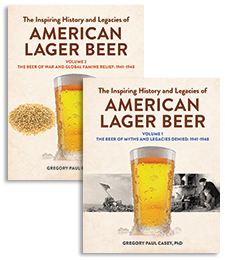
The Inspiring History and Legacies of American Lager Beer, Volume 2: The Beer of War and Global Famine Relief: 1941–1948
By Gregory Paul Casey The series examines the history of the American lager brewing between the 1840s and the 1940s. A period and a beer little studied by historians, the political, societal, and cultural history of the United States profoundly influenced the evolution of American adjunct lager beer.
The Inspiring History and Legacies of American Lager Beer, Volume 2: The Beer of War and Global Famine Relief: 1941–1948
The Beer of War and Global Famine Relief: 1941–1948 is the second book in a one-of-a-kind, five-volume series, The Inspiring History and Legacies of American Lager Beer, which details the unlikely rise of American adjunct lager beer, as told by industry expert Greg Casey. The author has compiled more than 17,000 period references, with sources as varied as the Library of Congress to interviews with contemporary descendants. The series examines the history of American lager brewing between the 1840s and the 1940s. A period and a beer little studied by historians, the political, societal, and cultural history of the United States profoundly influenced the evolution of American adjunct lager beer. This series is the result of Casey’s 16 years of passionate self-directed and self-funded research.
During World War II, the brewing industry faced unprecedented challenges as wartime shortages affected key ingredients such as corn, which breweries like Pabst had relied on since the late 19th century as a preferred adjunct. These shortages spurred innovations and adaptations that reshaped the industry’s approach to brewing, debunking the long-standing myth that adjuncts such as corn were a wartime necessity born of malt shortages. Instead, as Greg Casey explores in depth, these adjustments exemplify the resilience and resourcefulness of American brewers during one of history’s most trying eras.
With impressive forewords from Ken Grossman (Founder, Owner, and President of Sierra Nevada Brewing Company) and Richard L. Yuengling, Jr. (President and CEO of D. G. Yuengling & Son, Inc.), this second volume, The Beer of War and Global Famine Relief: 1941–1948, transitions to an archivally based review of the actual history of this period of the American lager brewing industry—a story of perseverance and the embodiment of the American dream, which the author hopes each reader finds not only surprising but also inspiring.
The stories told in The Inspiring History and Legacies of American Lager Beer will be of interest and value to a diverse audience: readers interested in the history of the United States or World War II, American craft brewers or employees of macro lager breweries, and even those who simply enjoy drinking American lager and craft beers. All readers are guaranteed a newfound pride, knowledge, and appreciation for the perseverance of American adjunct lager beer.
The Inspiring History and Legacies of American Lager Beer, Volume 1: The Beer of Myths and Legacies Denied: 1941–1948
By Gregory Paul Casey The series examines the history of the American lager brewing between the 1840s and the 1940s. A period and a beer little studied by historians, the political, societal, and cultural history of the United States profoundly influenced the evolution of American adjunct lager beer.
The Inspiring History and Legacies of American Lager Beer, Volume 1: The Beer of Myths and Legacies Denied: 1941–1948
The Beer of Myths and Legacies Denied: 1941–1948 is the first book in a one-of-a-kind, five-volume series, The Inspiring History and Legacies of American Lager Beer, which details the unlikely rise of American adjunct lager beer, as told by industry expert Greg Casey. The author has compiled more than 17,000 period references, with sources as varied as the Library of Congress to interviews with contemporary descendants. The series examines the history of American lager brewing between the 1840s and the 1940s. A period and a beer little studied by historians, the political, societal, and cultural history of the United States profoundly influenced the evolution of American adjunct lager beer. This series is the result of Casey’s 16 years of passionate self-directed and self-funded research.
With impressive forewords from Ken Grossman (Founder, Owner, and President of Sierra Nevada Brewing Company) and Richard L. Yuengling, Jr. (President and CEO of D. G. Yuengling & Son, Inc.), The Beer of Myths and Legacies Denied: 1941–1948 follows a “who, what, where, when, and why” format to dissect the many myths that shroud the conception of American adjunct lager beer and thus uncover the true histories and voices that were once buried. The author reviews and explores the remarkable parallels between the first half-centuries of the history of the American lager brewing industry (1870s–1910s) and today’s craft brewing industry (1980s–2020s)—presenting readers with a living history of this era. This book is not a droll collection of statistics or a numbing array of technical jargon or a trade-centric emphasis on brewing science and technology but rather an emphasis placed on the people whose lives pulsate throughout the series.
The stories told in The Inspiring History and Legacies of American Lager Beer will be of interest and value to a diverse audience: readers interested in the history of the United States or World War II, American craft brewers or employees of macro lager breweries, and even those who simply enjoy drinking American lager and craft beers. All readers are guaranteed a newfound pride, knowledge, and appreciation for the perseverance of American adjunct lager beer.
The Inspiring History and Legacies of American Lager Beer, Volume 2: The Beer of War and Global Famine Relief: 1941–1948 and The Inspiring History and Legacies of American Lager Beer, Volume 1: The Beer of Myths and Legacies Denied: 1941–1948
By Gregory Paul Casey The series examines the history of the American lager brewing between the 1840s and the 1940s. A period and a beer little studied by historians, the political, societal, and cultural history of the United States profoundly influenced the evolution of American adjunct lager beer.
The Inspiring History and Legacies of American Lager Beer, Volume 2: The Beer of War and Global Famine Relief: 1941–1948 and The Inspiring History and Legacies of American Lager Beer, Volume 1: The Beer of Myths and Legacies Denied: 1941–1948
The Beer of Myths and Legacies Denied: 1941–1948 and The Beer of War and Global Famine Relief: 1941–1948 are the first two books in the one-of-a-kind, five-volume series, The Inspiring History and Legacies of American Lager Beer, which details the unlikely rise of American adjunct lager beer, as told by industry expert Greg Casey. The author has compiled more than 17,000 period references, with sources as varied as the Library of Congress to interviews with contemporary descendants. The series examines the history of American lager brewing between the 1840s and the 1940s. A period and a beer little studied by historians, the political, societal, and cultural history of the United States profoundly influenced the evolution of American adjunct lager beer. This series is the result of Casey’s 16 years of passionate self-directed and self-funded research.
Volume 1: The Beer of Myths and Legacies Denied: 1941–1948 follows a “who, what, where, when, and why” format to dissect the many myths that shroud the conception of American adjunct lager beer and thus uncover the true histories and voices that were once buried. The author reviews and explores the remarkable parallels between the first half-centuries of the history of the American lager brewing industry (1870s–1910s) and today’s craft brewing industry (1980s–2020s)—presenting readers with a living history of this era. This book is not a droll collection of statistics or a numbing array of technical jargon or a trade-centric emphasis on brewing science and technology but rather an emphasis placed on the people whose lives pulsate throughout the series.
During World War II, the brewing industry faced unprecedented challenges as wartime shortages affected key ingredients such as corn, which breweries like Pabst had relied on since the late 19th century as a preferred adjunct. These shortages spurred innovations and adaptations that reshaped the industry’s approach to brewing, debunking the long-standing myth that adjuncts such as corn were a wartime necessity born of malt shortages. Volume 2: The Beer of War and Global Famine Relief: 1941–1948, transitions to an archivally based review of the actual history of this period of the American lager brewing industry—a story of perseverance and the embodiment of the American dream, which the author hopes each reader finds not only surprising but also inspiring.
Volumes 1 and 2 feature impressive forewords from Ken Grossman (Founder, Owner, and President of Sierra Nevada Brewing Company) and Richard L. Yuengling, Jr. (President and CEO of D. G. Yuengling & Son, Inc.).
The stories told in The Inspiring History and Legacies of American Lager Beer will be of interest and value to a diverse audience: readers interested in the history of the United States or World War II, American craft brewers or employees of macro lager breweries, and even those who simply enjoy drinking American lager and craft beers. All readers are guaranteed a newfound pride, knowledge, and appreciation for the perseverance of American adjunct lager beer.
Brewery Safety: Principles, Processes, and People
By Matt Stinchfield From physical trauma to chemical irritations, biological hazards to psychosocial hazards, Brewery Safety explores in-depth how to think about and avoid these hazards.
Brewers of all sizes should uphold the value of safety alongside their edgy brands and creative and carefully crafted beers and other beverages. It’s the responsibility of all brewery employees to assess hazards, learn how to control or eliminate them, and to document and train each other on the safest ways to perform tasks. It’s not just about government regulation, but it is also about making your brewery the best brewery possible—for your beer, your staff, and your visitors.
Breweries face hazards that can be divided into physical, chemical, biological, ergonomic, and psychosocial hazards. Learning to address these aspects of safety to ensure a safe product and working environment is paramount. From physical trauma to chemical irritations, biological hazards to psychosocial hazards, Brewery Safety explores in-depth how to think about and avoid these hazards. Brewers will learn to evaluate, educate, and execute safety conscious measures to ensure that the working environment, welfare of staff, and the quality of the product are first and foremost.
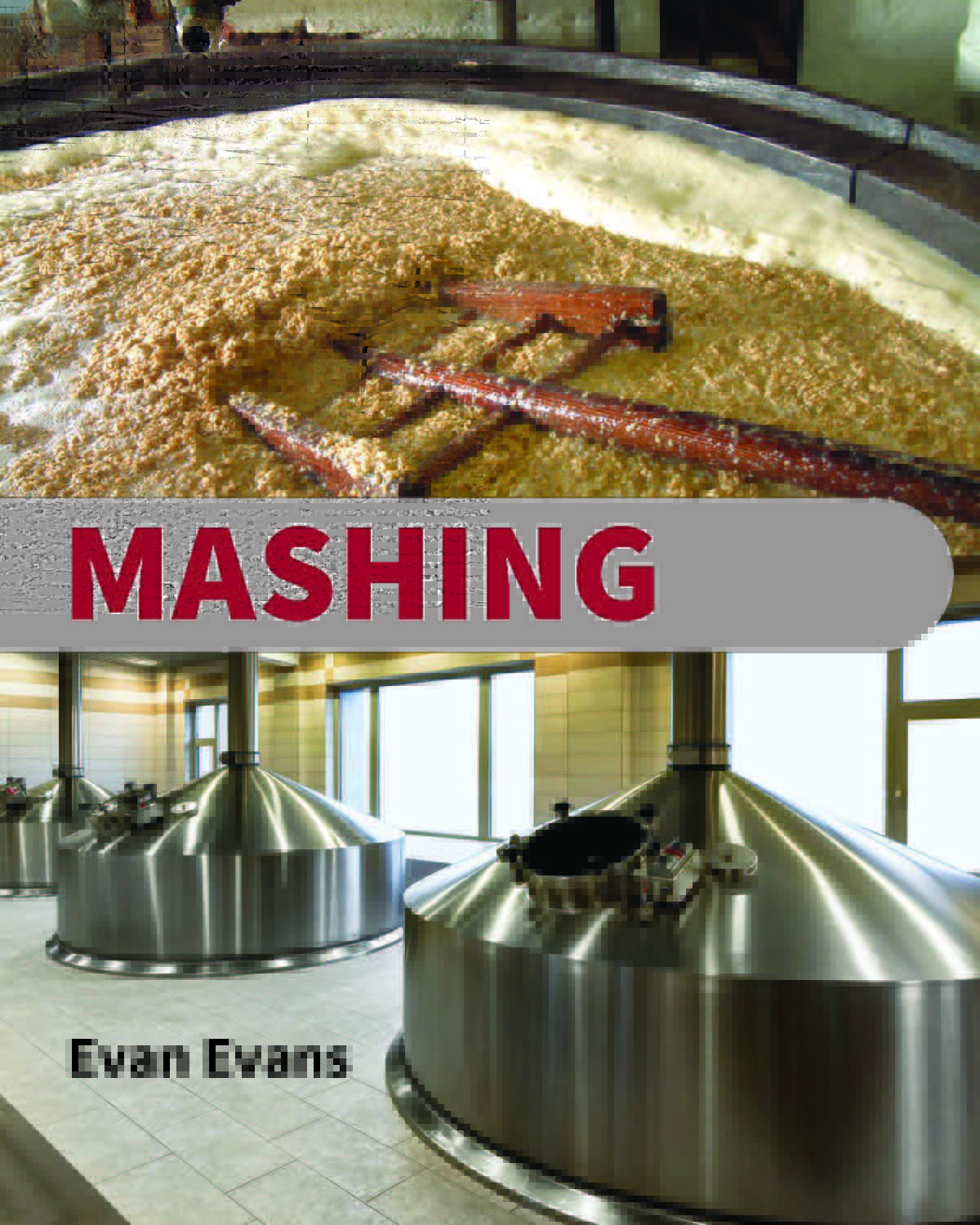
Mashing
By Evan Evans Readers will emerge from this book with a deeper understanding of the foundations of mashing biochemistry, such as the relationships between starch and starch-hydrolyzing enzymes and between proteins and proteases.
Provides a comprehensive foundation in the biochemistry of mashing, enabling brewers to confidently fine-tune the process with desirable results
Instructs brewers how to target key malt and mash parameters to troubleshoot quality and efficiency issues stemming from the mashing process
Includes practical examples of what happens when the mashing process is modified
With a career in malt quality research, Evan Evans has had many conversations with maltsters and brewers about the practical aspects of mashing. In Mashing, he provides an informed perspective on the mashing process, ranging from foundational knowledge to brewing applications.
Evans coined the phrase “from grass to glass” to summarize his perspective on malting quality. He approaches the topic from a malt chemist’s perspective, showing how the equipment interacts with malt quality so that brewers can fine-tune the process to consistently produce the style and brand of beer desired or make the necessary adjustments to produce a new beer.
Over the years, Evans has learned that most practical advances in malt quality and brewing result from subtle adjustments rather than quantum shifts. To this end, he strives to provide a holistic understanding of mashing by encompassing malt quality, equipment, and process control. He also includes practical examples of what happens when the mashing process is modified—from mash temperature and time to water-to-grist ratio and malt grinding.
Readers will emerge from this book with a deeper understanding of the foundations of mashing biochemistry, such as the relationships between starch and starch-hydrolyzing enzymes and between proteins and proteases. Readers will be able to knowledgeably integrate malt quality with brewhouse engineering to develop new beer brands and understand how to modify the mash to produce lite beers and low-alcohol beers. They also will be able to target key malt and mash parameters to troubleshoot quality and efficiency issues that stem from mashing, including fermentability, flavor stability, and filterability.
Brewery Cleaning: Equipment, Procedures, and Troubleshooting
By Richard J. Rench This book provides theoretical and the practical information needed by brewing professionals to identify and correct cleaning issues throughout the brewery. Following the recommendations in this book will improve brewery operations in measurable ways.
Brewery Cleaning: Equipment, Procedures, and Troubleshooting
Most brewers are passionate about the products they produce, and they understand that achieving and maintaining high quality is critical to their ongoing success. Many strive to get the finest raw materials, to understand their equipment and its limitations, and to continually hone their craft.
However, even many formally trained brewers may not have a good understanding of the cleaning products they use or how to apply them in the most effective manner. Likewise, brewery production staff may not know how to identify potential cleaning issues or understand how cleaning products, procedures, and systems work. These topics are not well covered in many college brewing courses and textbooks.
Brewery Cleaning: Equipment, Procedures, and Troubleshooting provides both the theoretical and the practical information needed by brewing professionals to identify and correct cleaning issues in all parts of the brewery. The book covers a range of topics that will improve brewery operations in measurable ways:
Key components of cleaning products and how they work: Understanding cleaning products will lead to making better selections, resulting not only in improved microbiological performance but also in reduced cleaning time and costs.
Brewery cleaning procedures: Knowing fundamental procedures will enable examining and improving existing procedures for efficiency and effectiveness.
Brewery cleaning systems: Understanding the equipment and principles associated with typical cleaning systems will allow determining whether current systems are designed and working correctly, as well as improve microbiological performance and reduce cleaning time and costs.
Optimizing, auditing, and troubleshooting cleaning systems: Recognizing common issues and knowing how to troubleshoot them will increase productivity and lower costs.
Developments in cleaning technologies: Considering technologies such as acid cleaning and sanitizers will provide options for reducing cleaning time and utility costs.
Safe handling, storage, and disposal of chemicals: Following best practices will lower the risk of injuries, help compliance with local regulations, and avoid the costs that can be related to both.
The author, Richard J. Rench, is an experienced and well-qualified brewer. In addition, he has spent many years working with a chemical cleaning product supplier to resolve cleaning issues in a variety of breweries and to provide solutions that help reduce costs while improving microbiological performance.
Brewery Cleaning will be an indispensable resource for brewery production professionals, including brewmasters, brewers, and lead hands, as well as brewery engineers and quality control managers and staff. Quality control and assurance managers in the dairy industry will also find this book valuable in addressing cleaning issues. For brewing instructors and their students, this book will provide the text they have needed for some time.
Beer Packaging, Second Edition
Edited by Ray Klimovitz and Karl Ockert Beer Packaging offers complete coverage of the packaging process from containers through handling and quality controls. It shares experiences from expert contributors to give you knowledge for real-life situations.
Packaging is the most expensive aspect of brewing, representing up to two thirds of the cost of beer production. It is also one of the least forgiving steps in the brewing process.
A perfect batch of beer can be ruined in nanoseconds by microorganisms on your nozzles or too much oxygen making its way into your bottles or cans. Foreign objects, like glass, can get into your product…and to your consumers. Too little glue on your boxes can send your product (and profit) crashing to the ground.
Brewers have a lot invested in their packaging process, and nothing less than reputations and profitability are at stake. An up-to-date, comprehensive book on the topic has been long overdue. And with all the changes and innovations in packaging that have taken place in the past 20 years, no such book has been written…until now.
Enter Beer Packaging, Second Edition, the first comprehensive book on the beer packaging process since the early 1980s. This thorough, one-of-a-kind guide and reference represents the many new innovations and best practices developed since MBAA published the best-selling first edition. It is a must-have resource for all of today’s brewers up and down the production line, and includes perspectives for both the small craft brewers and those managing small scale pilot runs for large breweries averaging more than 10 million barrels per year.
Beer Packaging, Second Edition guides users around the many potential pitfalls of packaging, particularly those that can affect your current or future customers, and ultimately your profit margins.It covers the beer packaging process from the tank to containers, to filling and boxing, and everything in between, including…
Packaging Line Design, Control, and Instrumentation
Environmental Management of Brewery Operations
Packaging Line Project Management
Basic Principles and Operation of a Bottle Washer
Small-Scale Canning Lines
Flash and Tunnel Pasteurization
Bottle Filling and Crowning
Cans and Seaming
Container and Product Movement
Keg Line Operations
Brewery Case Palletizing
This book is formatted in a way that is easy to understand. Each facet of packaging is broken down so that any person in the brewery can become familiar with each step in the process. In addition, case history experiences from expert contributors give the reader knowledge for real-life situations, while technical features by industry experts cover both the fundamentals and details for each subject.
Beer Packaging, Second Edition is an excellent “go-to” manual for those working in beer packaging. It is a highly useful reference for beer packaging professionals already on the job and for those planning to build or expand their operations.
The book is also ideal for brewers and brewing managers, brewery engineers, materials and equipment suppliers, as well as brewing program instructors and their students.
Those who own and use books from MBAA’s Practical Brewer Handbook series will also find this book useful.
Dinner in the Beer Garden
By Lucy Saunders It's a cookbook for people who enjoy carrots and kale, but also love beer, cheese and chocolate.
Lucy Saunders is the author of four cookbooks about beer, and has been writing about beer and food for magazines and newspapers for more than 20 years.
DINNER IN THE BEER GARDEN is the theme of her cookbook – but this isn’t a cookbook about typical bratwurst or roasted pork. All the recipes feature fresh fruits and vegetables at the center of the plate, and a few call for fish and seafood.
It’s a cookbook for people who enjoy carrots and kale, but also love beer, cheese and chocolate. Profiles of beer gardens and tips on pairing beer with fruits and vegetables appear in between chapters, with lots of stories and tips on pairing.
Recipes are contributed by chefs such as AJ Hurst from Vintage Brewing Co. who made the Beet--Ricotta Gnocchi with a Weiss Blau Sauce, and chefs from the Kohler Festival of Beer, as well as home cooks like Lucy.
Easy recipes include the Grilled Vegetables with the New Glarus Beer and salads. The Burnt Caramel Cream and Chocolate Shortcakes with Sprecher Black Bavarian are simple to make, but taste impressive.
"My goal in writing the cookbook is to focus on pairing beer with fresh--grown food," says Saunders. "People are growing vegetables at home, buying fresh produce at farmers markets, participating in community supported agriculture, enjoying Meatless Mondays, so it’s good to show what can be done with beer pairings.
Saunders also wrote the profiles in the cookbook to highlight sustainable brewing such as Bell’s Brewery starting to grow its own barley and Rogue Ales Grow Your Own initiative in preserving farm land for hops and barley.
Beer Steward Handbook, Second Edition
Edited by Stephen R. Holle, Ray Klimovitz, Lars Larson, Karl Ockert, and Steve Presley This book includes an overview of the brewing process, a description of a multitude of beer styles worldwide, the rules for pairing food and beer, and the ingredients behind brewing.
As a beer devotee, you need to know which beers are malty or hoppy and the difference between an English IPA and an American IPA. You may even want to know which beer goes with which glass, or with which dinner course. The Beer Steward Handbook–A Practical Guide to Understanding Beer is an excellent and well-written guide to learning the basics surrounding beer. It includes an overview of the brewing process, a description of a multitude of beer styles worldwide, the rules for pairing food and beer, and the ingredients behind brewing. It discusses how to best maintain freshness of beer and the ideal ways to serve beer, right down to glass shape, size, and angle of the pour.
The Beer Steward Handbook provides an excellent background to help you explain the entire brewing process to others, the importance of proper serving techniques, the large variety found among beer styles, and much more. It even describes the important health benefits of beer through a science-based, but understandable approach.
This book is perfect for wholesalers, retail managers, restaurateurs, bar managers, servers, retail sales staff, duty managers, and beer enthusiasts at all levels.
Yeast Flocculation, Vitality, and Viability
Edited by Alex Speers Proceedings of the 2nd International Brewers Symposium
This book is a comprehensive resource on yeast vitality and viability, flocculation, malt influences on yeast performance, and the use of dried yeast in the brewing process. Editor Alex Speers brings together more than 20 leading international brewing scientists to give an update on the latest theoretical and applied findings regarding brewing yeast behavior. The book reflects updates to the conference presentations of the same name and is certain to serve as an important reference for those responsible for brewing yeast behavior and its role when creating and producing high-quality, well-crafted beers. It gives brewers and brewing scientists an essential perspective on the functionality of this important brewing component.
Brewing Classic Styles: 80 Winning Recipes Anyone Can Brew
By Jamil Zainasheff and John Palmer In this book he teams up with homebrewing expert John J. Palmer to share award-winning recipes for each of the 80-plus competition styles.
Brewing Classic Styles: 80 Winning Recipes Anyone Can Brew
Jamil Zainasheff is a perennial award winner at the National Homebrew Competition finals and winner of more than 500 brewing awards across all style categories. In this book he teams up with homebrewing expert John J. Palmer to share award-winning recipes for each of the 80-plus competition styles. Using extract-based recipes for most categories, the duo gives sure-footed guidance to brewers interested in reproducing classic beer styles for their own enjoyment or to enter into competitions.
Jamil Zainasheff started brewing in 1999 and soon started winning awards in homebrew competitions. He has brewed beers in every style recognized by the Beer Judge Certification Program, taken medals in the finals of the National Homebrew Competition every year since 2002 and amassed more than 20 Best-of-Show awards. He contributes articles to Zymurgy magazine and is the Style Profile columnist for Brew Your Own. Author of the homebrewing bestseller How To Brew, John J. Palmer shares his years of hands-on experience to help homebrewers consistently make great beers while expanding their knowledge and experience with the hobby.
Compressed Air in Breweries
Written by Hartmut Evers and Hans J Manger; Translated by Robert Liedl, David Schleef, David Lewis, and Ken Belau; Edited by Lars Larson and Inge Russell Compressed air systems are the third most important utility in breweries and are often the most misunderstood.
Compressed air systems are the third most important utility in breweries and are often the most misunderstood. This manual is for brewery operators and brewery engineers and is designed to provide an understanding of common compression systems and operation techniques in breweries. The manual is extensively illustrated and covers key topics of common installations of modern compressed air systems, design applications, physical laws of compressed air, drying compressed air, and maintenance recommendations.
The goal of this book is to illustrate the interconnecting aspects of a compressed air system and to show advantageous solutions to problems that arise when planning and operating such systems properly. The planning of a compressed air system must be carried out carefully, using a comprehensive layout of information and criteria that can be clearly understood. The requirements for a cost-effective and reliable compressed air production system include a detailed description, comparable quotations, a well-worked-out contract, and reliable equipment with proven capacities.
This value-packed book will help you increase your understanding of brewery compressed air systems when used in the following areas:
To push fluids through piping and empty tanks, in the form of dry, oil-free, sterile air.
To aerate wort, yeast, or water, in the form of dry, oil-free, sterile air.
As an energy carrier for the pneumatic transportation of solids, such as spent grains, whole malt, sugar, and filter media, in the form of oil-free, and where necessary, dry air.
As a purge gas to displace CO2 from tanks prior to being cleaned in place (CIP) with caustic, in the form of oil-free, sterile air.
To modulate valves in valve control operations, in the form of dry, oil-free air.
As an energy carrier to drive air tools, in the form of dry air.
Plant maintenance and control
All employees in the fermentation and beverage industries with any responsibility for compressed air applications should have access to this book. MBAA has value-priced this title so you can make it available across your entire brewery operation, large or small.
Standards of Brewing: A Practical Approach to Consistency
Edited by Karl Ockert Written by industry experts, this resource is regarded as a trade standard achieving worldwide acceptance as an outstanding basic training tool in the art and science of brewing.
Standards of Brewing: A Practical Approach to Consistency
Inside Volume 3: Brewing Engineering and Plant Operations Power plant engineering, including hands-on discussion of pumps, valves, steam boilers, and compressors
Environmental engineering, concentrating on wastewater issues Cleaning and sanitation of brewery tanks, equipment, and the plant Draft dispense system design, cleaning, and maintenance Safety considerations in the brewery processes, and options used for producing Specialty Beers.
Practical Handbook for the Specialty Brewer: Fermentation, Cellaring, and Packaging Operations Volume 2
Edited by Karl Ockert Increase your Specialty Brewing knowledge with this easy-to-use handbook series!
Practical Handbook for the Specialty Brewer: Fermentation, Cellaring, and Packaging Operations Volume 2
Sixty years ago, MBAA created a simple, practical, technical book on all aspects of brewing in a user friendly question-and-answer format. Building on that best-selling concept, this handbook series written by MBAA experts expands the Q&A format in a comprehensive manner, making it easier than ever to find answers to your questions on the broad subject of specialty brewing.
The unique simplicity of the Q&A format makes understanding and application straightforward. Editor Karl Ockert has assembled a talented group of expert contributors from within the pub, craft, and large brewing communities, who write from their own experience and knowledge to bring you the know-how you need in order to answer real-life questions quickly and easily. Practical convenience is the objective for this handbook series which stresses useful applications over theory.
Inside Volume 2: Fermentation, Cellaring, and Packaging Operations
Get fast answers to technical questions on cellar and tank design, fermentation biochemistry and microbiology and their relationship to the cellar processes in producing specialty ales and lager beers. A review of fundamentals and practical and theoretical considerations in the areas of:
Traditional and modern processes for the fermentation of ales and lagers
Cellar, tank, and equipment design considerations
Clarification, filtration, and carbonation of finished beers
Racking beer in kegs and casks
Bottle filling operations, materials, and equipment
Laboratory methods, equipment, and calculations
Practical Handbook for the Specialty Brewer: Raw Materials and Brewhouse Operations, Volume 1
Edited by Karl Ockert Find fast answers to technical questions on the raw materials, brewhouse processes, and options used for producing Specialty Beers.
Practical Handbook for the Specialty Brewer: Raw Materials and Brewhouse Operations, Volume 1
Sixty years ago, MBAA created a simple, practical, technical book on all aspects of brewing in a user friendly question-and-answer format. Building on that best-selling concept, this handbook series written by MBAA experts expands the Q&A; format in a comprehensive manner, making it easier than ever to find answers to your questions on the broad subject of specialty brewing.
The unique simplicity of the Q&A; format makes understanding and application straightforward. Editor Karl Ockert has assembled a talented group of expert contributors from within the pub, craft, and large brewing communities, who write from their own experience and knowledge to bring you the know-how you need in order to answer real-life questions quickly and easily. Practical convenience is the objective for this handbook series which stresses useful applications over theory.
Inside Volume 1: Raw Materials and Brewhouse Operations Find fast answers to technical questions on the raw materials, brewhouse processes, and options used for producing Specialty Beers. Get a review of fundamentals and learn about the practical and theoretical considerations in the areas of:
Water, the base ingredient of all styles
Barley and malting fundamentals
Specialty malts, their processing and use in specialty beer styles
Hops, hop varieties and their use in brewing different styles
Adjunct use in the brewhouse
Brewhouse equipment, operations and methods for brewing traditional ales and lager beers
Practical Handbook for the Specialty Brewer, Vol 1-3
Edited by Karl Ockert Written by industry experts, this resource is regarded as a trade standard achieving worldwide acceptance as an outstanding basic training tool in the art and science of brewing.
Practical Handbook for the Specialty Brewer, Vol 1-3
More than 65 years ago MBAA created a simple, practical, technical book on all aspects of brewing in a user friendly question-and-answer format. Building on that best-selling concept, this popular handbook series, written by MBAA experts, expands the Q&A; format in a comprehensive manner, making it easier than ever to find answers to your questions on the broad subject of specialty brewing.
The unique simplicity of the Q&A; format makes understanding and application straightforward. Editor Karl Ockert has assembled a talented group of expert contributors from within the pub, craft, and large brewing communities, who write from their own experience and knowledge to bring you the know-how you need in order to answer real-life questions quickly and easily. Practical knowledge is the objective for this handbook series which stresses useful applications over theory.
Inside Volume 1: Raw Materials and Brewhouse Operations Water, the base ingredient of all styles
Barley and malting fundamentals
Specialty malts, their processing and use in specialty beer styles
Hops, hop varieties and their use in brewing different styles
Adjunct use in the brewhouse
Brewhouse equipment, operations and methods for brewing traditional ales and lager beers
Inside Volume 2: Fermentation, Cellaring, and Packaging Operations Traditional and modern processes for the fermentation of ales and lagers
Cellar, tank, and equipment design considerations
Clarification, filtration, and carbonation of finished beers
Racking beer in kegs and casks
Bottle filling operations, materials, and equipment
Laboratory methods, equipment, and calculations
Inside Volume 3: Brewing Engineering and Plant Operations Power plant engineering, including hands-on discussion of pumps, valves, steam boilers, and compressors
Environmental engineering, concentrating on wastewater issues
Cleaning and sanitation of brewery tanks, equipment, and the plant
Draft dispense system design, cleaning, and maintenance
Safety considerations in the brewery
processes, and options used for producing Specialty Beers.
Practical Handbook For The Specialty Brewer
Standards of Brewing: A Practical Approach to Consistency
Edited by Karl Ockert Written by industry experts, this resource is regarded as a trade standard achieving worldwide acceptance as an outstanding basic training tool in the art and science of brewing.
Standards of Brewing: A Practical Approach to Consistency
Inside Volume 3: Brewing Engineering and Plant Operations Power plant engineering, including hands-on discussion of pumps, valves, steam boilers, and compressors
Environmental engineering, concentrating on wastewater issues Cleaning and sanitation of brewery tanks, equipment, and the plant Draft dispense system design, cleaning, and maintenance Safety considerations in the brewery processes, and options used for producing Specialty Beers.
Practical Handbook for the Specialty Brewer: Fermentation, Cellaring, and Packaging Operations Volume 2
Edited by Karl Ockert Increase your Specialty Brewing knowledge with this easy-to-use handbook series!
Practical Handbook for the Specialty Brewer: Fermentation, Cellaring, and Packaging Operations Volume 2
Sixty years ago, MBAA created a simple, practical, technical book on all aspects of brewing in a user friendly question-and-answer format. Building on that best-selling concept, this handbook series written by MBAA experts expands the Q&A format in a comprehensive manner, making it easier than ever to find answers to your questions on the broad subject of specialty brewing.
The unique simplicity of the Q&A format makes understanding and application straightforward. Editor Karl Ockert has assembled a talented group of expert contributors from within the pub, craft, and large brewing communities, who write from their own experience and knowledge to bring you the know-how you need in order to answer real-life questions quickly and easily. Practical convenience is the objective for this handbook series which stresses useful applications over theory.
Inside Volume 2: Fermentation, Cellaring, and Packaging Operations
Get fast answers to technical questions on cellar and tank design, fermentation biochemistry and microbiology and their relationship to the cellar processes in producing specialty ales and lager beers. A review of fundamentals and practical and theoretical considerations in the areas of:
Traditional and modern processes for the fermentation of ales and lagers
Cellar, tank, and equipment design considerations
Clarification, filtration, and carbonation of finished beers
Racking beer in kegs and casks
Bottle filling operations, materials, and equipment
Laboratory methods, equipment, and calculations
Practical Handbook for the Specialty Brewer: Raw Materials and Brewhouse Operations, Volume 1
Edited by Karl Ockert Find fast answers to technical questions on the raw materials, brewhouse processes, and options used for producing Specialty Beers.
Practical Handbook for the Specialty Brewer: Raw Materials and Brewhouse Operations, Volume 1
Sixty years ago, MBAA created a simple, practical, technical book on all aspects of brewing in a user friendly question-and-answer format. Building on that best-selling concept, this handbook series written by MBAA experts expands the Q&A; format in a comprehensive manner, making it easier than ever to find answers to your questions on the broad subject of specialty brewing.
The unique simplicity of the Q&A; format makes understanding and application straightforward. Editor Karl Ockert has assembled a talented group of expert contributors from within the pub, craft, and large brewing communities, who write from their own experience and knowledge to bring you the know-how you need in order to answer real-life questions quickly and easily. Practical convenience is the objective for this handbook series which stresses useful applications over theory.
Inside Volume 1: Raw Materials and Brewhouse Operations Find fast answers to technical questions on the raw materials, brewhouse processes, and options used for producing Specialty Beers. Get a review of fundamentals and learn about the practical and theoretical considerations in the areas of:
Water, the base ingredient of all styles
Barley and malting fundamentals
Specialty malts, their processing and use in specialty beer styles
Hops, hop varieties and their use in brewing different styles
Adjunct use in the brewhouse
Brewhouse equipment, operations and methods for brewing traditional ales and lager beers
Practical Handbook for the Specialty Brewer, Vol 1-3
Edited by Karl Ockert Written by industry experts, this resource is regarded as a trade standard achieving worldwide acceptance as an outstanding basic training tool in the art and science of brewing.
Practical Handbook for the Specialty Brewer, Vol 1-3
More than 65 years ago MBAA created a simple, practical, technical book on all aspects of brewing in a user friendly question-and-answer format. Building on that best-selling concept, this popular handbook series, written by MBAA experts, expands the Q&A; format in a comprehensive manner, making it easier than ever to find answers to your questions on the broad subject of specialty brewing.
The unique simplicity of the Q&A; format makes understanding and application straightforward. Editor Karl Ockert has assembled a talented group of expert contributors from within the pub, craft, and large brewing communities, who write from their own experience and knowledge to bring you the know-how you need in order to answer real-life questions quickly and easily. Practical knowledge is the objective for this handbook series which stresses useful applications over theory.
Inside Volume 1: Raw Materials and Brewhouse Operations Water, the base ingredient of all styles
Barley and malting fundamentals
Specialty malts, their processing and use in specialty beer styles
Hops, hop varieties and their use in brewing different styles
Adjunct use in the brewhouse
Brewhouse equipment, operations and methods for brewing traditional ales and lager beers
Inside Volume 2: Fermentation, Cellaring, and Packaging Operations Traditional and modern processes for the fermentation of ales and lagers
Cellar, tank, and equipment design considerations
Clarification, filtration, and carbonation of finished beers
Racking beer in kegs and casks
Bottle filling operations, materials, and equipment
Laboratory methods, equipment, and calculations
Inside Volume 3: Brewing Engineering and Plant Operations Power plant engineering, including hands-on discussion of pumps, valves, steam boilers, and compressors
Environmental engineering, concentrating on wastewater issues
Cleaning and sanitation of brewery tanks, equipment, and the plant
Draft dispense system design, cleaning, and maintenance
Safety considerations in the brewery
processes, and options used for producing Specialty Beers.
El Cervecero en la Practica (The Practical Brewer, Third Edition Spanish Version)
Spanish language book Edited by John T. McCabe Written by industry experts, this resource is regarded as a trade standard achieving worldwide acceptance as an outstanding basic training tool in the art and science of brewing.
The Craft Brewer's Guide to Best Practices Volume 1: Management, Regulation, and Brewery Design
The Craft Brewer’s Guide to Best Practices—written by Karl Ockert, lead editor of Master Brewers’ bestselling series Practical Handbook for the Specialty Brewer—provides information to help readers design, build, and run a craft brewery to consistently make high-quality beer. Presented in an accessible question-and-answer format, these books cover subjects and current practices relevant to craft brewers everywhere. Based on his wide-ranging experience, Ockert provides information and insights that are not found in other brewing guides and textbooks.
Volume 1: Management, Regulation, and Brewery Design provides practical, real-life answers to technical questions on an array of topics crucial for successful craft brewing:
The human, operational, and business sides of the brewery operation
The regulatory and applied concepts of personal safety
How to assemble and run a quality management program that fits your brewery
Food safety fundamentals to comply with requirements of the Food Safety Modernization Act
Key aspects of selecting a building site and constructing a hygienic operation
What to look for in selecting or designing brewing tanks and equipment
Who will benefit from reading this book?
Anyone looking to start or maintain a career in craft brewing
Personnel in manually operated craft brewpubs and breweries (although many of the concepts can be applied universally to a brewery of any size)
Brewing and malting science educators and students
Technical staff and other professionals in industries related to brewing and fermentation
The Craft Brewer’s Guide to Best Practices Volume 2: Raw Materials, Wort Production, and Fermentation
By Karl Ockert This book provides information to help readers design, build, and run a craft brewery to consistently make high-quality beer.
The Craft Brewer’s Guide to Best Practices Volume 2: Raw Materials, Wort Production, and Fermentation
The Craft Brewer’s Guide to Best Practices—written by Karl Ockert, lead editor of Master Brewers’ bestselling series Practical Handbook for the Specialty Brewer—provides information to help readers design, build, and run a craft brewery to consistently make high-quality beer. Presented in an accessible question-and-answer format, these books cover subjects and current practices relevant to craft brewers everywhere. Based on his wide-ranging experience, Ockert provides information and insights that are not found in other brewing guides and textbooks.
Volume 2: Raw Materials, Wort Production, and Fermentation provides practical, real-life answers to technical questions on an array of topics crucial for successful craft brewing:
Selecting suppliers, contracting for packaging and raw materials, and managing the supply chain
Practical applications for cleaning and sanitizing brewery tanks and equipment
Techniques and methods used in producing sweet wort in the brewhouse
Production techniques for boiled wort, including cool pooling, hot side high gravity brewing, and whirlpool hopping
In-depth discussions of both traditional and modernized methods of ale and lager fermentation and beer maturation
Who will benefit from reading this book?
Anyone looking to start or maintain a career in craft brewing
Personnel in manually operated craft brewpubs and breweries (although many of the concepts can be applied universally to a brewery of any size)
Brewing and malting science educators and students
Technical staff and other professionals in industries related to brewing and fermentation
The Craft Brewer’s Guide to Best Practices Volume 3: Dry Hopping, Sours and Funky Beer Production, Packaging, and Utilities
By Karl Ockert This book provides information to help readers design, build, and run a craft brewery to consistently make high-quality beer.
The Craft Brewer’s Guide to Best Practices Volume 3: Dry Hopping, Sours and Funky Beer Production, Packaging, and Utilities
The Craft Brewer’s Guide to Best Practices—written by Karl Ockert, lead editor of Master Brewers’ bestselling series Practical Handbook for the Specialty Brewer—provides information to help readers design, build, and run a craft brewery to consistently make high-quality beer. Presented in an accessible question-and-answer format, these books cover subjects and current practices relevant to craft brewers everywhere. Based on his wide-ranging experience, Ockert provides information and insights that are not found in other brewing guides and textbooks.
Volume 3: Dry Hopping, Sours and Funky Beer Production, Packaging, and Utilities provides practical, real-life answers to technical questions on an array of topics crucial for successful craft brewing:
Techniques for developing hop flavor in the brewhouse and cellars and mitigation for hop creep
Production and wood aging techniques to produce saisons, sours, funky, and flavored beers
Preparation methods and materials for finishing the matured beer for packaging
Packaging beer into kegs and serving tanks and draft system design, care, and upkeep
Packaging line design and packaging beer into cans and bottles using rotary and inline filling equipment
Using a proactive maintenance program and understanding key plant utility systems
Who will benefit from reading this book?
Anyone looking to start or maintain a career in craft brewing
Personnel in manually operated craft brewpubs and breweries (although many of the concepts can be applied universally to a brewery of any size)
Brewing and malting science educators and students
Technical staff and other professionals in industries related to brewing and fermentation
The Craft Brewer’s Guide to Best Practices Volume 4: Standard Operating Procedures
By Karl Ockert This book provides information to help readers design, build, and run a craft brewery to consistently make high-quality beer.
The Craft Brewer’s Guide to Best Practices Volume 4: Standard Operating Procedures
The Craft Brewer’s Guide to Best Practices—written by Karl Ockert, lead editor of Master Brewers’ bestselling series Practical Handbook for the Specialty Brewer—provides information to help readers design, build, and run a craft brewery to consistently make high-quality beer. Presented in an accessible question-and-answer format, these books cover subjects and current practices relevant to craft brewers everywhere. Based on his wide-ranging experience, Ockert provides information and insights that are not found in other brewing guides and textbooks.
Volume 4: Standard Operating Procedures describes SOPs for key procedures to bring consistency in producing world-class craft-brewed beers in your brewery:
An introduction to SOPs, including how to write an SOP and produce an SOP manual Fundamental SOPs in the warehouse, brewhouse, tank cellar, wood barrel cellar, finishing, and packaging areas (including both operational and cleaning/sanitizing procedures) that can be adapted to any brewery Drawings of several setups for easy visual reference Who will benefit from reading this book?
Anyone looking to start or maintain a career in craft brewing Personnel in manually operated craft brewpubs and breweries (although many of the concepts can be applied universally to a brewery of any size) Brewing and malting science educators and students Technical staff and other professionals in industries related to brewing and fermentation
The Craft Brewer’s Guide to Best Practices, Volumes 1–4
By Karl Ockert Set of four comprehensive handbooks offering craft brewers information that is current, practical, and relevant to operations of their scale.
The Craft Brewer’s Guide to Best Practices, Volumes 1–4
The Craft Brewer’s Guide to Best Practices—written by Karl Ockert, lead editor of Master Brewers’ bestselling series Practical Handbook for the Specialty Brewer—provides information to help readers design, build, and run a craft brewery to consistently make high-quality beer. Presented in an accessible question-and-answer format, these books cover subjects and current practices relevant to craft brewers everywhere. Based on his wide-ranging experience, Ockert provides information and insights that are not found in other brewing guides and textbooks.
Volume 4: Standard Operating Procedures describes SOPs for key procedures to bring consistency in producing world-class craft-brewed beers in your brewery:
An introduction to SOPs, including how to write an SOP and produce an SOP manual
Fundamental SOPs in the warehouse, brewhouse, tank cellar, wood barrel cellar, -finishing, and packaging areas (including both operational and cleaning/sanitizing procedures) that can be adapted to any brewery
Drawings of several setups for easy visual reference
Who will benefit from reading this book?
Anyone looking to start or maintain a career in craft brewing
Personnel in manually operated craft brewpubs and breweries (although many of the concepts can be applied universally to a brewery of any size)
Brewing and malting science educators and students
Technical staff and other professionals in industries related to brewing and fermentation
Mashing
By Evan Evans Readers will emerge from this book with a deeper understanding of the foundations of mashing biochemistry, such as the relationships between starch and starch-hydrolyzing enzymes and between proteins and proteases.
Provides a comprehensive foundation in the biochemistry of mashing, enabling brewers to confidently fine-tune the process with desirable results
Instructs brewers how to target key malt and mash parameters to troubleshoot quality and efficiency issues stemming from the mashing process
Includes practical examples of what happens when the mashing process is modified
With a career in malt quality research, Evan Evans has had many conversations with maltsters and brewers about the practical aspects of mashing. In Mashing, he provides an informed perspective on the mashing process, ranging from foundational knowledge to brewing applications.
Evans coined the phrase “from grass to glass” to summarize his perspective on malting quality. He approaches the topic from a malt chemist’s perspective, showing how the equipment interacts with malt quality so that brewers can fine-tune the process to consistently produce the style and brand of beer desired or make the necessary adjustments to produce a new beer.
Over the years, Evans has learned that most practical advances in malt quality and brewing result from subtle adjustments rather than quantum shifts. To this end, he strives to provide a holistic understanding of mashing by encompassing malt quality, equipment, and process control. He also includes practical examples of what happens when the mashing process is modified—from mash temperature and time to water-to-grist ratio and malt grinding.
Readers will emerge from this book with a deeper understanding of the foundations of mashing biochemistry, such as the relationships between starch and starch-hydrolyzing enzymes and between proteins and proteases. Readers will be able to knowledgeably integrate malt quality with brewhouse engineering to develop new beer brands and understand how to modify the mash to produce lite beers and low-alcohol beers. They also will be able to target key malt and mash parameters to troubleshoot quality and efficiency issues that stem from mashing, including fermentability, flavor stability, and filterability.
Brewery Cleaning: Equipment, Procedures, and Troubleshooting
By Richard J. Rench This book provides theoretical and the practical information needed by brewing professionals to identify and correct cleaning issues throughout the brewery. Following the recommendations in this book will improve brewery operations in measurable ways.
Brewery Cleaning: Equipment, Procedures, and Troubleshooting
Most brewers are passionate about the products they produce, and they understand that achieving and maintaining high quality is critical to their ongoing success. Many strive to get the finest raw materials, to understand their equipment and its limitations, and to continually hone their craft.
However, even many formally trained brewers may not have a good understanding of the cleaning products they use or how to apply them in the most effective manner. Likewise, brewery production staff may not know how to identify potential cleaning issues or understand how cleaning products, procedures, and systems work. These topics are not well covered in many college brewing courses and textbooks.
Brewery Cleaning: Equipment, Procedures, and Troubleshooting provides both the theoretical and the practical information needed by brewing professionals to identify and correct cleaning issues in all parts of the brewery. The book covers a range of topics that will improve brewery operations in measurable ways:
Key components of cleaning products and how they work: Understanding cleaning products will lead to making better selections, resulting not only in improved microbiological performance but also in reduced cleaning time and costs.
Brewery cleaning procedures: Knowing fundamental procedures will enable examining and improving existing procedures for efficiency and effectiveness.
Brewery cleaning systems: Understanding the equipment and principles associated with typical cleaning systems will allow determining whether current systems are designed and working correctly, as well as improve microbiological performance and reduce cleaning time and costs.
Optimizing, auditing, and troubleshooting cleaning systems: Recognizing common issues and knowing how to troubleshoot them will increase productivity and lower costs.
Developments in cleaning technologies: Considering technologies such as acid cleaning and sanitizers will provide options for reducing cleaning time and utility costs.
Safe handling, storage, and disposal of chemicals: Following best practices will lower the risk of injuries, help compliance with local regulations, and avoid the costs that can be related to both.
The author, Richard J. Rench, is an experienced and well-qualified brewer. In addition, he has spent many years working with a chemical cleaning product supplier to resolve cleaning issues in a variety of breweries and to provide solutions that help reduce costs while improving microbiological performance.
Brewery Cleaning will be an indispensable resource for brewery production professionals, including brewmasters, brewers, and lead hands, as well as brewery engineers and quality control managers and staff. Quality control and assurance managers in the dairy industry will also find this book valuable in addressing cleaning issues. For brewing instructors and their students, this book will provide the text they have needed for some time.
Beer Packaging, Second Edition
Edited by Ray Klimovitz and Karl Ockert Beer Packaging offers complete coverage of the packaging process from containers through handling and quality controls. It shares experiences from expert contributors to give you knowledge for real-life situations.
Packaging is the most expensive aspect of brewing, representing up to two thirds of the cost of beer production. It is also one of the least forgiving steps in the brewing process.
A perfect batch of beer can be ruined in nanoseconds by microorganisms on your nozzles or too much oxygen making its way into your bottles or cans. Foreign objects, like glass, can get into your product…and to your consumers. Too little glue on your boxes can send your product (and profit) crashing to the ground.
Brewers have a lot invested in their packaging process, and nothing less than reputations and profitability are at stake. An up-to-date, comprehensive book on the topic has been long overdue. And with all the changes and innovations in packaging that have taken place in the past 20 years, no such book has been written…until now.
Enter Beer Packaging, Second Edition, the first comprehensive book on the beer packaging process since the early 1980s. This thorough, one-of-a-kind guide and reference represents the many new innovations and best practices developed since MBAA published the best-selling first edition. It is a must-have resource for all of today’s brewers up and down the production line, and includes perspectives for both the small craft brewers and those managing small scale pilot runs for large breweries averaging more than 10 million barrels per year.
Beer Packaging, Second Edition guides users around the many potential pitfalls of packaging, particularly those that can affect your current or future customers, and ultimately your profit margins.It covers the beer packaging process from the tank to containers, to filling and boxing, and everything in between, including…
Packaging Line Design, Control, and Instrumentation
Environmental Management of Brewery Operations
Packaging Line Project Management
Basic Principles and Operation of a Bottle Washer
Small-Scale Canning Lines
Flash and Tunnel Pasteurization
Bottle Filling and Crowning
Cans and Seaming
Container and Product Movement
Keg Line Operations
Brewery Case Palletizing
This book is formatted in a way that is easy to understand. Each facet of packaging is broken down so that any person in the brewery can become familiar with each step in the process. In addition, case history experiences from expert contributors give the reader knowledge for real-life situations, while technical features by industry experts cover both the fundamentals and details for each subject.
Beer Packaging, Second Edition is an excellent “go-to” manual for those working in beer packaging. It is a highly useful reference for beer packaging professionals already on the job and for those planning to build or expand their operations.
The book is also ideal for brewers and brewing managers, brewery engineers, materials and equipment suppliers, as well as brewing program instructors and their students.
Those who own and use books from MBAA’s Practical Brewer Handbook series will also find this book useful.
Dark Lagers: History, Mystery, Brewing Techniques, Recipes
By Thomas Kraus-Weyermann and Horst Dornbusch This book addresses both historical and technical brewing topics with a balance of science and wit.
Dark Lagers: History, Mystery, Brewing Techniques, Recipes
Dark Lagers draws on the diverse experience and extensive knowledge of Thomas Kraus-Weyermann and Horst Dornbusch, both established figures in the brewing world. The authors met by chance on the tradeshow floor of the 1999 Craft Brewers Conference: Horst, author of several books and owner of a craft brewery in Massachusetts, and Thomas, a Bavarian maltster steeped in German beer culture. A series of collaborative projects followed, from producing historic and classic beers to writing articles in brewing industry journals—and now, this book.
Why write this book? In reviewing the brewing literature, the authors found plenty of books about brewing beers such as British pale and dark ales, sour beers, Belgian farmhouse ales, and even futuristic “extreme” or “radical” ales. However, they did not find even one book in any language about brewing dark lagers. In the authors’ words, “We decided to plug that gap in the literature ourselves.”
Dark Lagers addresses both historical and technical brewing topics with a balance of science and wit. First, the authors tell the story of lagers, which begins in or around the sixteenth century and has many subplots in terms of history, politics, climate, and microbiology. Until now, many aspects of the story have never been told in a definitive or authoritative publication. Then, the authors share 40-plus recipes for dark lagers of three general types: classic, craft, and innovative. They test-brewed about half of the recipes in the pilot brewery of the Weyermann® malting plant in Bamberg, Germany, and the other half in different-sized breweries in the United States and Canada.
Craft brewers, home brewers, and brewing students will find this book an invaluable resource. It provides not only the background necessary to understand the evolution of dark lagers but also dozens of unique, tested recipes. Brewing professionals will be intrigued by the “history and mystery” of dark lagers and enjoy a really good read!
A Handbook of Basic Brewing Calculations
By Stephen R. Holle Provides a rare combination of a scientifically accurate and practical information written for sophisticated brewing professionals, educators, students, craft brewers, and home brewers.
Most brewing textbooks focus on the science of what happens and why it happens during the brewing process. Methods that describe specifically “how” to control what happens usually receive brief treatment. A Handbook of Basic Brewing Calculations is a survey of authoritative textbooks that use quantitative methods to show the brewer how to translate the “what’s and why’s” of brewing science into practical brewing applications that result in more consistent and higher quality beer. Equations and procedures that would receive short treatment in other texts are thoroughly explained through numerous examples of practical brewing applications.
A Handbook of Basic Brewing Calculations clearly illustrates how to apply sound science in the brew house. A typical textbook might explain why it is important to have a certain level of calcium in the brewing water, a specific mash temperature, the correct yeast pitching rate, or a certain carbonation level, but may not explain how to achieve these results. This handbook shows the brewer how to determine what weight of gypsum will provide the desired ppm of calcium in the brewing water, what mash water temperature will achieve the desired mash temperature, what volume of yeast slurry will provide the desired yeast cell pitching rate, and what weight of priming will provide the desired carbonation level.
Learn to translate theory into practical applications in the brewhouse!
Explore step-by-step calculations from malt through dispense for increased control over brewing variables and improved consistency
Understand the science establishing each equation and its applicability to brewing to ensure correct variables are used in equations
Learn each mathematical step in solving equations to thoroughly comprehend how solutions are reached
Stephen R. Holle has completed the Associate Member Exam by the Institute and Guild of Brewing, London and is a Recognized Beer Judge by the Beer Judge Certification Program. Peer-reviewed and endorsed by the Master Brewers Association of the Americas, A Handbook of Brewing Calculations is the rare combination of a scientifically accurate and practical reference written for sophisticated brewing professionals, educators, students, craft brewers, and home brewers.
How to Make Hard Seltzer: Refreshing Recipes for Sparkling Libations
By Chris Colby Learn about the development of the current market and delve into the intricacies of sugars used in making seltzer.
How to Make Hard Seltzer: Refreshing Recipes for Sparkling Libations
Hard seltzer is a booming category in the world of lifestyle beverages and many craft brewers are lending their artisanal skills to this refreshing beverage. Simple to make and with a wide range of creative flavor additions, hard seltzer is a sparkling alternative for beer lovers looking to give their palate a different experience. Learn about the development of the current market and delve into the intricacies of sugars used in making seltzer. Understand the different regulations for this beverage based on how you make it so you can be in legal compliance.
Explore recipes, serving suggestions, and even mocktails for using hard seltzer. In this guide, some of the country' s best hard seltzer producers provide recipes and advice for making seltzer for both commercial and home enjoyment.
Sensory And Tasting
Hop Flavor and Aroma: Proceedings of the 2nd International Brewers Symposium
This timely book summarizes the current scientific understanding of hop flavor and aroma with contributions from the world's leading hop scientists. This book is a joint publication of ASBC and MBAA.
Hop Flavor and Aroma: Proceedings of the 2nd International Brewers Symposium
This timely book summarizes the current scientific understanding of hop flavor and aroma with contributions from the world’s leading hop scientists.
As interest in hops continues to rise and brewers approach hops in unprecedented ways, many in the brewing world are seeking the latest research and guidance to help them create better beer. This comprehensive book presents the industry’s current understanding of hop chemistry as it relates to beer flavor.
Hop Flavor and Aroma begins with a historical overview of hop flavor research and then examines thiols, a powerful class of odorants for hop aromas; hop oil characterization and recombination to create beer flavor; hop cultivation and its impact on hops and beer quality; and the genetics of breeding new hop varieties. The book also discusses the difficulties of adapting research analytical methods for QC practices and the impact of dry hopping on beer flavor and bitterness.
Hop Flavor and Aroma documents the significant scientific progress that was made during the 10 years between the 1st and 2nd International Brewers Symposia. The world’s leading hop researchers gathered at the second symposium, sharing their knowledge and summarizing their research contributions to the industry’s understanding of hop aroma and flavor. Contributors and topics were curated by editors Thomas H. Shellhammer and Scott R. Lafontaine to achieve a specific breadth and depth on hop flavor and aroma.
Many in the brewing industry—from flavor chemists and sensory scientists to hop growers and brewing raw material specialists—will be informed by this book. It will feed the interest of anyone seeking a scientific understanding of what drives hoppy aroma in beer.
Mashing
By Evan Evans Readers will emerge from this book with a deeper understanding of the foundations of mashing biochemistry, such as the relationships between starch and starch-hydrolyzing enzymes and between proteins and proteases.
Provides a comprehensive foundation in the biochemistry of mashing, enabling brewers to confidently fine-tune the process with desirable results
Instructs brewers how to target key malt and mash parameters to troubleshoot quality and efficiency issues stemming from the mashing process
Includes practical examples of what happens when the mashing process is modified
With a career in malt quality research, Evan Evans has had many conversations with maltsters and brewers about the practical aspects of mashing. In Mashing, he provides an informed perspective on the mashing process, ranging from foundational knowledge to brewing applications.
Evans coined the phrase “from grass to glass” to summarize his perspective on malting quality. He approaches the topic from a malt chemist’s perspective, showing how the equipment interacts with malt quality so that brewers can fine-tune the process to consistently produce the style and brand of beer desired or make the necessary adjustments to produce a new beer.
Over the years, Evans has learned that most practical advances in malt quality and brewing result from subtle adjustments rather than quantum shifts. To this end, he strives to provide a holistic understanding of mashing by encompassing malt quality, equipment, and process control. He also includes practical examples of what happens when the mashing process is modified—from mash temperature and time to water-to-grist ratio and malt grinding.
Readers will emerge from this book with a deeper understanding of the foundations of mashing biochemistry, such as the relationships between starch and starch-hydrolyzing enzymes and between proteins and proteases. Readers will be able to knowledgeably integrate malt quality with brewhouse engineering to develop new beer brands and understand how to modify the mash to produce lite beers and low-alcohol beers. They also will be able to target key malt and mash parameters to troubleshoot quality and efficiency issues that stem from mashing, including fermentability, flavor stability, and filterability.
Beer Steward Handbook, Second Edition
Edited by Stephen R. Holle, Ray Klimovitz, Lars Larson, Karl Ockert, and Steve Presley This book includes an overview of the brewing process, a description of a multitude of beer styles worldwide, the rules for pairing food and beer, and the ingredients behind brewing.
As a beer devotee, you need to know which beers are malty or hoppy and the difference between an English IPA and an American IPA. You may even want to know which beer goes with which glass, or with which dinner course. The Beer Steward Handbook–A Practical Guide to Understanding Beer is an excellent and well-written guide to learning the basics surrounding beer. It includes an overview of the brewing process, a description of a multitude of beer styles worldwide, the rules for pairing food and beer, and the ingredients behind brewing. It discusses how to best maintain freshness of beer and the ideal ways to serve beer, right down to glass shape, size, and angle of the pour.
The Beer Steward Handbook provides an excellent background to help you explain the entire brewing process to others, the importance of proper serving techniques, the large variety found among beer styles, and much more. It even describes the important health benefits of beer through a science-based, but understandable approach.
This book is perfect for wholesalers, retail managers, restaurateurs, bar managers, servers, retail sales staff, duty managers, and beer enthusiasts at all levels.
MBAA Beer Tasting Journal (single copy)
MBAA A tool to help you talk about and sell beer! It helps you create a record of the great (and not-so-great) beers that you taste.
The MBAA Beer Tasting Journal is a tool to help you talk about and sell beer! It helps you create a record of the great (and not-so-great) beers that you taste. It provides a place to capture and document pertinent flavor traits, aromas, brewery facts, and other useful information gleaned from your tasting experience. Watch your tasting skills improve as you use the “Style, Flavor, and Aroma Vocabulary Guide” in the front of the book to learn and practice the vocabulary of beer through your tasting experiences.
Is the brew malt-driven or hop-driven? The journal suggests 15 flavors to taste for and judge within the pale, amber, and dark roasted malt types. Six hop categories containing 21 distinct flavors and aromas help you to isolate just the right descriptor for how hoppy a beer presents. What is the beer’s fermentation style? Taste, texture, and aromas will tell you, and the journal suggests specific flavors that match fermentation styles.
The spiral-bound format and heavyweight page stock make it perfect for writing all of the key tasting traits. It is small enough to take to the pub or keep behind the bar and is perfect for sensory evaluation professionals in any size brewing operation. The full-color “Glass Type Guide” located in the back of the book helps you identify the glassware like a tasting professional.
Each page of the tasting journal provides prompts for:
Brand
Style
Date
Brewery
Package and Code
Tasting Location
Ingredient-Driven Flavors
Malt
Hop
Adjuncts/Fruits/Spices
Yeast
Taste Experience
Glass Type
Visual
Aroma
Flavor
Mouthfeel and Body
Bitterness
Style or Other Process Driven Characteristics
The MBAA Beer Tasting Journal provides a hands-on history to share with your friends and brewing colleagues and makes a great gift. Buy one for yourself, or get a special rate when you buy in bulk for your customers and suppliers.
Textbooks And Training
Brewing Yeast Volume 1: Yeast Fundamentals and Propagation
Edited by Florian Kuplent and William Maca “This compendium of Bill’s and Florian’s experience and expertise will guide you in making the best decisions about all things yeast in your brewery.” —Karl Ockert, Karl Ockert Brewing Services LLC, Portland, Oregon
Brewing Yeast Volume 1: Yeast Fundamentals and Propagation
Offers a road map on processes and procedures that even a small brewery could easily implement in its day-to-day operations
Supported by extensive visual material: photographs, process diagrams, graphs, and flowcharts
Bridges theory and practice with contributions from renowned subject-matter experts
Healthy, viable yeast is essential for reliable fermentation and beer quality. Brewing Yeast, Volume 1: Yeast Fundamentals and Propagation is a comprehensive, up-to-date reference that explores how yeast functions and how brewers store, manage, and propagate yeast—the living organism behind every beer. Designed for both students and brewing professionals, the book combines clear scientific explanations with proven, real-world methods. Readers will find practical guidance on yeast selection and propagation, supported by photographs, process diagrams, and data tables. The book explains why yeast behaves as it does and how to use that knowledge to achieve consistently high-quality beer. Drawing on decades of professional and academic brewing experience, the editors and nine contributing authors connect cutting-edge research with everyday brewing practice. Topics range from yeast biology and fermentation dynamics to flavor development and process optimization. This modern brewing manual fills a long-standing gap between technical microbiology texts and practical brewing guides, offering an essential, accessible resource for anyone interested in the science—and the craft—of fermentation.
Beer Packaging, Second Edition
Edited by Ray Klimovitz and Karl Ockert Beer Packaging offers complete coverage of the packaging process from containers through handling and quality controls. It shares experiences from expert contributors to give you knowledge for real-life situations.
Packaging is the most expensive aspect of brewing, representing up to two thirds of the cost of beer production. It is also one of the least forgiving steps in the brewing process.
A perfect batch of beer can be ruined in nanoseconds by microorganisms on your nozzles or too much oxygen making its way into your bottles or cans. Foreign objects, like glass, can get into your product…and to your consumers. Too little glue on your boxes can send your product (and profit) crashing to the ground.
Brewers have a lot invested in their packaging process, and nothing less than reputations and profitability are at stake. An up-to-date, comprehensive book on the topic has been long overdue. And with all the changes and innovations in packaging that have taken place in the past 20 years, no such book has been written…until now.
Enter Beer Packaging, Second Edition, the first comprehensive book on the beer packaging process since the early 1980s. This thorough, one-of-a-kind guide and reference represents the many new innovations and best practices developed since MBAA published the best-selling first edition. It is a must-have resource for all of today’s brewers up and down the production line, and includes perspectives for both the small craft brewers and those managing small scale pilot runs for large breweries averaging more than 10 million barrels per year.
Beer Packaging, Second Edition guides users around the many potential pitfalls of packaging, particularly those that can affect your current or future customers, and ultimately your profit margins.It covers the beer packaging process from the tank to containers, to filling and boxing, and everything in between, including…
Packaging Line Design, Control, and Instrumentation
Environmental Management of Brewery Operations
Packaging Line Project Management
Basic Principles and Operation of a Bottle Washer
Small-Scale Canning Lines
Flash and Tunnel Pasteurization
Bottle Filling and Crowning
Cans and Seaming
Container and Product Movement
Keg Line Operations
Brewery Case Palletizing
This book is formatted in a way that is easy to understand. Each facet of packaging is broken down so that any person in the brewery can become familiar with each step in the process. In addition, case history experiences from expert contributors give the reader knowledge for real-life situations, while technical features by industry experts cover both the fundamentals and details for each subject.
Beer Packaging, Second Edition is an excellent “go-to” manual for those working in beer packaging. It is a highly useful reference for beer packaging professionals already on the job and for those planning to build or expand their operations.
The book is also ideal for brewers and brewing managers, brewery engineers, materials and equipment suppliers, as well as brewing program instructors and their students.
Those who own and use books from MBAA’s Practical Brewer Handbook series will also find this book useful.
Dinner in the Beer Garden
By Lucy Saunders It's a cookbook for people who enjoy carrots and kale, but also love beer, cheese and chocolate.
Lucy Saunders is the author of four cookbooks about beer, and has been writing about beer and food for magazines and newspapers for more than 20 years.
DINNER IN THE BEER GARDEN is the theme of her cookbook – but this isn’t a cookbook about typical bratwurst or roasted pork. All the recipes feature fresh fruits and vegetables at the center of the plate, and a few call for fish and seafood.
It’s a cookbook for people who enjoy carrots and kale, but also love beer, cheese and chocolate. Profiles of beer gardens and tips on pairing beer with fruits and vegetables appear in between chapters, with lots of stories and tips on pairing.
Recipes are contributed by chefs such as AJ Hurst from Vintage Brewing Co. who made the Beet--Ricotta Gnocchi with a Weiss Blau Sauce, and chefs from the Kohler Festival of Beer, as well as home cooks like Lucy.
Easy recipes include the Grilled Vegetables with the New Glarus Beer and salads. The Burnt Caramel Cream and Chocolate Shortcakes with Sprecher Black Bavarian are simple to make, but taste impressive.
"My goal in writing the cookbook is to focus on pairing beer with fresh--grown food," says Saunders. "People are growing vegetables at home, buying fresh produce at farmers markets, participating in community supported agriculture, enjoying Meatless Mondays, so it’s good to show what can be done with beer pairings.
Saunders also wrote the profiles in the cookbook to highlight sustainable brewing such as Bell’s Brewery starting to grow its own barley and Rogue Ales Grow Your Own initiative in preserving farm land for hops and barley.
Brewing Classic Styles: 80 Winning Recipes Anyone Can Brew
By Jamil Zainasheff and John Palmer In this book he teams up with homebrewing expert John J. Palmer to share award-winning recipes for each of the 80-plus competition styles.
Brewing Classic Styles: 80 Winning Recipes Anyone Can Brew
Jamil Zainasheff is a perennial award winner at the National Homebrew Competition finals and winner of more than 500 brewing awards across all style categories. In this book he teams up with homebrewing expert John J. Palmer to share award-winning recipes for each of the 80-plus competition styles. Using extract-based recipes for most categories, the duo gives sure-footed guidance to brewers interested in reproducing classic beer styles for their own enjoyment or to enter into competitions.
Jamil Zainasheff started brewing in 1999 and soon started winning awards in homebrew competitions. He has brewed beers in every style recognized by the Beer Judge Certification Program, taken medals in the finals of the National Homebrew Competition every year since 2002 and amassed more than 20 Best-of-Show awards. He contributes articles to Zymurgy magazine and is the Style Profile columnist for Brew Your Own. Author of the homebrewing bestseller How To Brew, John J. Palmer shares his years of hands-on experience to help homebrewers consistently make great beers while expanding their knowledge and experience with the hobby.
Standards of Brewing: A Practical Approach to Consistency
Edited by Karl Ockert Written by industry experts, this resource is regarded as a trade standard achieving worldwide acceptance as an outstanding basic training tool in the art and science of brewing.
Standards of Brewing: A Practical Approach to Consistency
Inside Volume 3: Brewing Engineering and Plant Operations Power plant engineering, including hands-on discussion of pumps, valves, steam boilers, and compressors
Environmental engineering, concentrating on wastewater issues Cleaning and sanitation of brewery tanks, equipment, and the plant Draft dispense system design, cleaning, and maintenance Safety considerations in the brewery processes, and options used for producing Specialty Beers.
Practical Handbook for the Specialty Brewer: Fermentation, Cellaring, and Packaging Operations Volume 2
Edited by Karl Ockert Increase your Specialty Brewing knowledge with this easy-to-use handbook series!
Practical Handbook for the Specialty Brewer: Fermentation, Cellaring, and Packaging Operations Volume 2
Sixty years ago, MBAA created a simple, practical, technical book on all aspects of brewing in a user friendly question-and-answer format. Building on that best-selling concept, this handbook series written by MBAA experts expands the Q&A format in a comprehensive manner, making it easier than ever to find answers to your questions on the broad subject of specialty brewing.
The unique simplicity of the Q&A format makes understanding and application straightforward. Editor Karl Ockert has assembled a talented group of expert contributors from within the pub, craft, and large brewing communities, who write from their own experience and knowledge to bring you the know-how you need in order to answer real-life questions quickly and easily. Practical convenience is the objective for this handbook series which stresses useful applications over theory.
Inside Volume 2: Fermentation, Cellaring, and Packaging Operations
Get fast answers to technical questions on cellar and tank design, fermentation biochemistry and microbiology and their relationship to the cellar processes in producing specialty ales and lager beers. A review of fundamentals and practical and theoretical considerations in the areas of:
Traditional and modern processes for the fermentation of ales and lagers
Cellar, tank, and equipment design considerations
Clarification, filtration, and carbonation of finished beers
Racking beer in kegs and casks
Bottle filling operations, materials, and equipment
Laboratory methods, equipment, and calculations
Practical Handbook for the Specialty Brewer: Raw Materials and Brewhouse Operations, Volume 1
Edited by Karl Ockert Find fast answers to technical questions on the raw materials, brewhouse processes, and options used for producing Specialty Beers.
Practical Handbook for the Specialty Brewer: Raw Materials and Brewhouse Operations, Volume 1
Sixty years ago, MBAA created a simple, practical, technical book on all aspects of brewing in a user friendly question-and-answer format. Building on that best-selling concept, this handbook series written by MBAA experts expands the Q&A; format in a comprehensive manner, making it easier than ever to find answers to your questions on the broad subject of specialty brewing.
The unique simplicity of the Q&A; format makes understanding and application straightforward. Editor Karl Ockert has assembled a talented group of expert contributors from within the pub, craft, and large brewing communities, who write from their own experience and knowledge to bring you the know-how you need in order to answer real-life questions quickly and easily. Practical convenience is the objective for this handbook series which stresses useful applications over theory.
Inside Volume 1: Raw Materials and Brewhouse Operations Find fast answers to technical questions on the raw materials, brewhouse processes, and options used for producing Specialty Beers. Get a review of fundamentals and learn about the practical and theoretical considerations in the areas of:
Water, the base ingredient of all styles
Barley and malting fundamentals
Specialty malts, their processing and use in specialty beer styles
Hops, hop varieties and their use in brewing different styles
Adjunct use in the brewhouse
Brewhouse equipment, operations and methods for brewing traditional ales and lager beers
Practical Handbook for the Specialty Brewer, Vol 1-3
Edited by Karl Ockert Written by industry experts, this resource is regarded as a trade standard achieving worldwide acceptance as an outstanding basic training tool in the art and science of brewing.
Practical Handbook for the Specialty Brewer, Vol 1-3
More than 65 years ago MBAA created a simple, practical, technical book on all aspects of brewing in a user friendly question-and-answer format. Building on that best-selling concept, this popular handbook series, written by MBAA experts, expands the Q&A; format in a comprehensive manner, making it easier than ever to find answers to your questions on the broad subject of specialty brewing.
The unique simplicity of the Q&A; format makes understanding and application straightforward. Editor Karl Ockert has assembled a talented group of expert contributors from within the pub, craft, and large brewing communities, who write from their own experience and knowledge to bring you the know-how you need in order to answer real-life questions quickly and easily. Practical knowledge is the objective for this handbook series which stresses useful applications over theory.
Inside Volume 1: Raw Materials and Brewhouse Operations Water, the base ingredient of all styles
Barley and malting fundamentals
Specialty malts, their processing and use in specialty beer styles
Hops, hop varieties and their use in brewing different styles
Adjunct use in the brewhouse
Brewhouse equipment, operations and methods for brewing traditional ales and lager beers
Inside Volume 2: Fermentation, Cellaring, and Packaging Operations Traditional and modern processes for the fermentation of ales and lagers
Cellar, tank, and equipment design considerations
Clarification, filtration, and carbonation of finished beers
Racking beer in kegs and casks
Bottle filling operations, materials, and equipment
Laboratory methods, equipment, and calculations
Inside Volume 3: Brewing Engineering and Plant Operations Power plant engineering, including hands-on discussion of pumps, valves, steam boilers, and compressors
Environmental engineering, concentrating on wastewater issues
Cleaning and sanitation of brewery tanks, equipment, and the plant
Draft dispense system design, cleaning, and maintenance
Safety considerations in the brewery
processes, and options used for producing Specialty Beers.
Dark Lagers: History, Mystery, Brewing Techniques, Recipes
By Thomas Kraus-Weyermann and Horst Dornbusch This book addresses both historical and technical brewing topics with a balance of science and wit.
Dark Lagers: History, Mystery, Brewing Techniques, Recipes
Dark Lagers draws on the diverse experience and extensive knowledge of Thomas Kraus-Weyermann and Horst Dornbusch, both established figures in the brewing world. The authors met by chance on the tradeshow floor of the 1999 Craft Brewers Conference: Horst, author of several books and owner of a craft brewery in Massachusetts, and Thomas, a Bavarian maltster steeped in German beer culture. A series of collaborative projects followed, from producing historic and classic beers to writing articles in brewing industry journals—and now, this book.
Why write this book? In reviewing the brewing literature, the authors found plenty of books about brewing beers such as British pale and dark ales, sour beers, Belgian farmhouse ales, and even futuristic “extreme” or “radical” ales. However, they did not find even one book in any language about brewing dark lagers. In the authors’ words, “We decided to plug that gap in the literature ourselves.”
Dark Lagers addresses both historical and technical brewing topics with a balance of science and wit. First, the authors tell the story of lagers, which begins in or around the sixteenth century and has many subplots in terms of history, politics, climate, and microbiology. Until now, many aspects of the story have never been told in a definitive or authoritative publication. Then, the authors share 40-plus recipes for dark lagers of three general types: classic, craft, and innovative. They test-brewed about half of the recipes in the pilot brewery of the Weyermann® malting plant in Bamberg, Germany, and the other half in different-sized breweries in the United States and Canada.
Craft brewers, home brewers, and brewing students will find this book an invaluable resource. It provides not only the background necessary to understand the evolution of dark lagers but also dozens of unique, tested recipes. Brewing professionals will be intrigued by the “history and mystery” of dark lagers and enjoy a really good read!
Practical Brewing Science Series
El Cervecero en la Practica (The Practical Brewer, Third Edition Spanish Version)
Spanish language book Edited by John T. McCabe Written by industry experts, this resource is regarded as a trade standard achieving worldwide acceptance as an outstanding basic training tool in the art and science of brewing.