Historical ArticlesExplore the rich history of the Master Brewers Association. Below you will find articles from Master Brewers Historian Rick Seemueller and others, exploring various parts of the association's heritage. Table of Contents 1890 Brewmaster Convention Stein 19th-Century Brewing in Cincinnati Barley Rains in NYC Become a Heritage Chair Creating a First Response Digitizing Archives Diploma of William Gerst Jr. District Caribbean District Detroit Minutes District Michigan District Midwest District Milwaukee District NorCal District Northwest District Western Canada Donation to Archives Example Inquiry Filling in the Gaps Finding Memories (Cincy) Hands-On Heritage Heritage from Yuengling Happy 125th Anniversary History in the Making How to do the Job Inquiry Requests Historical Timeline Jefferson, Country Brewer Language of First Convention Designated Heritage Award MBAA Proactivity Partnering Organizations Preserving District Heritage Preserving: Knowing Story Preserving: Prompts Preserving: Art of Archiving Progress Copying Editions Recording History Resource Retirees Searching for First TQ Seeking More History Special Edition Found! American Brewing Initiative AB Corporate Library Historical Practical Brewer Huebner-Toledo Archives Life of Louis Pasteur Life of William Gerst Sr. The Master Brewers Logo Traditions Live On Treasured Reading UNESCO and Reinheitsgebot Using Internet to Find Past Visiting MBAA Archives Volunteer and Help Why We Should Care
Click a topic to jump to the article. 1890 Brewmaster Convention SteinIn previous pages of our Communicator, I have shared several examples of what I like to refer to as "Hands-On-Heritage." These are examples of ordinary people from all walks of life who come into possession of items of historical significance. It could be a photograph, book, letter, document, journal, print, unique memento...some item that their inherent heritage-mindset tells them NOT to throw away and NOT to discard, but to preserve. More often than not, that whisper on their shoulder, tugging them to preserve, requires something else of them. They are usually required to make an investment in time researching their item, possibly photographing it, writing a letter or two...or three, and a parade of emails. All because of their desire to preserve rather than discard. I want to share a real gem of an example. Very recently, MBAA received the following brief email: "I have a stein commemorating the 1890 Brewmasters Convention. Can you tell me the rarity of this item?” You have what?? Really??? Well...uummm... ok... I have had boatloads of requests for information about items that “commemorate brewmaster events.” My baseline response is usually to explain the difference between the U.S. Brewers Association and the Master Brewers Association of the Americas. In like manner, my response to this individual was as follows: "There were two entities at that time: The U.S. Brewers Association, formed in 1862, and the Master Brewers Association of the Americas (MBAA...our group), chartered in 1887. So, the stein could commemorate either group's annual meeting or convention. The Brewer's Association held their 30th annual meeting in Washington in May, 1890. Our MBAA held its 4th national convention in October, 1890 in Philadelphia. Perhaps the stein indicates which group it represents..." The individual requesting clarification sent me the following photos:  I was beside myself. To my uproarious joy, the stein was indeed a personalized memento from our 4th MBAA Convention, fully 124 years ago this very month! My translation from the front of the stein reads: "Memories of the United States Brewmasters Convention, October, 1890 for...( I think) F. C. Geters (the name of an individual attendee)." Wow...What a find! I will ensure that these photos find their way into our MBAA archives housed at Iowa State University. I am so very grateful for the individual who shared them with all of us. That said, there really is a secondary yet very pertinent lesson here. Quite possibly, your very own district has closets and attics full of old, musty, tattered, weakening items depicting your district heritage. In a spirit of clutter reduction, you know that you need to do...something. But you just can't part with these treasured items. Maybe this is the time to think about “going digital.” If handled correctly, any item can be digitally preserved in perpetuity. Once done, it can be shared instantaneously, literally from one coast to the other. Amazing! Digital images are a very cost-effective solution to clearing clutter while preserving the importance... the core essence of any meaningful item. And THAT will be the focus of some heritage writing in these pages in the very near future. 19th-Century Brewing in Cincinnati, OhioAs a local district heritage chair, it just doesn’t get any better than this! I recently experienced total immersion into brewing history.…right in my own backyard. The weekend of September 22, my wife and I drove the two hours to Cincinnati, Ohio, from our home city of Columbus. This trip was made for the sole purpose of touring some of the unique, 19th-century, still-standing breweries, their turn-of-the-century lagering cellars, and connecting tunnels! Our tour was organized by the Over-the-Rhine Brewery District Community Urban Redevelopment Corporation, a nonprofit Cincinnati organization committed to preserving this 360-acre, 19th-century neighborhood. In the mid-19th century, 18 of the 36 existing breweries in Greater Cincinnati were located in the Over-the-Rhine neighborhood. During the mid-1800s, the Miami & Erie Canal snaked its way through the center of the neighborhood, reminding the overwhelmingly German immigrant population who located there of their hilly homeland and its Rhine River. It was they who dubbed the neighborhood “Over-the-Rhine” (OTR). Most of the buildings in OTR date from the mid-1850s to about 1900 and still reflect everyday life in this German community. Its Brewery District was the very epicenter of Cincinnati’s rich beer-brewing history. As the OTR Brewery District website says: “Today, the large number of Romanesque brewery and industrial structures sits amid the largest collection of Italianate architecture anywhere, befitting one of the most unique urban neighborhoods in the country.” (www.otrbrewerydistrict.org) 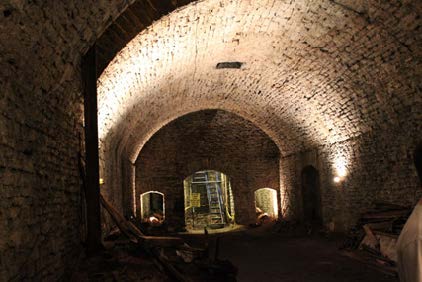
The newly discovered fermentation cellars of the Gerke Brewery. Our tour was called the Marzen Tour. It included visits to the Gerke, Jackson, and Hudepohl Breweries. At the Gerke Brewery, we descended a steep stairway, down 40 feet under the street, into Gerke’s recently discovered fermentation cellars and connecting tunnels. There, and at each location, volunteers introduced the background of the brewery and shared insights as to what the heritage tourists were experiencing. 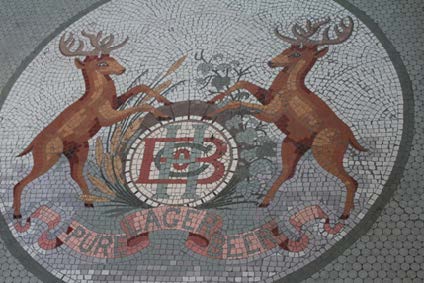
The mosaic floor at the entry to the Hudepohl Brewing Company. The Marzen Tour appeared to be a huge success, with multiple tours leaving every half-hour. It was no accident that it was timed to coincide with the fabulous Cincinnati Oktoberfest celebration! From the vantage point of a district heritage chair, it was great fun! And, it was especially wonderful to see, first hand, the efforts of the OTR Brewery District working diligently to save these historic brewing structures and to repopulate their neighborhood with heritage tourism visitors, full-time residents, businesses, and even festivals. Barley Rains in New York City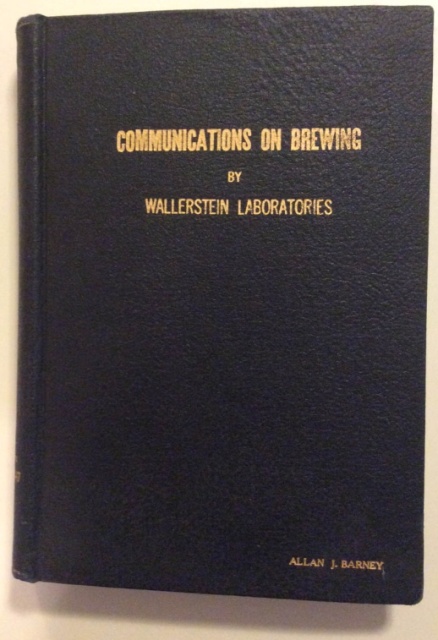 A forward-thinking, heritage-minded individual sent me a volume of Communications on Brewing, a hard-cover compilation of the quarterly technical journal published by Wallerstein Laboratories. This particular volume included the four journals from the year 1951. It is hardbound, with gold embossed printing. He has many of these, originally owned by his father, and wanted to know if they were “worth saving.” The particular gem he sent to me included the following New York Times article: Barley and Corn Rain from Skies, but Only on Empire State Tower Several “savants of renown” offered their personal explanations: perhaps birds of passage, perhaps brewery chimneys, or perhaps grain elevators, with each explanation requiring a brisk, high wind to support it. The New York Times article then diffuses the “brisk wind” possibility: “The strength of this learned conjecturing was somewhat sapped by Ernest J. Christie, the official in charge of all meteorologists at the United States Weather Bureau. He consulted multitudinous graphs and charts, all rich with isobars and windpaths. ‘...my charts here clearly indicate that at the upper levels, where the wind is strongest, velocity this morning never exceeded five miles an hour,’ he said.” The article continued: “Mysterious phenomena, in our own and in ancient days, have been abundant. In 1842 New York City was startled by a rain of toads in a deep storm. Cattail seeds blanketed the Great City's chimney tops and its streets in 1931. There is a rich legend of rains of frogs, fishes, mice, grain, snails, earthworms, serpents and weirdly colored soot, and other afflictions. The first thought when the grain descended yesterday was the Scriptural manna that fed the exiles from Egypt (Exodus XVI). An explanation did indeed come, and it came from none other than… Wallerstein Laboratories! "No explanation? Set at rest now all musings and wonderings. All...persons far and wide, may know...that Wallerstein Laboratories, among its manifold activities, on behalf of the brewers of beer, do indeed probe and analyze daily many samples of barley malt, corn, and other grains. ...Chemists and assistants, kindly as they are skillful, spread such grains on the sills of their laboratory windows so that the City's pigeons may in their hunger partake of food. To these laboratory windows do indeed flock many of The Great City's pigeons, for no other morsels delight their fancy quite so much.” The “explanation” went on to point out that their window sills sit at the corner of Madison Avenue and 34th Street, just east of the Empire State Building, at 1250 feet below the new television tower. “One well versed in the arts of geometry and the law of the square of the hypotenuse might well reckon as not unreasonable the distance from sill to tower as the pigeons might fly it. All other speculations and conjecturings have been found wanting by the Times’ learned investigators; and so it is ventured no one will now cast doubt on the hypothesis here suggested, to wit, that we look to our pigeons and their foresight in hoarding the surplus of their grain...” I am still laughing, and simultaneously enjoying yet marveling at the elevated writing style that was so common in our publications, even as recently as this 1951 example (“savants of renown,” “to wit,” “no other morsels delight their fancy”). As I said, brewing heritage is not without humor. And this “Barley Rain” story underscores, yet again, that history and heritage offer such a wide range of insights, enjoyment, complexities, colors, and textures... just like the wide range of beer styles we brewers provide! Become a District Heritage ChairMy wife is a passionate genealogist. She would tell you that one of the most compelling arguments for studying genealogy is the sheer celebration and sense of pride that comes with discovering one’s identity through their family heritage. Dedicated to that very purpose, she has spent countless hours researching both of our individual family histories. Her efforts (and mine) recently included a month-long trip to Germany. We crisscrossed that country researching tiny church graveyards, locating family home addresses and long-gone family business sites, visiting a local museum and searching their archives, all in the spirit of knowing and understanding our heritage. “Without that sense of individual memory,” she says, "I think that some folks suffer a disconnect in the form of a lost family identity.” Her choice of words, “individual memory” stuck with me. I reasoned that every one of our MBAA Districts is, in a very real sense, an individual memory. Geographically, they spread from coast to coast, and even beyond our own borders. Chronologically, some districts are quite old, dating back to the original MBAA Chicago meeting in March, 1887. Others are much younger. But they all offer the rich heritage of their individual memories. Taken one step further, those individual memories build upon one another, evolving into MBAA's “collective memories.” And isn't historical knowledge really nothing more than a series of individual contributions leading toward a “collective memory?” It is in that spirit that I ask each local district to consider the establishment of a District Heritage Chair. I can think of no better way to celebrate the 125th Anniversary of MBAA. A District Heritage Chair would not have to be a complicated or consuming position. It might be chaired by someone who is somewhat historically minded. Perhaps they like to read history. Or perhaps they enjoy genealogical research themselves, already pursuing their own family roots and individual memories. When attending their District events, perhaps they are just a bit more aware of the importance of meeting minutes and photo archives. But a District Heritage Chair, established at every one of our local Districts would be the first step in formalizing a process to capture individual memories, turning them into MBAA's collective memories. It would be the first step in ensuring that we continue to build upon our rich heritage for another 125 years! I would appreciate any thoughts you might have on this at: [email protected]. Creating a “First Response” to Answer Research InquiriesOne of the unexpected privileges of serving as the MBAA Heritage Chair includes assisting organizations and individuals with their research inquiries. In my two years on the job, I have had university students, Ph.D. candidates, scholars, writers, and family genealogists contact MBAA or me personally with a wide range of research requests. We are primarily a technical organization. But the fact of our enduring 127-year history and our unique organizational structure that includes 23 local geographical districts stretching across the United States, Canada, Europe, South America, and the Caribbean, makes MBAA a go-to resource for such scholarly inquiries. These ongoing requests for information comprise a significant portion of this job, challenging me to better understand exactly what we have in our records housed in St. Paul (not to be confused with our archives housed at Iowa State University). And they are frequent enough that to properly manage them, I want to create an organized "first response" that would include an action plan involving a sequence of steps that hopefully sets a path toward obtaining the information being requested. The action plan would include:
Perhaps this first step to reach for some form of organized response will allow us to better assist researchers in their quest for all-important, scholarly information. Let me know if you have any additional considerations that might be helpful. Cheers! Digitizing Your District ArchivesEvery family seems to have a “special someone”... that one individual who ends up with the box or the suitcase that is crammed with all of the family's treasures. Those family treasures include the things that no one had the heart to throw away and commonly include old photographs, letters, diaries, newspaper clippings, ledgers, military records and ribbons, birth/death certificates, etc. My wife, being a passionate and life-long genealogist, has spent countless hours researching, organizing, and preserving items of importance to her family. She is her family's designated “special someone.” The longer I serve in the role of MBAA’s Heritage Chair, the more I learn that many of our local districts have their own “special someone,” the keeper-of-the-district's-treasures. Often, those treasures are handled much the same way as family treasures are handled. They are crammed into cardboard boxes, suitcases, trunks, or totes. They are stashed away in the basement, the attic, or the garage. These spaces can be veritable catacombs of catastrophe subjecting the treasures to dampness, mold, mildew, and wild gyrations of temperature extremes virtually ensuring their decomposition and breakdown. Even worse, they can be quickly and totally destroyed by fire, flood, or other natural disasters. 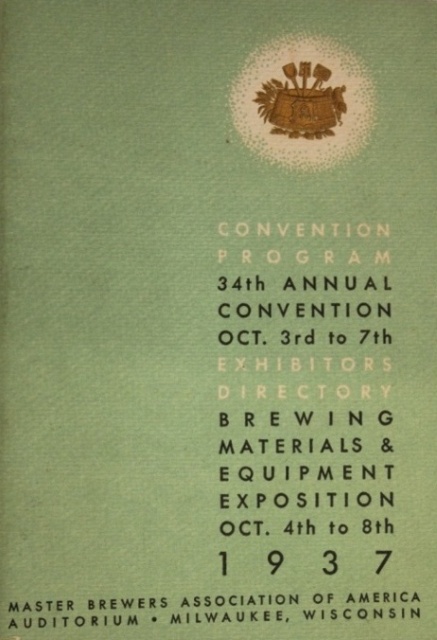 It is in this spirit that I want to begin occasional Communicator pieces offering some basic, achievable archival advice. The basis for my advice is digitizing: that is, creating digital copies of selected district items. Digital technology has ushered in a variety of digitizing options that are quite doable and affordable. Possibilities include portable scanners, digital cameras, tablets, and even smartphones. All these devices are capable of creating surprisingly clear and accurate images of photos, journal articles, and other district documents, including larger or odd-shaped heirloom pieces such as mugs, plaques, trays, etc. Digitizing causes no harm to the original. The images created can (and should!) be stored in multiple locations. They can easily be shared and enjoyed via email. And the images can be improved and embellished if so desired! 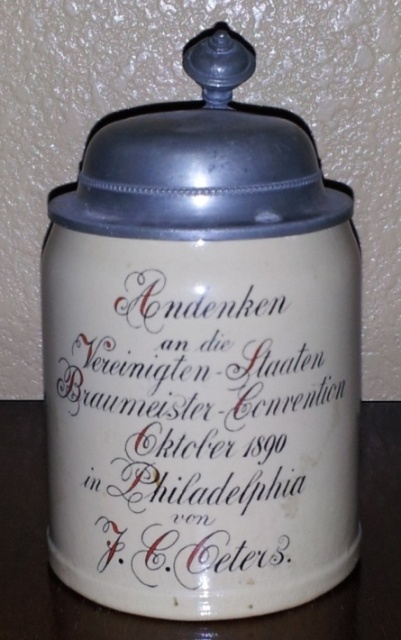 I have included two examples. The first digital image depicts a program cover from the 34th MBAA Convention that was held in 1937 in Milwaukee, Wisconsin. I found the program in our archives while I was researching at Iowa State University. I created the image myself using my Canon EOS Rebel T2i camera. I did not use a tripod or camera stand. I simply used the close-up feature of the camera with an 18-55mm lens. I disabled the camera's flash, hand-held it as steady as I could, and shot away within the existing lighting of the archival room. You can see that even with such unsophisticated technique, the details of the program are clear, even the traits of the textured paper on which the program cover is printed. The second digital image represents an "odd-shaped" item: a stein from our 4th MBAA Convention, held in Philadelphia in 1890. I wrote about this stein back in October 2014. This image was generously shared with us by its collector. You can see that the details of the stein are clear, and the inscription is clearly legible, reading: “Memories of the United States Brewmasters Convention, October, 1890, in Philadelphia for... (I think) F. C. Geters (the name of an individual attendee).” In these two simple examples, you can see how both a piece of printed matter, as well as a physical, odd-shaped item can be captured and archived, then shared and enjoyed. The images are safe, preserved in perpetuity, and always available for viewing. I believe that digitizing can be a viable and affordable tool for preserving a district's treasures, easily achieved by a district's “special someone.” Diploma of William Gerst Jr.One of the great joys of being the Master Brewers Heritage Chair is being on the receiving end of the generosity of alert, heritage-minded individuals. Usually, these are folks who find themselves in possession of some beer industry historical artifact that they believe would be of some value or interest to Master Brewers. They actually take the time out of their busy schedules to contact us and gladly share their heritage gems. You might remember the Louis Pasteur biography that was published by Master Brewers for its 33rd Convention in Philadelphia, 1936. A woman “bought a copy at a flea market” and forgot about it. Years later, she was cleaning while preparing for a move. She found it, but instead of pitching it, she wondered if Master Brewers would want it. She sent it to me. You might remember the ceramic mug from our 2nd MBAA Convention in 1890. A reader sent me some digital images of it and “wondered as to its rarity.” You might remember when the good folks at Yuengling explored a back room and discovered hand-painted placards promoting MBAA National Conventions from the 1930s. They shared images of those placards with me. 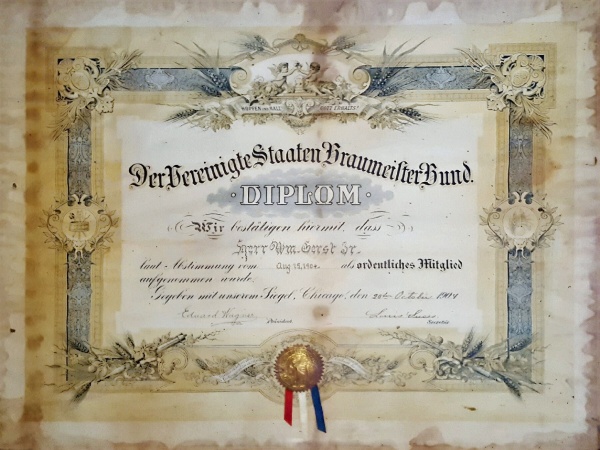 We find ourselves on the receiving end of heritage generosity again. Master Brewers was contacted by Scott Mertie. Scott is a Nashville-based brewer, a brewing historian, a memorabilia collector, and an author. He writes: "I saw under your historical archives on your website that you have a picture of an MBAA diploma. I have attached another picture for William Gerst Jr. of Nashville, TN, who received his diploma in 1904. His father, William Gerst was the 2nd president of the MBAA (1889 – 1891) and the namesake for the William Gerst Brewing Co in Nashville. I spoke on this subject at the MBAA conference in Nashville in 2007. Feel free to post on your website." Undoubtedly, this is indeed another valuable heritage coup. It also has heritage ties to my own District Midwest (formerly District Cincinnati). The William Gerst Sr. that Scott refers to was indeed the second president of Master Brewers. He was also the president of District Cincinnati the very year that Master Brewers was originally chartered in Chicago in 1887. We certainly thank Scott for taking the time to write us and to his share of the image of the diploma. We will post that diploma on our website, as well. District Caribbean HeritageFrom Master Brewers’ two collections of district histories, the 75th Diamond Jubilee Edition published in 1962 and the 100th Golden Jubilee published in 1987, we salute District Caribbean! Once again, I have included digital images of both histories for you to read and enjoy. The impetus for choosing District Caribbean came from our March 30, 2017, BOG WebEx meeting. I listened to the attendee-speakers. And during the “New Business” portion of the meeting, District Caribbean BOG Representative Michael Bowen encouraged everyone to attend his district's upcoming May event. I went to the District Caribbean web page to discover that they are hosting their 56th District Caribbean Convention. It runs from May 9 to May 13, at the St. Kitts Marriott Resort and Royal Beach Casino. Wow! Now, I am the first to admit that any District Caribbean Convention, beyond its practical reasons for being, is certain to be a fun time for all if there ever was one. Admittedly, my mental images of the Caribbean have been created by a half-dozen cruise ships. Over the years, my wife and I have completely circumnavigated that alluring gem of water. I can say “rum punch” in several dialects. The very word “Caribbean” conjures up Hemingway-esque bouts with blue marlin and bar stool gymnastics. I suspect I am not alone in these perspectives. And the Diamond and Golden Jubilee histories of the district confirm my suspicion. 
Click to view full size Reading from the 1962 75th Anniversary history, the seed for the conception of a District Caribbean was first planted in 1958 by Charles W. Frizzell. He initially lobbied other area brewmasters and generated enough interest to get the ball rolling. Tom Kelly organized the formation of the district and finally applied for an MBAA Charter in March of 1961. The Charter was granted, and officially presented at the 74th Anniversary Convention in Montreal on September 25, 1961. Ironically, District Caribbean received its charter at the very first MBAA convention ever to be held outside the boundaries of the United States. Its first elected officers included: Antony G. Kelly, President; Charles W. Frizzell, Vice-President; William H. Hedmann, Secretary; and Michael F. Porter, Treasurer. In 1962, all MBAA districts were asked to submit a concise history of their district for the 75 Year Diamond Jubilee Convention. The histories would be published and distributed in a special edition of the Communicator. Upon reading District Caribbean's submission, I noticed that the entire history was a summary of the 74th MBAA Convention when they received their charter, and a summary of their first District Caribbean Convention in Jamaica in May of 1962. I realized that when they submitted their history, the district was barely one year old! Those two initial conventions, one national and one local... were their history! 
Click to view full size In 1987, all MBAA districts were again asked to submit a concise history of their district for the 100 year Golden Jubilee Convention. The histories would again be published and distributed. That District Caribbean history was written by then President Michael Redhead. He updated the 1962 history by listing local conventions the district had hosted by country and date. President Redhead also confirmed my previous, aforementioned speculation about a perpetual fun-time-for-all mentality of the district by listing a few of their legendary convention moments! He set the stage with his own words: “District Caribbean Conventions have their own distinctive flavor.” I love that line, and I couldn't have said it better. Redman went on to provide examples of that “distinctive flavor,” including:
But one convention example won the Heritage Chair's grand prize, bestowing genuine bragging rights.
Talk about designated drivers! Clearly, District Caribbean has a rich and colorful history. It is clear that they have challenges unique among the districts... the sheer geographical expanse of their district boundaries, the number of nations, islands, all complicated by the vastness of the sea itself. In what I am certain have been exhaustive efforts, they continue to pull it off. The fact of hosting a “56th District Caribbean Convention” on St. Kitts-Nevis showcases and celebrates their uniqueness. District Detroit Meeting Minutes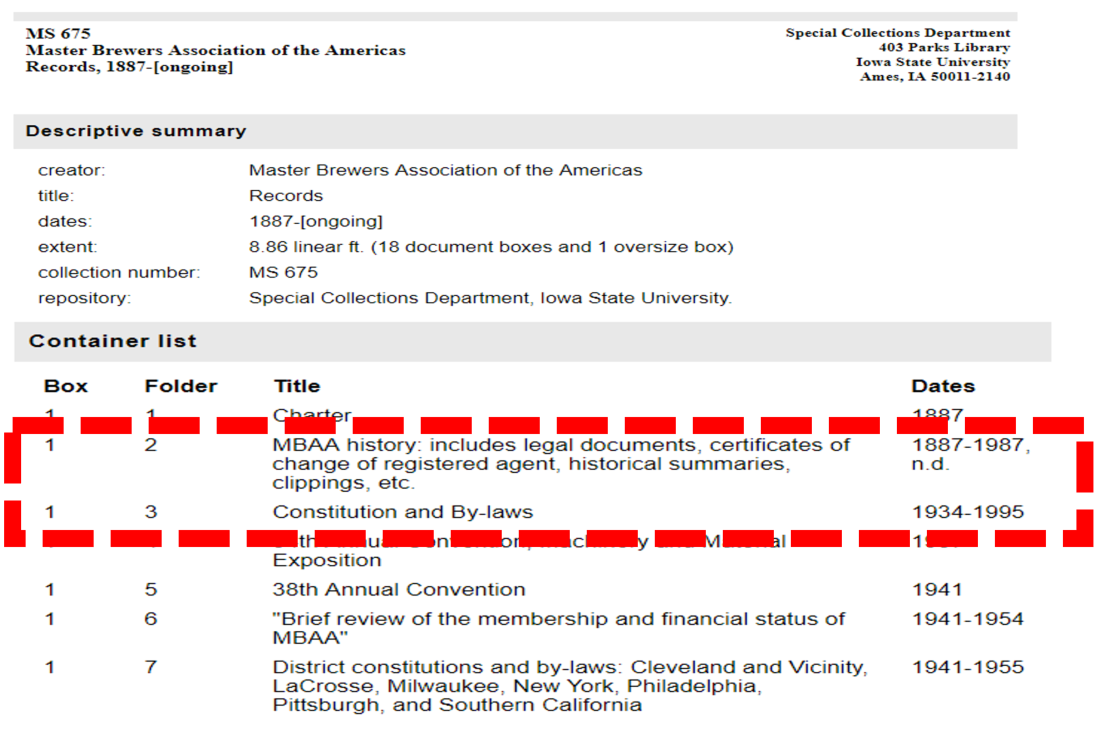
The first page of Master Brewers archives inventory listing at Iowa State Several months ago, I received a package in the mail that rates as perhaps the most unique item that I have ever received in my (almost) six years as your heritage chair. This rare heritage gem was sent to me from Master Brewers’ former Technical Director Ray Klimovitz. It is a “meeting minutes” book from District Detroit. This is a handwritten journal, the likes of which was typical of many of MBAA's local districts. What makes this one so amazing is the time period that it entails. Its first entry is dated July 6, 1918. Its last entry is dated October 21, 1937. As if the “start” and “stop” dates of the meeting minutes book weren't amazing enough, the bulk of it includes none other than all of the U.S.A.'s Prohibition years. It serves to help fill in a few details of Master Brewers’ history and struggles to remain viable through that critical period. The Master Brewers’ archives are housed in the Special Collections Division of Iowa State University. The image to the right illustrates the first page of our archives inventory listing there. I have highlighted the “gap” in archival box 1 between folders 2 and 3. We have virtually no information about Master Brewers between 1887 and 1934! All of that material was lost, damaged, and/or destroyed. Our Master Brewers collection description at Iowa State reads, in part: “The bulk of the collection dates from 1950 onward leaving the first 60 years of the organization only sparsely documented.” These District Detroit Meeting Minutes serve to shed some light on the years 1918 through 1937, in the form of a very unique, handwritten, primary historical resource. 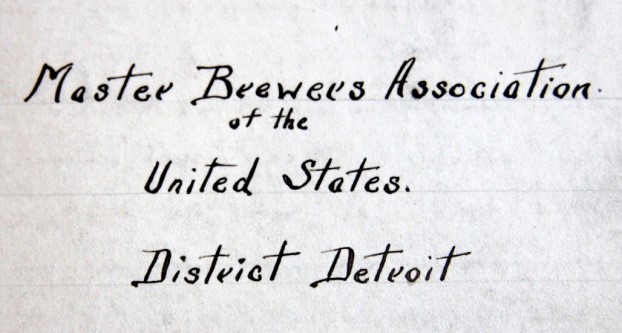
District Detroit Meeting Minutes Book title page 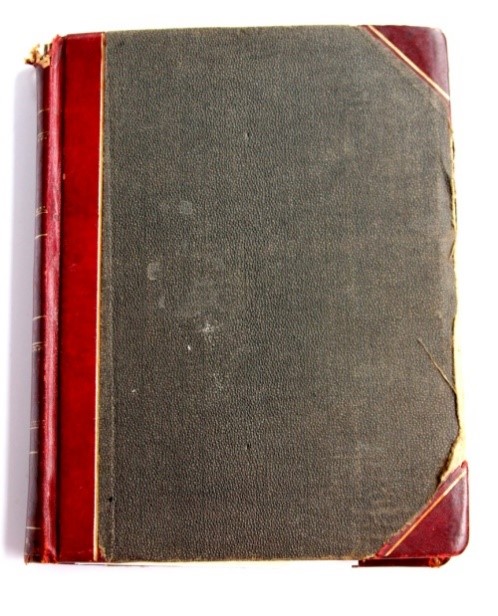
District Detroit Meeting Minutes Book first entry On opening the book, a quick scan of its yellowing, lined pages reveals the beautiful penmanship of most of its numerous recording secretaries, executed and flowing in calligraphy-like script, their eloquent vocabularies crystal-clear in their content. 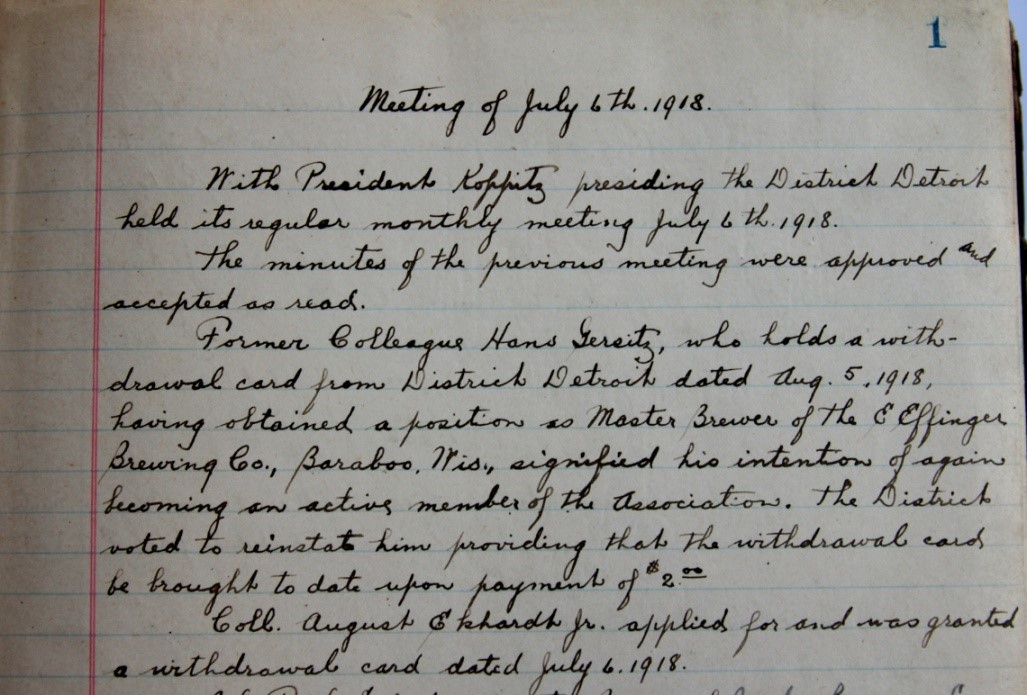
Meeting minutes 9 days after the 21st Amendment was ratified. Text is written in German. Some journal entries are written in English, often for many consecutive months. Then, quite suddenly, entries are written in German, often for many consecutive months. One particular recording secretary, Colleague Wm. Stempel, assumed his duties on November 5, 1921, and wrote his entries in beautiful, cursive English. Then, quite abruptly, Colleague Stempel switched to recording his entries...in German! Entries from each monthly meeting always included the mention of receipts for dues, immediately followed by a mention of disbursements. Other frequent entries include aspects of district membership, with members always referred to as “colleagues.” “The following colleagues were absent....[names listed]...” When colleague attendance at meetings was down, “...it was unanimously voted to...assess a fine of 50 cents for non-attendance.” Those fines helped sponsor a “German Child Feeding Campaign.” “Special” meetings were held, as needed, for any number of wide-ranging reasons. One such special meeting was “called” on November 23, 1918, by Wm. Stempel, who by then had become the District Detroit President “...to take proper action upon the death of one of the charter members of our District, Colleague Jos. Kaiser, who was killed in a traffic accident.” As might be expected, the meeting minutes book reveals the district’s struggle to remain viable during that period, as well as Prohibition concerns.
One of my favorites was entered May 20, 1920. A monthly meeting was held at the offices of the British-American Brewing Company of Windsor, Ontario, where colleagues could...drink beer! One entry for that meeting reads: “Following adjournment the colleagues enjoyed quaffs of good 9% proof lager...The occasion recalled the pleasant reminiscences of our yester-years. The colleagues spoke and sang of those wonderful times which are now only memories.” Folded and enclosed within the Meeting Minutes Book was a typed resolution, written and signed by District Detroit President Herman A. Rosenbusch. The resolution addressed a concern about the state of brewing education after the ratification of the 21st Amendment repealed Prohibition. It reads in part: “W H E R E A S due to the passage of laws legalizing the manufacture and sale of beer, a number of schools purporting to teach the art of brewing have sprung into existence.” The resolution went on to ask MBAA to adopt “uniform entry requirements for admission” into those schools. It was to be presented at the 1933 MBAA National Convention. What a joy this meeting minutes discovery has been. As I wrote earlier, this book is the most unique item that I have ever received as your Heritage Chair. It serves to fill a significant gap in Master Brewers’ 130 year history. Not only is the meeting minutes book a very unique handwritten, primary historical resource. It is, quite possibly, the only surviving original MBAA document offering critical insight into the Prohibition period. Though written from the perspective of one district, that district was one of the most active and influential in that period, predating even national MBAA. There are numerous references to the "National Association" on a wide range of topics. This heritage gem will be sent to Iowa State and housed in our archives there, protected in perpetuity. District Michigan Heritage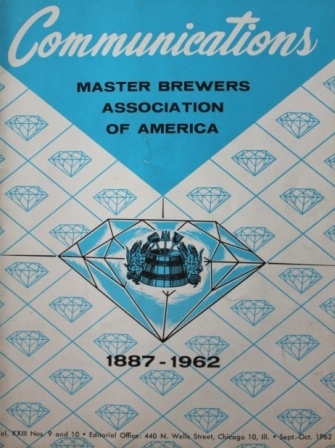 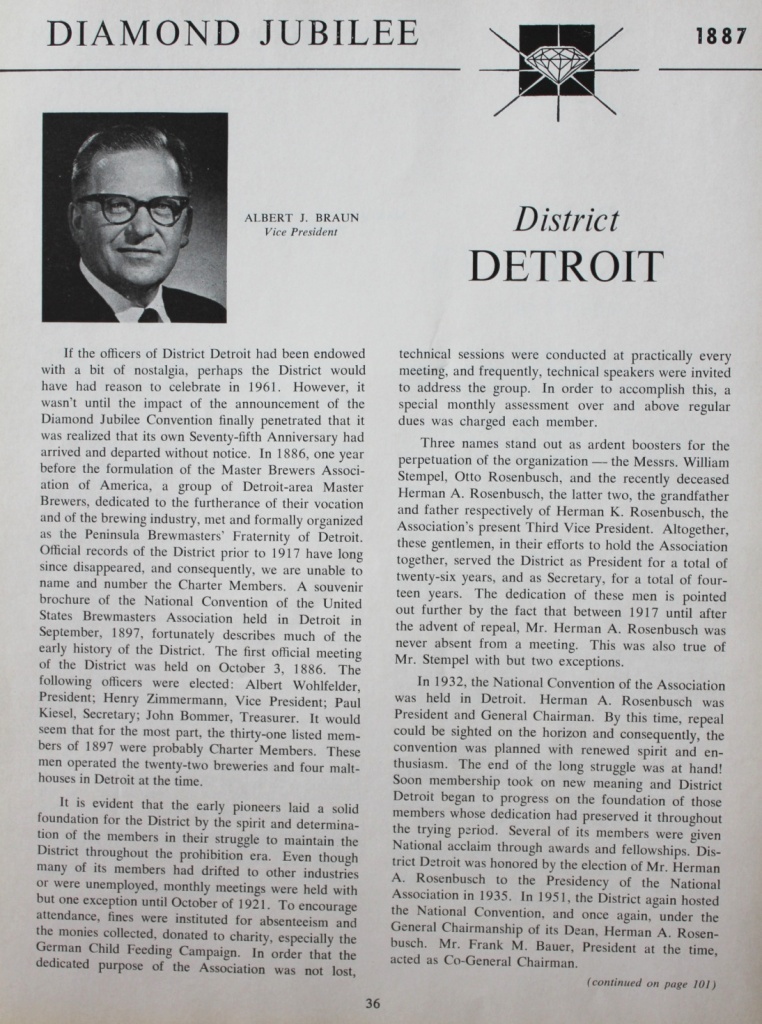 From MBAA's two collections of district histories, the 75th Diamond Jubilee from 1962 and the 100th Golden Jubilee in 1987, I am excited to share both editions’ celebrations of District Detroit. As you can probably figure, the rich history of District Detroit is the rock-solid foundation for what has evolved into District Michigan. The 1962 Communications Diamond Jubilee Celebration publication piece was written by then District Vice President Albert J. Braun. He was assuming the district leadership role as District President John Newell left Detroit before the expiration of his term. Vice President Braun makes a fabulous claim as he writes: "In 1886, one year before the formulation of the Master Brewers Association of America, a group of Detroit area Master Brewers… met and formally organized.... The first official meeting of the District was held on October 3, 1886." 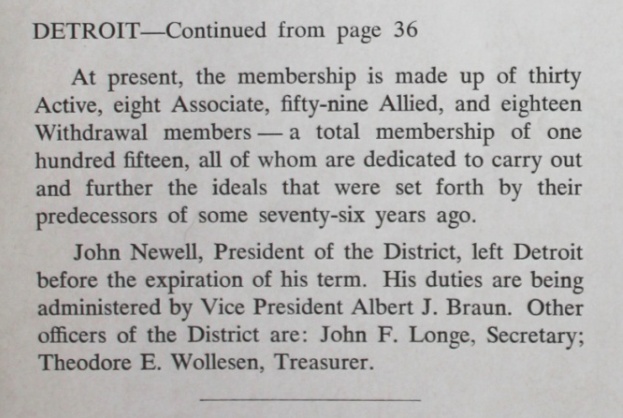 As you read the 1962 history, you'll see that Mr. Braun discusses the challenges of maintaining the district through the Prohibition Era. Of course, many districts suffered through Prohibition. But District Detroit went to unusual lengths to hold monthly meetings continuously until October of 1921. They were so serious that fines were levied to discourage absenteeism. The monies collected from the fines were donated to local charities, primarily the German Child Feeding Program.  The 1987 Golden Jubilee celebration district history was written by then District President Ray Klimovitz. Ray updates aspects of the 1962 history. He then addresses the severe challenges posed by the diminishing number of breweries and malt houses within the district. He points out: "In the 101 years that District Detroit has existed, our district has gone from twenty-two breweries and four malt houses to just two breweries and one malt house." 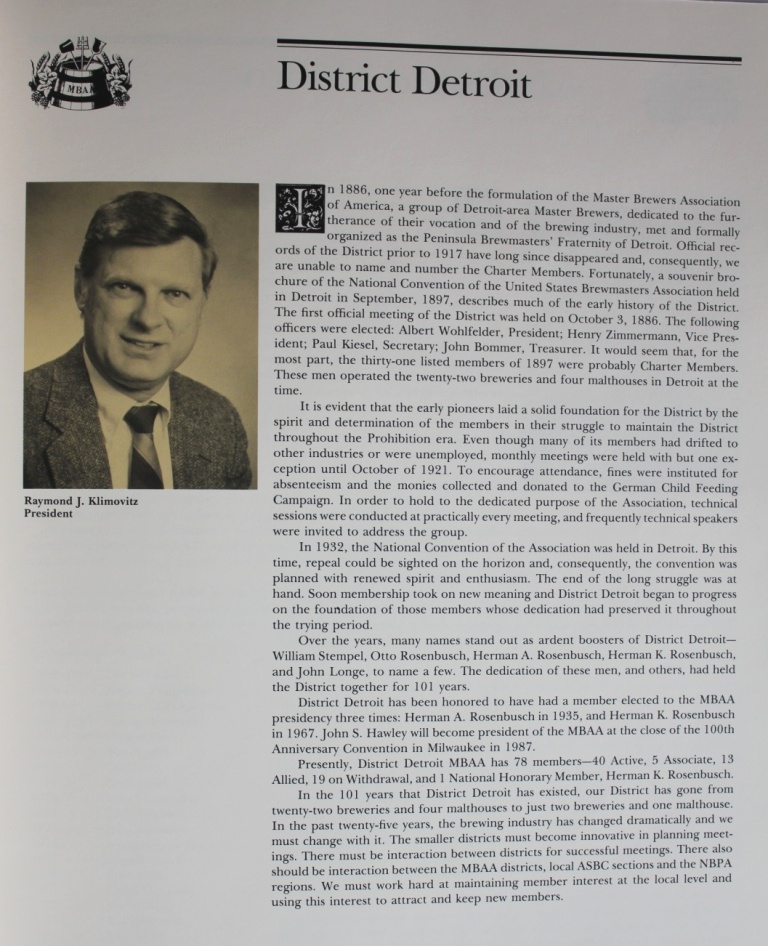 Ray acknowledged 25 years of a drastically changing brewing industry and called for more district innovation, more interaction between MBAA districts, and additional interaction between the MBAA and the American Society of Brewing Chemists. This was fresh off the heels of the first Brewing Congress of the Americas, jointly held between MBAA and ASBC in 1984. Of course we all know that District Michigan is a vibrant, forward-thinking success story. Today, the district is a showcase of collaboration among the growing micro brewery and craft beer segments. The late 1990s appropriately saw the name change from District Detroit to District Michigan. But 110+ years of District Detroit provided a firm foundation of heritage on which to grow and prosper. I am happy to share both of these vignettes of rich District Michigan history with our general readership. And even though the original documents are archived, the ability to share them with our readership once again showcases the value of "digital" to all of our districts in matters of history and heritage. District Midwest Heritage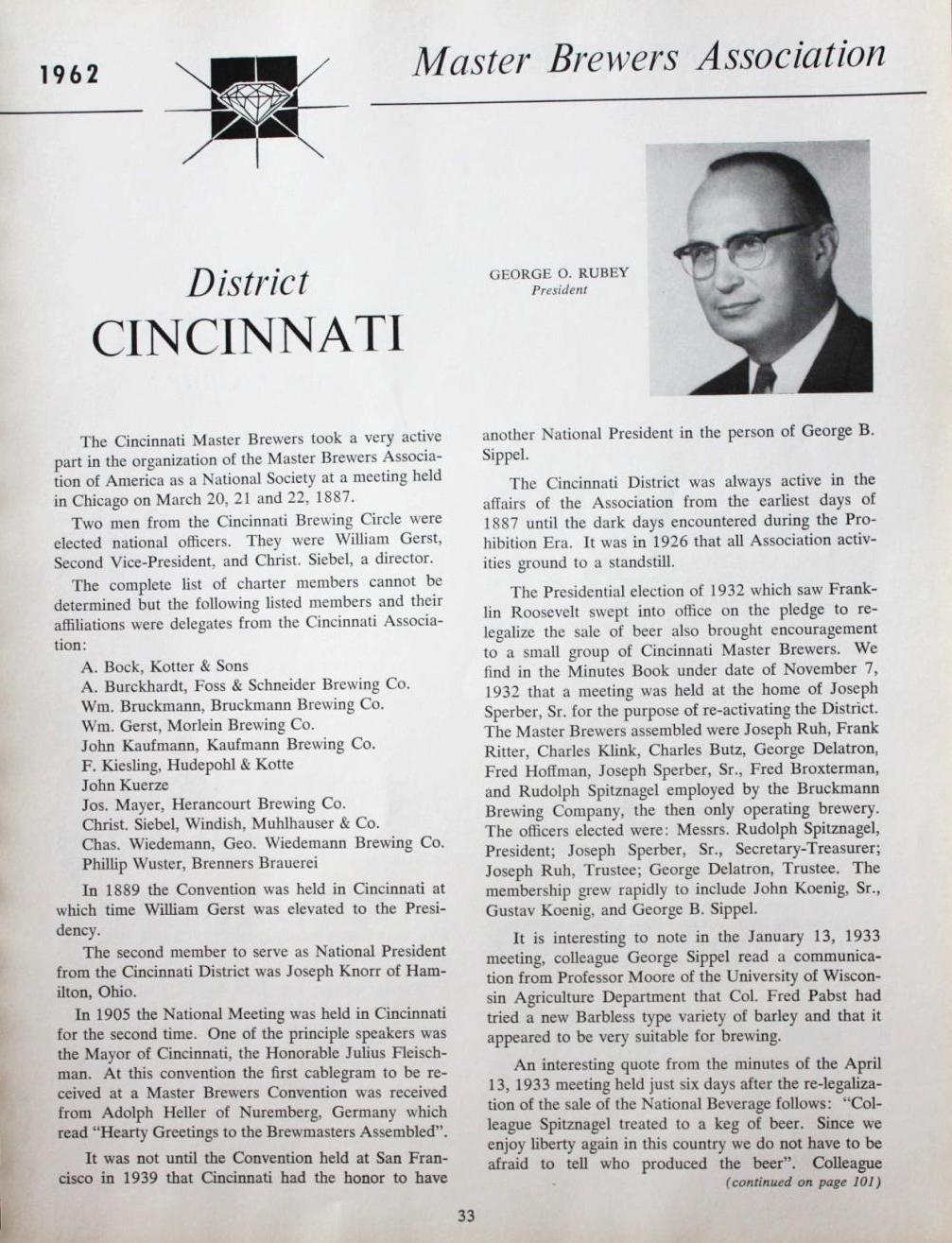 From MBAA's two collections of district histories—the 75th Diamond Jubilee published in 1962 and the 100th Golden Jubilee published in 1987—I am excited to share both editions’ celebration of my home district, District Cincinnati. As you can probably figure, the rich history of District Cincinnati serves as the foundation for what has evolved into our recent name change to District Midwest. As always, I have included digital images of both histories for you to read for yourself and enjoy. 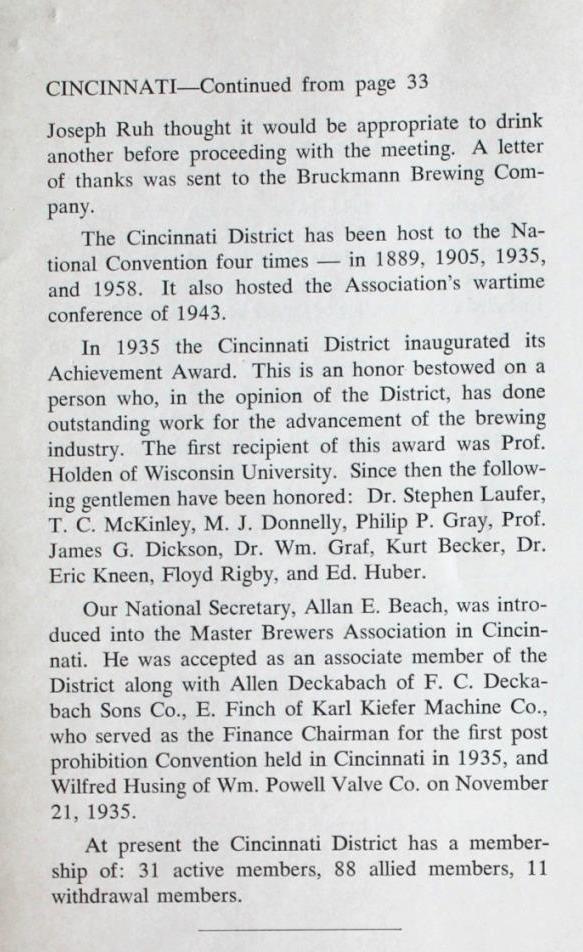 The 1962 Communications Diamond Jubilee Celebration piece was written by then District President George Rubey of Wedemann Brewing Company. George began his piece by establishing the fact that District Cincinnati was one of the original districts present at the first Chicago meeting in 1887 and became one of the original Charter Members. He quite proudly points out that two gentlemen from "Cincinnati Brewing Circles" were elected as original officers. He further provides an invaluable list of other Cincinnati Brewers who attended that first MBAA meeting! I particularly love his reference to Meeting Minutes Books. Oh... how I wish these had been properly saved and archived! George writes: "The Presidential election of 1932 which saw Franklin Roosevelt swept into office on the pledge to relegalize the sale of beer also brought encouragement to a small group of Cincinnati Brewers. We find in the Minutes Book under the date of November 7, 1932 that a meeting was held in the home of Joseph Sperber Sr., for the purpose of reactivating the District." George goes on to list all attendees at that critical 1932 "reactivation" meeting, a valuable piece of District Midwest history!! George also found it important enough to share this little gem: "It is interesting to note in the January 13, 1933, meeting, colleague George Sippel read a communication from Professor Moore of the University of Wisconsin Agriculture Department that Col. Fred Pabst had tried a new Barbless type variety of barley and that it appeared to be very suitable for brewing." 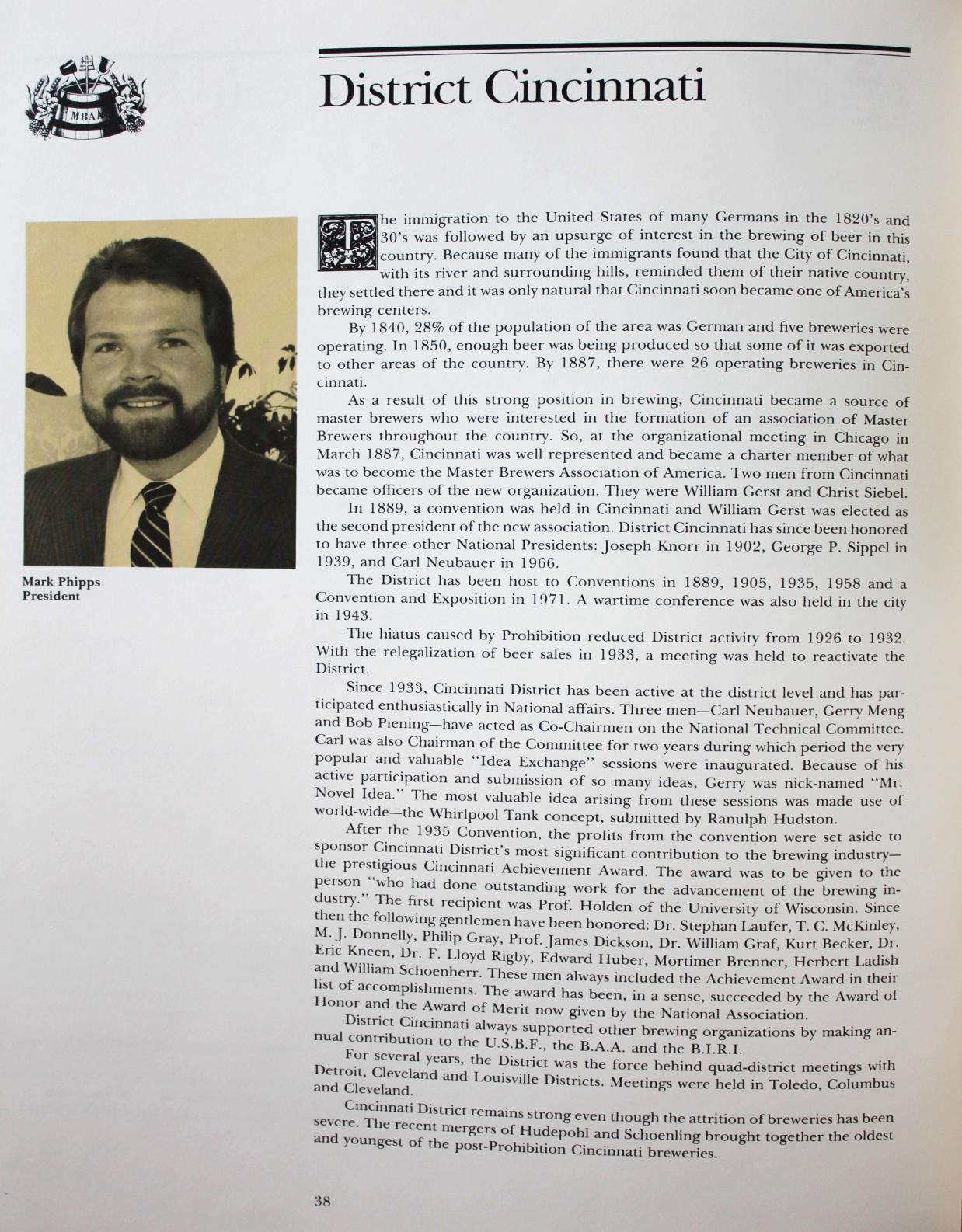 The 1987 Golden Jubilee Celebration district history was written by then District President Mark Phipps, brewmaster at Hudephol-Schoenling Brewing Co. Mark begins his district history by celebrating Cincinnati's uniqueness as the recipient of a major influx of German immigrants into the area from the 1820s extending over several decades. The city's Deutschland-like geography lured those immigrants to the area, where many remained. "Because many immigrants found that the City of Cincinnati with its river and surrounding hills, reminded them of their native country, they settled there and it was only natural that Cincinnati became one of America's brewing centers." By 1840, Mark points out that fully 28% of the city's population were German. By 1887, the very year MBAA was founded, there were 26 operating breweries in the city. Mark shares that the district was host to National Conventions in 1889, 1905, 1935, and 1958. Since his history was published, we can also include a convention seven years later in 1994. He also shares the origins of MBAA's Award of Honor and Award of Merit. "After the 1935 Convention, the profits from the convention were set aside to sponsor Cincinnati district's most significant contribution to the brewing industry—the prestigious Cincinnati Achievement Award. The award was to be given to the person 'who had done outstanding work for the advancement of the brewing industry'. The award has been, in a sense, succeeded by the Award of Honor and the Award of Merit now given by the National Association." The Award of Honor is given to an MBAA member who has rendered outstanding service to the association. The award consists of a plaque and complimentary MBAA Annual Conference registration. The Award of Merit may be given annually to an individual (or individuals if they have worked as a team) who, in the opinion of the Executive Committee, has made an outstanding contribution to the brewing industry and who will be invited to give a lecture at the annual meeting. The district's name change was driven by several factors. At two previous Board of Governors meetings—one in Portland, Oregon, in July 2012, and the other in Austin, Texas in October 2013—much of the dialogue centered upon ensuring value and driving relevance to our membership. MBAA's Strategic Plan and its accompanying objectives dealt with encouraging more participation in our local districts. Answering this call, many of us in District Cincinnati began discussing the possibility of changing the name of our local district from “District Cincinnati” to... something else that would better reflect just who we had become. Our boundaries now included the entire state of Ohio, parts of eastern Indiana, and northern Kentucky. Over the course of several district meetings, members discussed the pros and cons of the name change. Some district members were very much opposed to the change, citing the long-standing heritage of Cincinnati and its brewing traditions as pointed out by both George Rubey and Mark Phipps in their respective short histories. Others reminded our members that even MBAA has changed its name three times since 1887 to better reflect its purpose! "District Midwest" was suggested: a name considered far more inclusionary. It acknowledges and receives with open arms the gifts of the separate brewing heritages of our entire three-state geography. The change was agreed upon at our April 6, 2013, district meeting, quite fittingly, at the Morlein Lager House... in downtown Cincinnati. And, on March 20, 2014, District Cincinnati officially became District Midwest. District Midwest continues to be a vibrant, forward-thinking success story. Today, the district is a showcase of collaboration among the growing microbrewery and craft beer segments, while blessed with the presence of two mega breweries. I am happy to share both of these vignettes of rich District Midwest history with our general readership. And even though the original documents are archived, the ability to share them with our readership once again showcases the value of “digital” to all of our districts in matters of history and heritage. District Milwaukee HeritageFrom MBAA’s two collections of district histories—the 75th Diamond Jubilee from 1962 and the 100th Golden Jubilee in 1987—I am excited to share both editions’ celebration of District Milwaukee. As you can imagine, District Milwaukee, by virtue of the sheer number of German brewers who immigrated there, glistens with MBAA heritage that few districts can match. The 1962 Communications Diamond Jubilee celebration publication piece was written by then District President Flory M. Muehl, from Miller Brewing Co. He celebrates the fact that, of the 100 brewmasters attending the very first national convention in Chicago in 1887, nine were “hardy Wisconsin men” and “they represent[ed] the solid bedrock of leadership...from which has sprung the healthy, wealthy Milwaukee District.” In his own words, he further paints a fabulous portrait of a typical district meeting for us to visualize! “Early meetings, according to data available, consisted of sociability and gemuetlichkeit... brewmasters would exchange toasts and notes—you can almost picture the scene: the sturdy brewmasters arriving in horse-drawn carriages replete with high button shoes and starchy collars—but engaging in conversation along the same lines as now....” 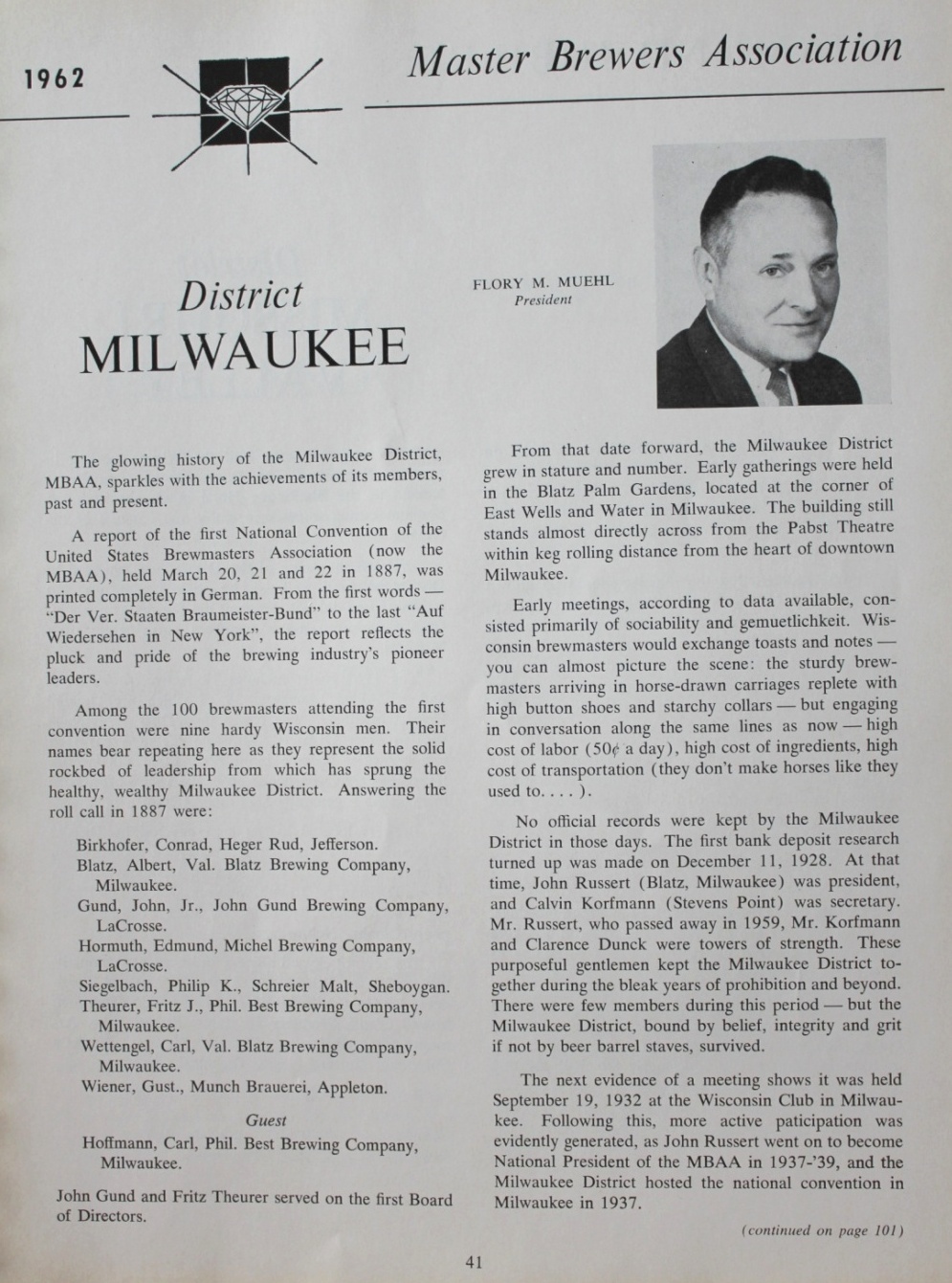 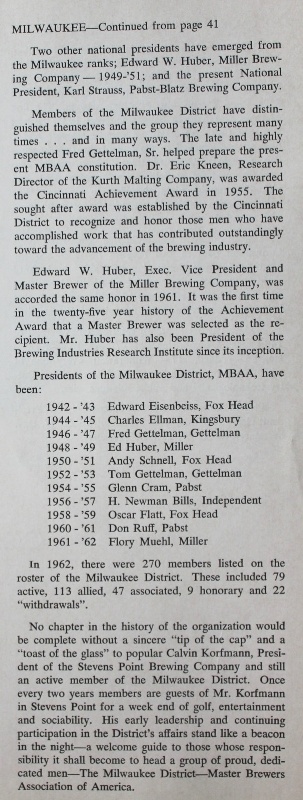 Click on the documents to read the full-size versions.
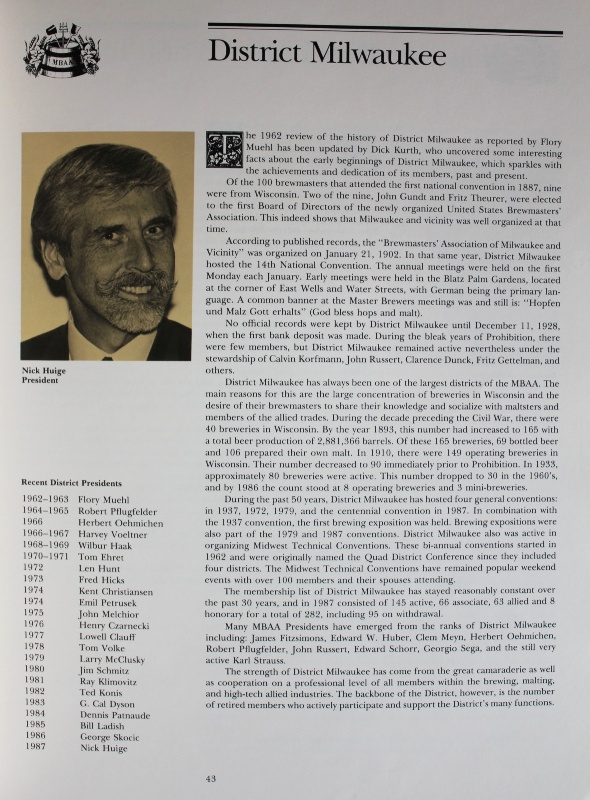 The 1987 Golden Jubilee celebration publication was written by then District President Nick Huige. He updates the 1962 history and celebrates that the German language was the primary language spoken and written at District Milwaukee's early meetings. “A common banner at the Master Brewers meetings was, and still is, ‘Hopfen und Malz Gott erhalts’ (God bless hops and malt).” Mr. Huige also shares that in 1893, there were 165 breweries in Wisconsin, and 106 of these still prepared their own malt. By 1986, the year before the Golden Jubilee celebration, there were 8 operating breweries, and what he calls three "mini-breweries." I am happy to share both of these vignettes of District Milwaukee history with our general readership. And even though the original documents are archived, the ability to share them with our readership once again showcases the value of "digital" to all of our districts in matters of history and heritage. The whole concept of "digital" will be the subject of some upcoming Heritage Communicator pieces. Before I close, we do have a request for information from our membership. It is fitting that the request involves information about a company from...none other than...Milwaukee! “I am researching a company called Baumbach-Reichel Co. of Milwaukee, Wis. They operated as a brewery equipment and brewing supply dealer between 1898 and 1922 when the company's name was changed to Reichel-Korfmann. The company now exists as RK Rubber (they no longer serve the brewing industry) and I recently met with the current manager of the firm to discuss their history. About all he had was a set of ledger books from 1927 to 1967, which didn't contain the information I was interested in. I was hoping to find a list of clients so I could get an idea of their market penetration. Charles Baumbach died in 1901 so there may not be much available on him but the other prominent names are Ernst Reichel, Ludwig Korfmann, and his son Calvin. Maybe, our own District Milwaukee can provide a lead? If anyone within our readership has any leads for the request, contact me and I will forward the lead to the researcher. District Northern California HeritageI am finishing up this Heritage piece for the Communicator the day before Thanksgiving. This is particularly fitting as I am so very...THANKFUL...for finally locating two collections of our MBAA district histories. One was published for our 75th Diamond Jubilee in 1962, and the second was published for our 100th Golden Jubilee in 1987. I have written about these publications before, and I promised to share each district history with our MBAA membership in these pages. With this December 2014 issue of the Communicator, I am...THANKFUL...to begin fulfilling that promise. I am excited to share the Diamond and Golden Jubilee histories celebrating District Northern California. 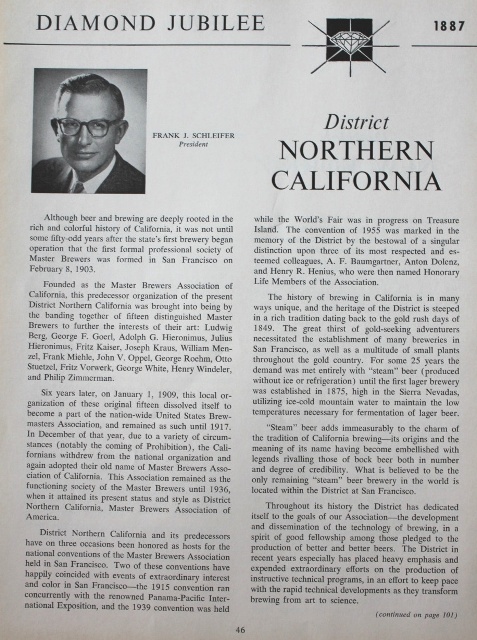 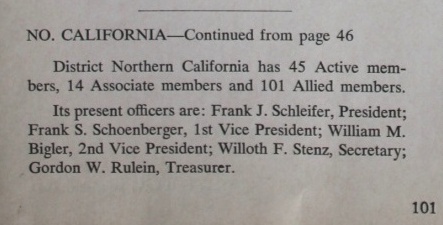 Click on the documents to read the full-size versions.
The 1962 Communications Diamond Jubilee celebration publication piece was written by District President Frank J. Schleifer. He shares the story of the founding of the District Northern California. He points out that his district's heritage is steeped in a rich California brewing tradition that includes the 1849 "Gold Rush" and the famous "steam beer." He is proud that District Northern California has hosted three annual conventions. 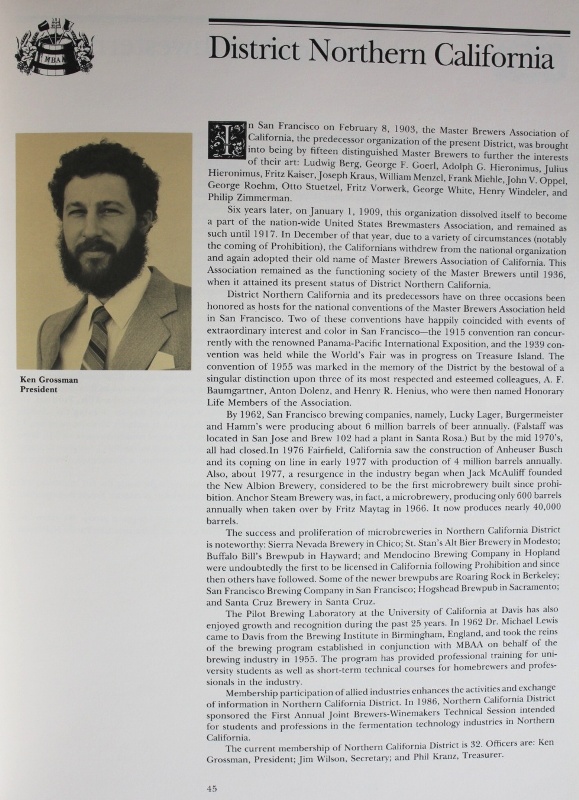 Click on the documents to read the full-size versions.
The 1987 Golden Jubilee celebration publication was written by District President Ken Grossman. Ken recounts the original 1962 history. He updates it by celebrating the noteworthy success and proliferation of microbreweries in northern California. He mentions several brewers and breweries by name including (fittingly) the "Sierra Nevada Brewery in Chico." Ken also updates readers on the growth and recognition of the Pilot Brewing Laboratory at UC Davis. If District Northern California didn't have these unique documents of their heritage before, it does now. I have certainly learned how elusive and downright unavailable they have become after their publications 52 and 27 years ago, respectively. But we now have both And sharing them with our readership once again showcases the value of “digital” to all of our districts in matters of history and heritage. District Northwest Heritage From Master Brewers' two collections of district histories, the 75th Diamond Jubilee Edition published in 1962 and the 100th Golden Jubilee Edition published in 1987, we salute District Northwest! The impetus for choosing District Northwest was an inquiry from Tiah Edmunson-Morton, who runs the Oregon Hops and Brewing Archives at Oregon State University. OSU houses the District Northwest historical records, and Tiah is writing a guide of those materials. She requested information about the establishment of District Northwest. As a reminder, in 1962, all MBAA districts were asked to submit a concise history of their district for the 75 year Diamond Jubilee Convention. The histories would be published and distributed in a special edition of the Communicator. The history submitted was written by the 1962 district president, Harold Rohrbeck. Mr. Rohrbeck concentrated on providing some details about when and how District Northwestern was formed. On June 1, 1935, twelve Master Brewers met in Seattle and formed their own Master Brewer Association independent of MBAA. They felt “the need for the common bond of a technical association... and organized for purposes of communication and sociability.” That initial effort was successful enough that they held a second meeting in autumn of 1935, in Spokane. At that second meeting, they agreed to petitioned MBAA for affiliation. They were officially granted an MBAA charter on December 6, 1935, and became known as “District Northwestern.” 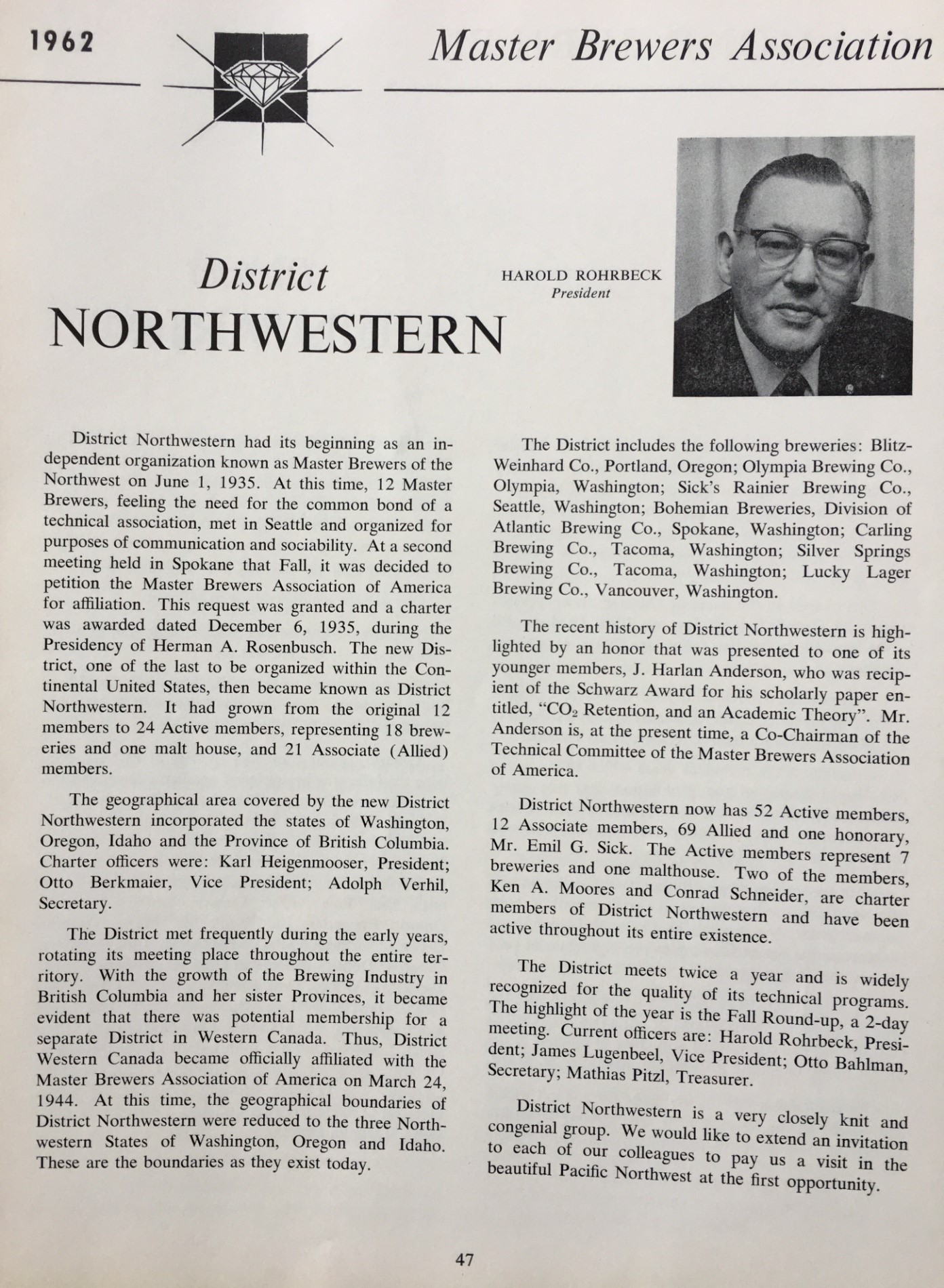 The original geographical expanse of District Northwestern included the states of Oregon, Washington, and Idaho, as well as the Canadian province of British Columbia. Over the next decade, the growth of breweries in the Canadian provinces warranted the creation of a separate Canadian district affiliation. Over that decade, the world became engulfed in the Second World War, and for the duration of the war, MBAA conventions were limited in scope as “wartime conferences.” The conferences limited participation to active MBAA members, and all discussion was limited to wartime production problems. Three such wartime conferences occurred: Cleveland in 1942, Cincinnati in 1943, and St. Louis in 1944. At the second wartime conference held in Cincinnati, MBAA tabled its wartime production dialogue just long enough to grant Canada's Western Provinces their own charter as MBAA's District Western Canada. The geographical boundaries of District Northwestern were reduced to include just the U.S. states of Oregon, Washington, and Idaho. Mr. Rohrbeck lists the seven breweries in the district at that time, providing 52 active members, 12 associate members, and 69 allied members. He also explains that the district met twice a year and was known for its two-day “Fall Round-Up,” offering excellent technical presentations. 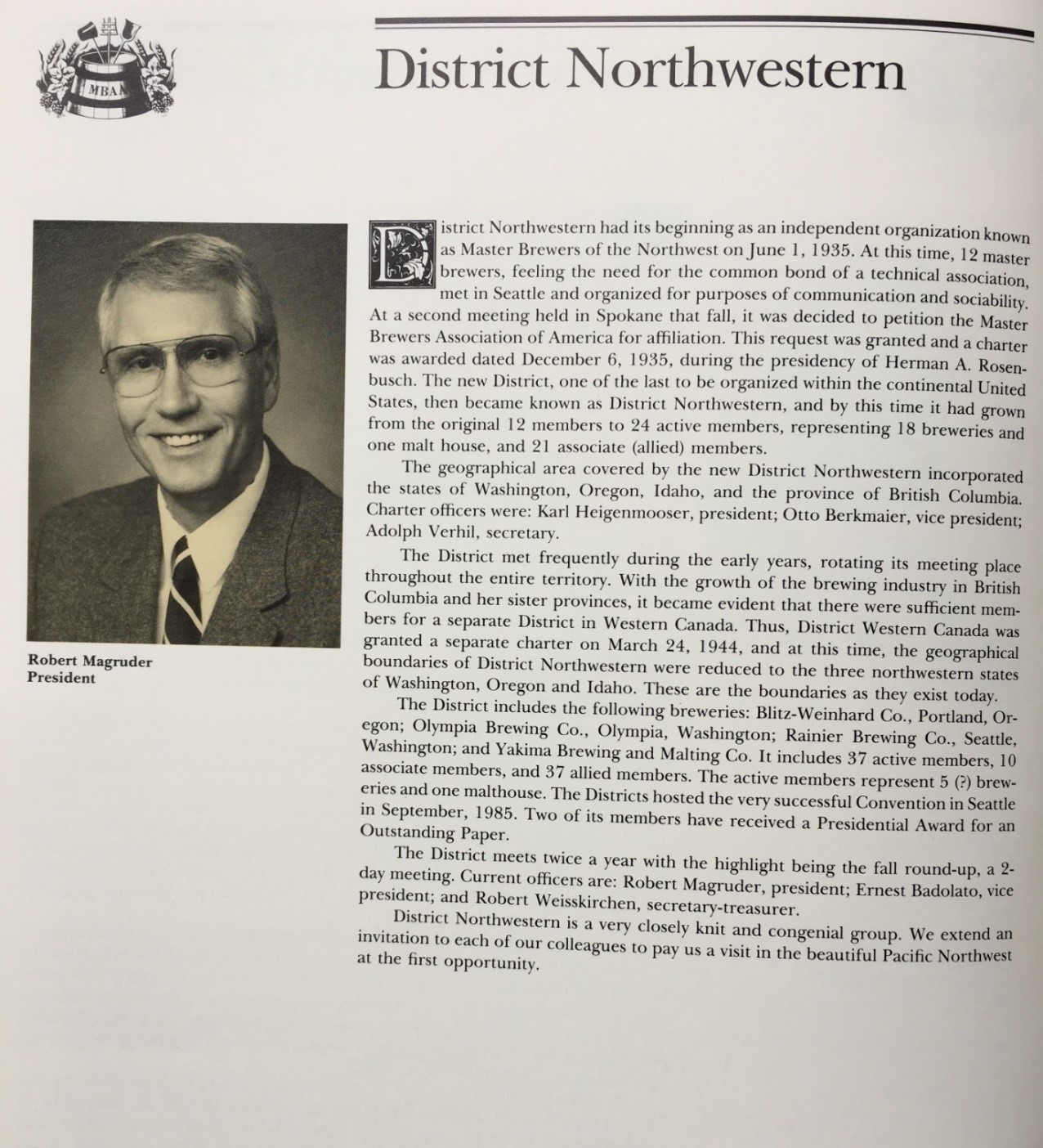 In 1987, all MBAA districts were again asked to submit a concise history of their district for the 100 year Golden Jubilee Convention. The histories would again be published and distributed. District Northwestern's 1987 president, Robert Magruder, updated the 1962 history for that document. Mr. Magruder, for the most part, reiterated the 1962 history. He updated the list of member breweries, which had dropped from seven to four by 1987, providing 37 active members, 10 associate members, and 37 allied members. He also notes that in 1985, the district hosted the MBAA National Convention in Seattle. Today, the district is known as “District Northwest,” and is one of 25 active Master Brewers districts. It is one of the largest in terms of geographic boundaries. The craft beer explosion has been especially kind to the district. Its membership includes some of the most recognized and venerated breweries in the country! Its brewing culture encompasses not just world-class breweries, but also a unique agricultural history of hop breeding, development, and production. District Northwest is one of the most heritage-aware districts in Master Brewers, influenced in no small part by Oregon State University and their brewing archival efforts. OSU established its Oregon Hops and Brewing Archives in 2013. Their website homepage describes it as “the first in the U.S. dedicated to collecting, preserving, and sharing materials that tell the story of Northwest brewing.” Their wide-ranging efforts include collections of historical papers, records, industry periodicals, and research reports, and also a very unique collection of oral histories with brewers and others who have impacted the states brewing industry. Your heritage chair salutes District Northwest and the ambitious, contagious culture of ongoing efforts to both preserve and communicate their heritage treasures. District Western Canada Heritage From Master Brewers’ two collections of district histories, the 75th Diamond Jubilee Edition published in 1962 and the 100th Golden Jubilee Edition published in 1987, we salute District Western Canada! Once again, I have included digital images of both histories for you to read and enjoy. The impetus for choosing District Western Canada is quite simple. They requested some historical information to share at an upcoming meeting. It is especially exciting as they are meeting in the province of British Columbia for the first time in over 20 years! As a reminder, in 1962 all MBAA districts were asked to submit a concise history of their district for the 75 Year Diamond Jubilee Convention. The histories would be published and distributed in a special edition of the Communicator. The history of District Western Canada was written by their president in 1962, Victor A Brachat. Victor concentrated on providing some details about when and how the District Western Canada was formed. On January 11, 1941, a number of brewers from Canada's western provinces met together at the Drewery's Brewery in Winnipeg, Manitoba. Their purpose was to formalize their efforts to form their own master brewers association. Those efforts were successful enough that they held a second meeting the following June 14, 1941, in Regina, Saskatchewan. At that second meeting, they first met, formally, as the Master Brewers Association of Western Canada. A third meeting was held on August 20–21, 1943 at the Fort Garry Hotel in Winnipeg. On the second day of that meeting, a motion was passed to “open negotiations” with the Master Brewers Association of America (our association's name at that time) for the purpose of officially affiliating and obtaining an MBAA district charter. It is worth pointing out that the world was engulfed in the Second World War. After Pearl Harbor and the United States’ entry into the war, MBAA President Phil Berkes immediately called an Executive Meeting in Chicago. He and the Executive Committee put the MBAA on a “wartime footing.” For the duration of the war, MBAA conventions would be limited in scope... “wartime conferences.” The conferences limited participation to active MBAA members, and all discussion was limited to wartime production problems. Three such wartime conferences followed: Cleveland in 1942, Cincinnati in 1943, and St. Louis in 1944. 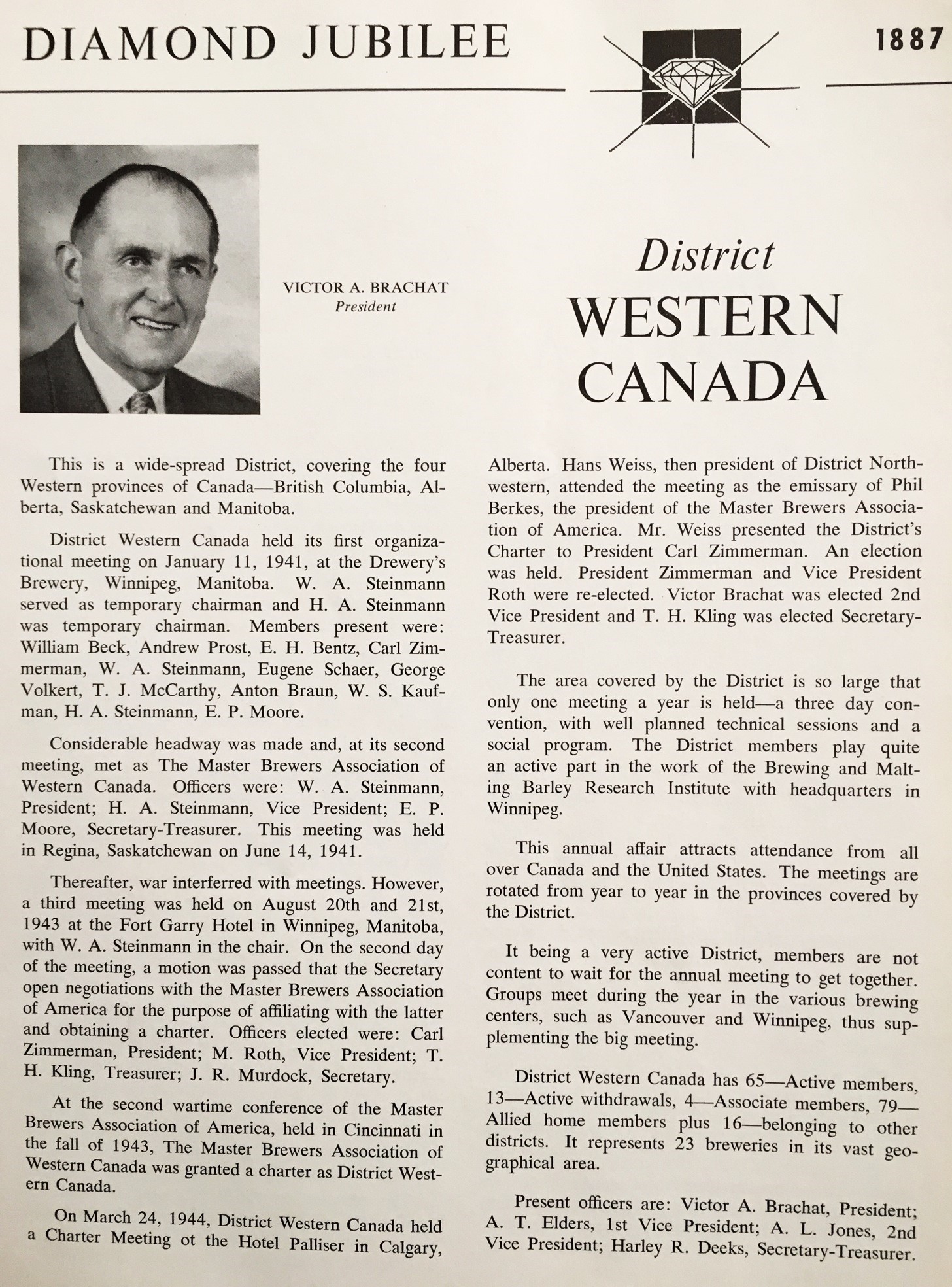 At the second wartime conference held in Cincinnati, MBAA tabled its wartime production dialogue just long enough to grant the Master Brewers Association of Western Canada a charter as MBAA's District Western Canada. On March 24, 1944, District Western Canada held their own “charter meeting” at the Hotel Palliser in Calgary. MBAA President Berkes traveled to Calgary and officially presented the district their MBAA Charter. With the war winding down in 1945, MBAA held a “Reconversion Conference” in Chicago with the intent of returning MBAA back to a normal, “peacetime footing.” The first post-war conference was scheduled for Pittsburg in 1946. In 1987, all MBAA districts were again asked to submit a concise history of their district for the 100 year Golden Jubilee Convention. The histories would again be published and distributed. District Western Canada's 1987 District President Dave Hamlin updated the 1962 history for that document. 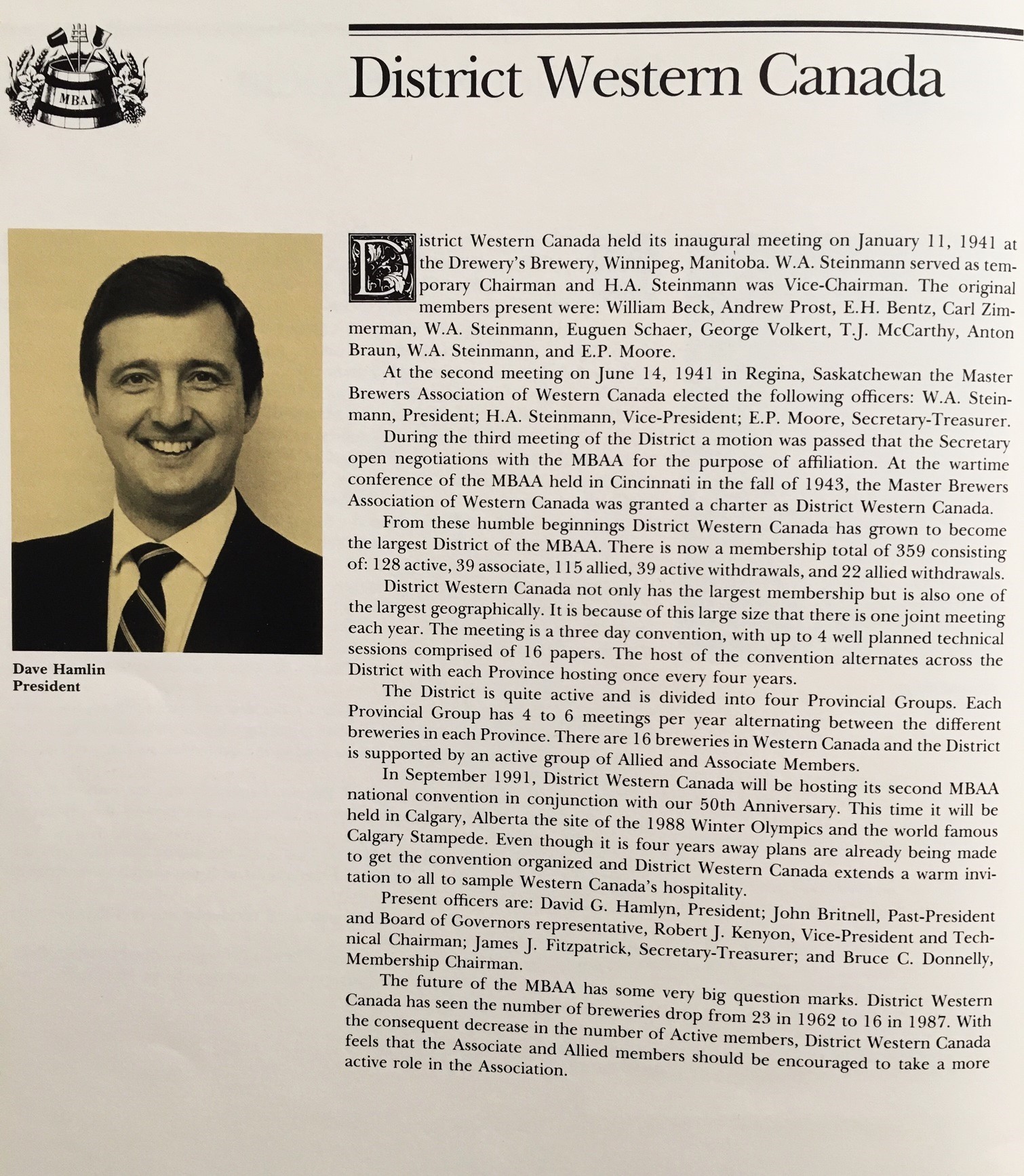 Dave Hamlin also notes that in 1987:
In that 1987 history, Dave Hamlin also recognized the impact of brewery attrition. As was so typical in the United States at that time, District Western Canada was experiencing brewery closings, consolidations, and mergers. Dave points out that the number of breweries in the four western provinces dropped from 23 in 1962 to 16 in 1987. An historical sketch of Master Brewers also included in the 1987 Golden Jubilee document reflects upon significant events 100 years earlier in 1887. Among world events and brewery milestones, it mentions that: "In Canada in 1887, the Canadian Pacific Railroad reached Vancouver joining the east and west coasts. In Montreal that year, the John H. R. Molson & Bros. brewery (to become Molson Breweries of Canada, Limited and now the oldest operating North American brewery) started its second century of brewing headed by the third generation of Molsons. Their records show that the average wage then in the brewing department was $1.10 a day; the most highly paid member of the brewing staff was the brewmaster who received $2.00 a day." Your Heritage Chair congratulates the brewers in British Columbia for their efforts at rejuvenating interest in Master Brewers. I especially applaud their interest in District Western Canada's rich heritage. Donation of Historic Documents to MBAA ArchivesGood things come to those who... wait. In our last Communicator, I shared the success story of how long-time MBAA member and past president Ray Klimovitz (1997–1998) so generously responded to my plea for help in locating the 1962 and 1987 publications that celebrate MBAA's 75th and 100th anniversaries, respectively. Ray promptly sent BOTH publications from his personal collection for me to photograph for the benefit of any other districts that might want to use the materials to preserve aspects of their own histories. Last week, I received another email from Ray, which simply said: “Hi Rick....I read your column in the latest MBAA Communicator....I believe that it would be best to have those two items deposited in the MBAA archives at Iowa State.” Of course, I was thrilled to hear such a preservation-focused and forward-thinking offer! I know how personal and even emotional such personal memorabilia can be. I asked Ray if he wanted to think about this a bit more. His response was “Rick.....you have my permission to archive them!” As requested, I will submit those treasures into our archives at Iowa State. I will designate a specific box and folder so they are easily described and retrieved by future researchers. 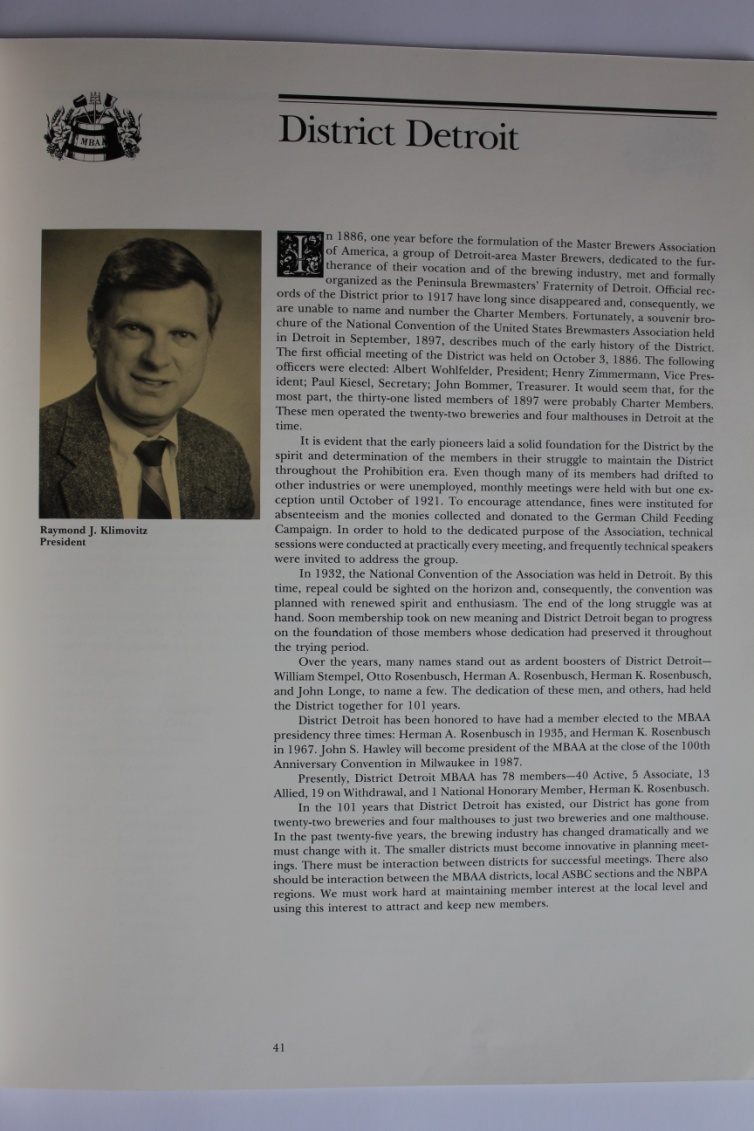 Ironically, the 1987 document highlighting MBAA's 100th anniversary contains a succinct history of District Detroit. It was written by its District President that year...Raymond J. Klimovitz!!! That history, and its District President, are pictured right. Ray’s writing begins: “In 1886, one year before the formulation of the Master Brewers Association of America, a group of Detroit-area master brewers, dedicated to the furtherance of their vocation and the brewing industry, met and formally organized as the Peninsula Brewmasters’ Fraternity of Detroit. Official records of the District prior to 1917 have long since disappeared..." It is quite ironic how preservation of our heritage, our history, and vital aspects of our past is so often achieved by forward-thinking, future-minded individuals. Ray's generosity puts very favorable closure on what has been a two-year journey for me. He has personally ensured that two publications containing many district histories will NOT disappear! The next time you are out enjoying one of your favorite lagers or ales, please raise your glass in a spirit of thanks and appreciation to Ray! Prost!! Example of a “First Response” InquiryIn the last MBAA Communicator, I shared my desire to create an organized "first response" to the increasing number a research inquiries that MBAA receives each year. I mentioned that individuals from all walks of life view MBAA and its 127-year heritage as a natural go-to resource for a wide range of information, both personal and scholarly in nature and on many levels. As the Heritage Chair, my goal is to help these folks get answers by getting their requests for heritage information placed before as many eyes as possible. I thought if might be fitting and fun to share one such recent request. The following email was received through our "Contact Us" form. It involves a past MBAA member employed by Joseph Schlitz Brewing Co. during the 1960s and 1970s: "My father, Donald R. Lange, was a member of the MBAA for many, many years. He was retired from the Jos. Schlitz Brewing Company where he had worked in several capacities, including Brewmaster. In the 1970's, Dad was, if I'm not mistaken, an officer (possibly even president?) of the District of your organization that included Texas. What moves me about this family's request is how it reflects...
WOW!! This heritage request certainly warrants our organized “first response.” On Sandy Lange's behalf, I will:
If you have any knowledge of Sandy's father, the supporting companies he did business with, the boxed deck of playing cards, and/or the commissioned paintings, please contact us so we can forward the information. Filling in the GapsIt is a fact of life that in offices and meeting rooms each and every day, all over the world, organizations of every conceivable type are continuously creating a deluge of... organizational records. Individuals, businesses, governments, institutions, for-profits, and not-for-profits all create a dazzling array of materials commencing with their original business plan and start-up requirements, moving through long-term plans and short-term goals, and showcasing day-to-day logistic and financial operations. Payroll, tax forms, memos, emails, meeting minutes, newsletters, and reports of special projects are all grist for the mill. Another fact of life is that organizational records are often mishandled. Almost immediately, they become non-current records and are haphazardly filed away, or in truth they are misfiled. As time goes on they further accumulate, becoming nothing short of a nuisance. Even MBAA has learned some very hard lessons when it comes to caring for its organizational records. Years of careless storage resulted in the loss of a treasure trove of MBAA records from flood, fire, and even, (I am told), malicious destruction. The net result is a "missing gap" that includes the loss of MBAA rosters, documents, photos, meeting minutes, and other information from just after 1887 through about 1934. Perhaps most tragically, that missing gap also virtually assures the loss of MBAA Annual Convention documentation spanning from our 2nd convention in New York City in 1888 to our 31st Convention ironically held again in New York City in 1934. Moving forward from lessons learned, MBAA is now far more serious and proactive at ensuring that devastating losses of our historical records will never happen again. That is the main reason that we house our archives with the Iowa State University Special Collections Department. You can see an overview of our collection archived at Iowa State at the following link: http://www.add.lib.iastate.edu/spcl/manuscripts/MS675.html 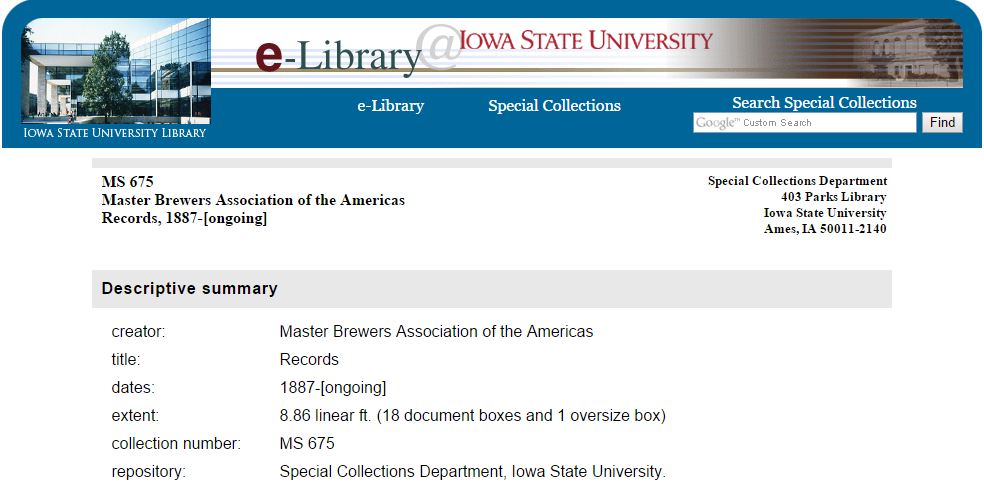 As listed at Iowa State, our collection number is MS 675, dated 1887 and ongoing. We are 8.86 linear feet, containing “18 document boxes and 1 oversize box.” In Iowa State's own language, our collection description reads as follows: “The collection (1887–[ongoing]) includes administrative records, committee records, constitutions and bylaws, convention materials, correspondence, meeting minutes, scholarship and award information, and St. Paul-Minneapolis District records. Committee files can include agendas, correspondence, minutes, and other related meeting materials. Convention materials can include Board of Governors meeting minutes, annual business meeting minutes, newsletters, and financial reports, and other supplemental reports...” The collection description then contains the following horrific statement of fact: “However, the bulk of the collection dates from 1950 onward leaving the first 60 years of the organization only sparsely documented…” The next image from Iowa State's website clearly shows our “missing gap.” Note that the descriptive text lists the date 1887, and then jumps immediately to 1934! 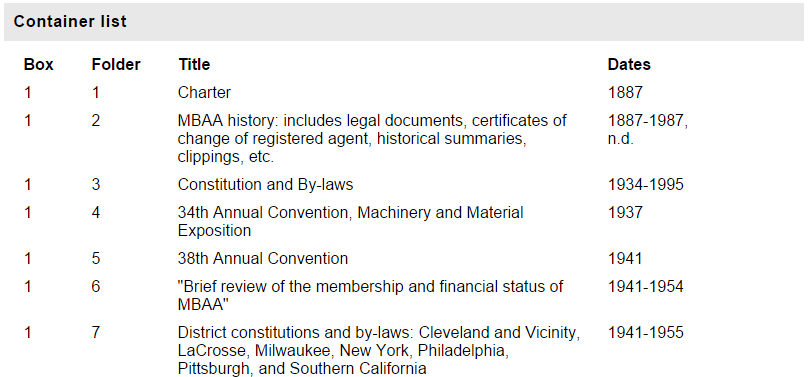 MBAA’s affiliation with Iowa State represents a unique opportunity for each of our 24 MBAA local districts. Perhaps your district has some “organizational records issues.” Perhaps your district views their growing collection of records with some concern. Or perhaps your district has some pertinent records that are slowly brittling and yellowing with time. Iowa State just might be able to assist. Iowa State Archivist Laura Sullivan shares with me: “We would be happy to talk to anyone who would like to donate the records they hold of the MBAA including meeting minutes, reports, publications, newsletters, and other records documenting the activities of the MBAA. If they have any questions about what we hold, or what might be considered for donation, they should not hesitate to contact us. Please let them know that a finding aid (collection description) can be found online if they would like to find out more about the contents of the MBAA Records.” It is important to know that records donated to Iowa State must meet their requirements, which are best reflected in their Special Collections mission statement, which is “to collect, preserve, and share documentation of the experiences, achievements, and memories of people and organizations reflecting the university's major research areas.” In like fashion, their vision is “to engage and encourage innovative research, interdisciplinary education, exploration, and discovery.” Our MBAA archives fit their mission and vision quite nicely. Laura continues: “Since its inception in 1969, the Iowa State University Special Collections Department has maintained a program dedicated to the acquisition and preservation of hundreds of unique historical collections related to science and technology. Once records are donated to the department, and the decision has been made to keep the materials for their historical significance, records are rehoused in acid-free folders and boxes, stored in environmentally controlled conditions, organized, described, and made available for researchers.” As Heritage Chair, I am in continuous contact with Iowa State, and routinely discuss with them additions to our archives. If your local district has some records that are worth preserving and you think that they might meet the mission and vision of Iowa State's Special Collections, feel free to contact me. There might be a chance that they could be properly preserved in perpetuity. And we will have taken a grass-roots stand to ensure that our MBAA at all levels will endure no more “missing gaps” in our heritage. Finding Memories in Cincinnati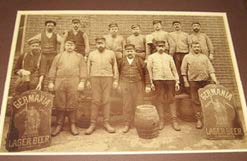 I was recently presenting at a Beer Steward Certification Program event in North Carolina. During a break, I was approached by Larry Wetterer, who was excited to share with me that he was a descendent of John Wetterer, who founded the Germania Brewery in Cincinnati in the 1880s, later renamed the Wetterer Brewery around 1902. Larry enthusiastically talked about his personal memorabilia, and even offered to share some of it with me! My discussions with Larry prompted me to do just a little digging.
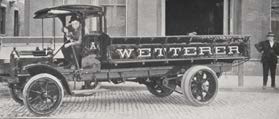 Both Wetterer buildings are located in the area of Cincinnati known as “Over-the-Rhine.” The Germans who immigrated to Cincinnati in the mid 1800s recognized the similarities of Cincinnati and their old-world homeland, named the area “Over-the-Rhine”, and built a profitable brewing industry there. To this day, the Over-the-Rhine Brewery District showcases a large number of Romanesque brewery structures and Italianate architecture. This is just one example of how easily it is to find history. A chance meeting with Larry Wetterer unearthed some District Cincinnati heritage…in North Carolina! As a district heritage chair, simply being attuned to such possibilities can reap rewards. In the spirit of our MBAA 125th Anniversary, thank you, Larry! 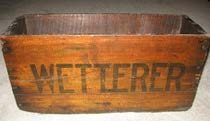 Hands-On Heritage!As the heritage chair, it is great fun to actually go out into our district every month and practice what I preach. In the October MBAA Communicator, I shared my research trip from my hometown of Columbus to Cincinnati, where I spent a Saturday exploring the newly discovered fermentation cellars of the Gerke Brewery. I was able to explore Ohio brewing history for a second time on Friday, November 16, 2012, when I traveled north to the city of Toledo. Again, my sole purpose was to enjoy hands-on brewing heritage research. Accompanying me was fellow Heritage Committee member and long-time brewer, Bill Weisenburger. Our mission: To visit the archives at both the University of Toledo and the Toledo Main Library for information about the Huebner-Toledo Brewery. Huebner-Toledo was once the city’s largest brewery, dating back to the post-Civil War period. John (Johann) Huebner learned the brewing trade in Bavaria. He also learned from his father, Jacob, at the family brewery located in Logansport, Indiana. In 1896, John, in association with James E. Pilliod, acquired the Toledo Malting and Brewing Company, which ultimately became the Huebner-Toledo Brewing Co. Prohibition caused most of the Toledo breweries to shut down, including Huebner-Toledo. It never reopened. 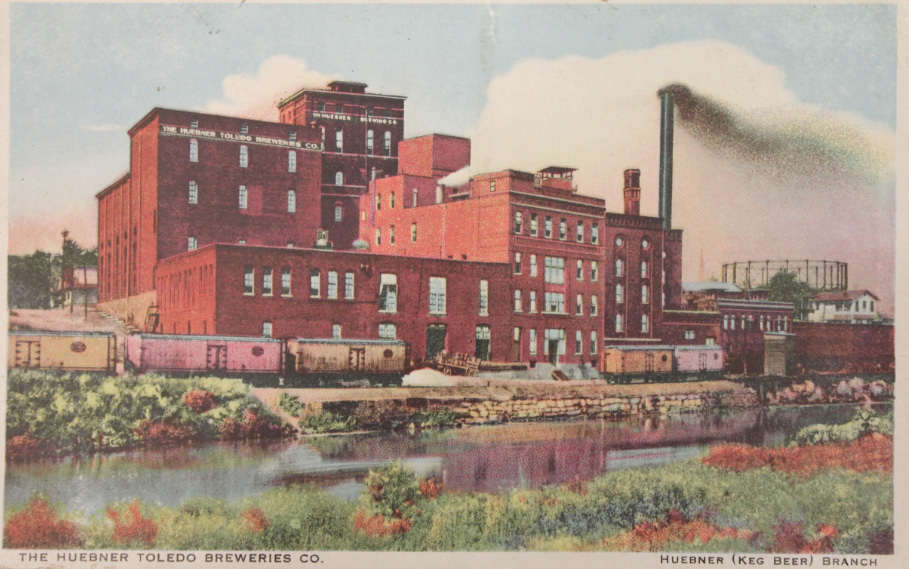
Huebner-Toledo Brewery in 1915. 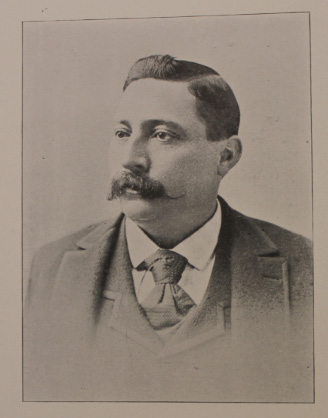
Johann Huebner In preparation for our research day, Bill had made prior arrangements with the university archivist at the Ward M. Canaday Center for Special Collections at the university. Their manuscript collection contains the “Alice E. Huebner Collection No. MSS-133” dated 1861–1976. It had already been pulled from archive storage and was waiting for us upon our arrival. We opened it and our eyes peered upon a fascinating array of donated items, many of which are related to the Huebner-Toledo Brewery. It contains several colorful postcard depictions of the interior and exterior of the brewery dating from 1915. It also includes letters, photos, various honors and award citations, newspaper clippings, and magazine articles. 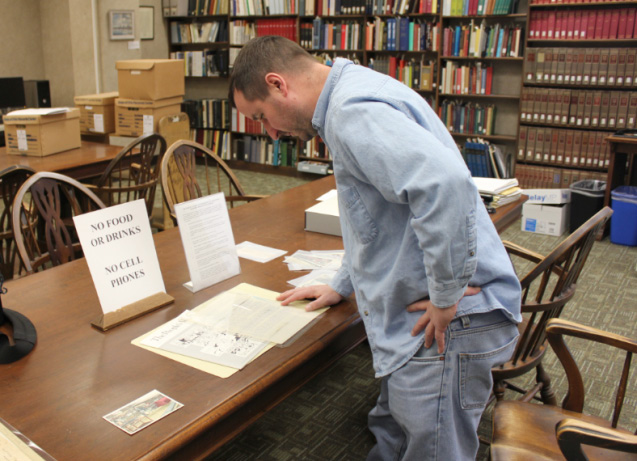
Bill Weisenburger studying an original Huebner-Toledo recipe. But for us, the real gem of the day was discovering an actual, Huebner-Toledo pre-Prohibition brewing recipe! It was quite tattered and in poor condition, but Bill and I were able to decipher its details. We put together enough information to attempt to duplicate the recipe! We will soon be brewing a five-gallon batch of this Huebner-Toledo pre-Prohibition recipe on my own homebrew system! 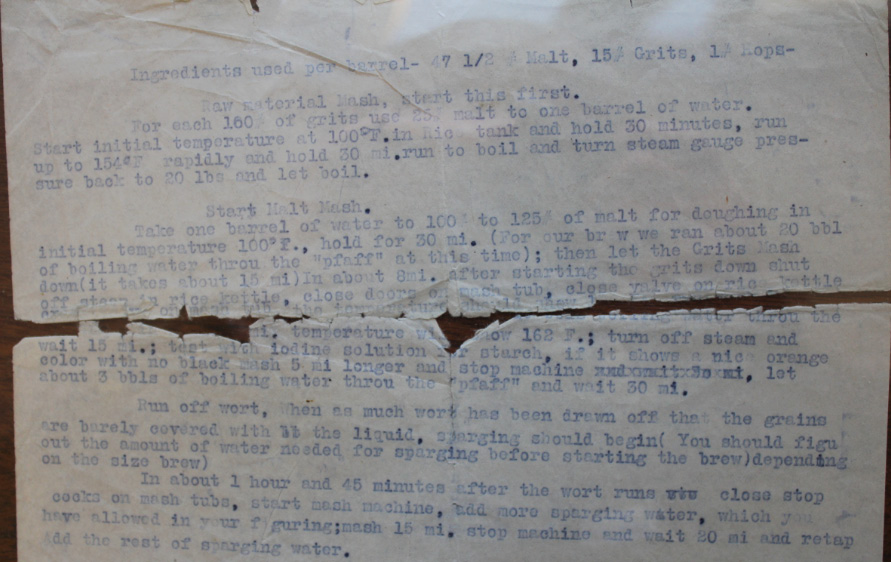
A portion of a pre-Prohibition Huebner-Toledo recipe. For a heritage guy, it just doesn’t get any better than this! This is quintessential hands-on heritage…total immersion in discoveries that quench the thirst of the mind and the thirst of the palate. Simultaneously, it is a tip-of-the-hat to all of the brewers who brewed before us. This find is a testament to the spirit of “heritage,” to the very core of what brewing used to be, and to how we want to respectfully ensure that brewing remains for others. And finally, in the spirit of the “WOW FACTOR” of actually discovering and brewing an archived pre-Prohibition recipe, one that was once the very life-blood of a proud, local industry that reflected all things “Bavarian” to an indigenous German population and all things “local” to the city of Toledo, to mash this recipe will be humbling and exciting at the same time! Again, this is quintessential hands-on heritage. As I continue to lobby for, and nurture, the district heritage chairs, this is but one more example of what is possible in your home district. As far as our five-gallon batch of the Huebner-Toledo pre-Prohibition recipe….I promise I will give you a full report. Over the holidays, raise a glass of your favorite beer and toast all those brewers who brewed before us, all those brewers who are part of the 125-year heritage of MBAA. Hands-on Heritage from D. G. YuenglingOnce in a while, an example of “Hands-On Heritage” comes along that takes on storybook proportions. Consider the stories and items shared with me by John Callahan, the brewing manager at D.G. Yuengling & Son, Pottsville, Pennsylvania. Yuengling is, of course, the oldest continuously operating brewery in the United States, its roots dating back to 1829. No other brewery can make such an amazing heritage claim. And it sets the stage for what you are about to read. John Callahan shared with me genuine heartfelt heritage when he inherited the brewmaster office of the venerable Ray Norbert: "I recently had the opportunity to inherit Ray Norbert’s old office. It was quite an honor, and I decided to let everything as is, even the old file cabinets with everything from 100 years ago stored in them. Old MBAA magazines, hydrometers, scales from 1920, and bi-focals from 1930..." 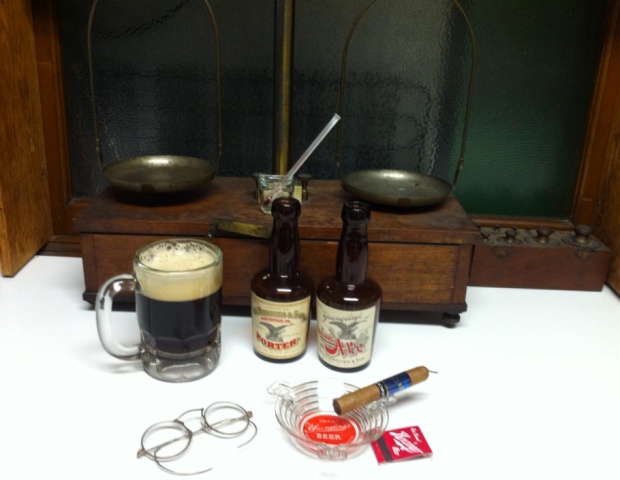 For those of you who don't know, Ray Norbert was one of the historical heavy-hitters that have served Yuengling well over the past 186 years. According to Robert A. Musson in his book, D. G. Yuengling & Son, Ray worked for Yuengling for an incredible 57 years, 40 of those years (1960–1999) as brewmaster. Under his watch, the company launched many of its iconic brands. John sent the digital image on the left to me, depicting several of the items he mentions that were in Norbert's office. In addition, there are two Yuengling bottles dating from the 1860s: Yuengling Porter and Chesterfield Ale, the combination precursor to Norbert's "Original Black and Tan" beer. John continued to celebrate his findings, pointing out that the filing cabinet included some items of personal correspondence: "I found a letter from Charlie Lieberman to name a few..." Charlie Lieberman was another venerable Pennsylvania brewmaster with a career spanning several decades. He was awarded MBAA's Award Of Merit in 1989. Interestingly enough, the last MBAA meeting that Charlie reportedly attended was a District Philadelphia meeting in the fall of 2005 hosted by... Yuengling, right there in Pottsville. Charlie was 96 years of age. The event was billed as “America's Oldest Brewmaster visits America's Oldest Brewery!” 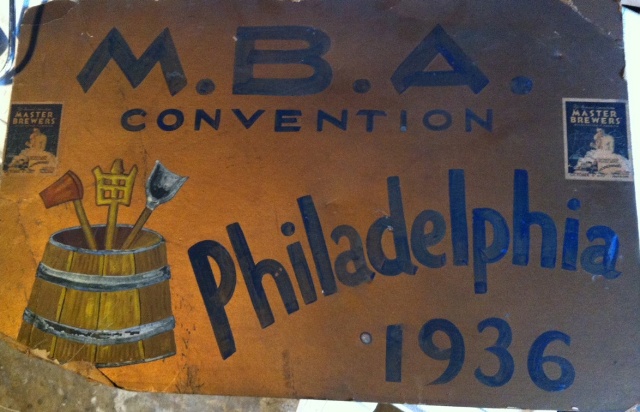 John next shared with me the fruits of his excursion into “a back room off [his] office...” His findings there were every bit as remarkable and included a hand-painted placard promoting MBAA's 33rd National Convention held in Philadelphia in 1936. That placard is shown as shown on the right. MBAA's 33rd National Convention was hosted by District Philadelphia and was held October 4–7, 1936, at the Bellevue-Stratford Hotel. The convention was quite memorable as it was dedicated to none other than Louis Pasteur. A volume entitled The Life of Pasteur, written by French writer René Vallery-Radot, who was also the son-in-law of Louis Pasteur, was translated from the French and published by Garden City Publishing Co. specifically for that convention. It was bound in an MBAA cover, complete with a gold embossed MBAA emblem and title page. The handsome biography was available to all convention attendees. I came into possession of a copy, and I wrote more extensively about it back in 2013. Now, to possess an image of the hand-painted placard promoting that historic convention is equally invaluable. 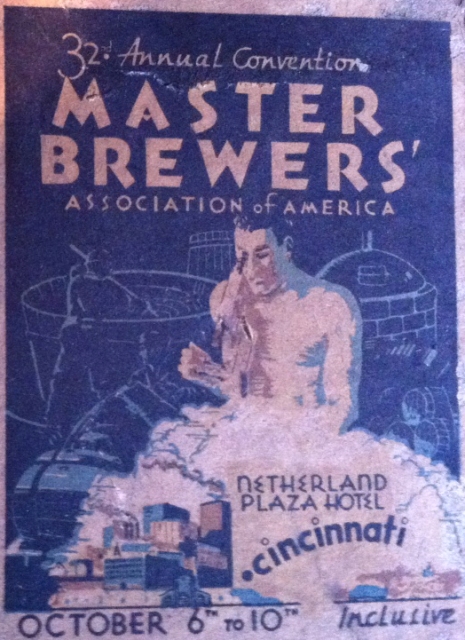 But wait... there's more. An alert eye will notice that affixed to the hand-painted 1936 convention placard are two smaller posters. They announced MBAA's national convention from the previous year, 1932. That convention was hosted by then District Cincinnati (now District Midwest) and held in that city. The more discernible poster is enlarged, and appears on the left. John Callahan has since been kind enough to share other digital images of MBAA items of interest. Many were provided to him from members of Ray Norbert's family and reflect a lifetime in our industry. I am working to properly archive them with our other historic items currently housed at Iowa State University's Special Collections Department. I want to ensure that they are secure and available and meet Iowa State's own mission of providing research accessibility. They represent a very small sampling of a very rich heritage from an iconic brewery dating back to 1829. Like John Callahan himself, the folks at Yuengling are well aware of their multi-generational gifts and are working hard to preserve them. Later this year, Yuengling will open an expanded on-site museum to share its 186-year heritage with everyone. Hands-On Heritage just doesn't get any better than that! A big thank you goes out to John Callahan for sharing his historical workday world and allowing some remarkable images to be made available to all MBAA members. Happy 125th AnniversaryIn 1887, President Grover Cleveland began the third year of his first term. That year, he focused on modernizing our navy, and the U.S. Senate reciprocated by approving a new naval base to be established at Pearl Harbor. He worked with Congress to form the Interstate Commerce Commission to provide federal regulation of the ever-expanding railroads. And, he continued to address ongoing issues with U.S. tariff policies. On March 21 of that same year, about 90 master brewers traveled to the windy city of Chicago. Some were members of brewing associations from New York, Chicago, Cincinnati, and Detroit. Others were not affiliated with any organization or association. In spite of the tragic and highly publicized Chicago Haymarket Riots of a few months earlier, these brewers traveled the distance and came together for the purpose of establishing a national brewing association. The goals of the new organization were to:
Thus, the Master Brewers Association of the Americas was born. MBAA’s 125-year timeline closely mirrors the challenges to an evolving and maturing United States of America: economic panics, recessions, depressions, local temperance, and national prohibition. And in a short period of time, two world wars resulted in transportation restrictions and shortages of material, equipment, and labor. There were also brewery attrition and several mergers. All of these have been issues requiring the attention and spirited dialogue of our leadership. MBAA has always delivered, providing ongoing and rotating leadership, the exhaustive efforts of annual national conventions and wartime conferences, focused efforts of committees, world-class educational endeavors, awards programs, and coordinated research. Our core values as written in that original 1887 charter and reflected in our current Long-Range Strategic Plan continue to serve us well. It is with great pleasure that I offer a hearty “Happy Birthday” to our Master Brewers Association of the Americas! This coming March 21st, go to your favorite pub, raise your glass, and toast those original, forward-thinking founders and the 125-year tradition that brought us to this very day! Prosit! History in the Making: District Cincinnati Changes Its Name to District MidwestAs the MBAA Heritage Chair, I am pleased to share with all of you...history in the making! District Cincinnati is formally announcing that it is changing its name to “District Midwest.” At our two previous Board of Governors meetings—first in Portland, Oregon, in July 2012, and our most recent meeting in Austin, Texas this past October—much of the dialogue centered around ensuring value and driving relevance to our membership. Our MBAA Strategic Plan and its accompanying objectives deal with encouraging more participation in our local districts. Answering this call, many of us in District Cincinnati began discussing the possibility of changing the name of our local district from “District Cincinnati” to, well, something else that would better reflect just who we are. Over the course of several district meetings, members discussed the pros and cons of the name change. The “preservation debate” is rarely, if ever, an easy one, and our district name change certainly fits that billing. Some members were very much opposed to the change, citing the long-standing heritage of Cincinnati and its brewing traditions. We were, after all, one of the original districts present at that first Chicago meeting when our founders formed MBAA in March of 1887—a remarkable claim! Just a few years ago, we even changed our district emblem to better reflect this. I reminded our members that, in order to drive relevance and better reflect its purpose, even MBAA has changed its name three times since 1887! In like manner, our name change to "District Midwest" also drives relevance and better reflects our purpose. The name is far more inclusionary. It acknowledges and receives with open arms the gifts of the separate brewing heritages of the entire state of Ohio, all of eastern Indiana, and all of northern Kentucky. The change was agreed upon at our April 6, 2013, district meeting, which was, quite fittingly, at the Morlein Lager House... in downtown Cincinnati. The MBAA Executive Committee fully supports the name change. Now we begin a second challenge: that of creating an emblem that properly represents just who we are as a district while at the same time recognizing our 127-year district history.  The accompanying photo was taken at our April 6 Morlein Lager House meeting. It shows me (left) with long-time District Cincinnati member John Piening (right), of Samuel Adams, proudly wearing a shirt bearing the District Cincinnati emblem. John is a third generation Cincinnati brewer. The Morlein Lager House mural behind us colorfully depicts the history of Cincinnati brewing. On that mural, nestled neatly between our shoulders is John's grandfather! This is District Cincinnati's heritage at its very best! Cheers! How to do the Job of a District Heritage ChairDuring the MBAA Board of Governors’ meeting at the World Brewing Congress in Portland, Oregon, I was able to utilize 10 presentation-minutes with my esteemed, captive audience to once again make the pitch for district heritage chairs. There was the expected cordial attentiveness as I expressed my views, followed by a handful of questions. Finally, there was a request that I clarify, write up, and send to the Board of Governors my personal “expectations” for the role. As I have written previously, I imagine that any district heritage chair volunteer would probably be the type of person who is somewhat historically minded. They would not necessarily be formally trained. They just might have more awareness, more of an attitude, an outlook, and a perspective that all leans toward the appreciation of “heritage” and “history.” Perhaps they just like to read history. Or perhaps they enjoy genealogical research, already pursuing their own family roots and memories. The role would be considered very self-directed and do-it-yourself as decided by each individual volunteer. My “vision” of the role includes three primary areas of participation: 1) helping to establish and maintaining a district “heritage tab” on the district web site; 2) capturing and preserving the memories of district events; and 3) preserving, possibly archiving, any pertinent district memorabilia.
Once the heritage tab is established, its maintenance would be quite minimal. Our District Cincinnati Heritage Tab, when launched, could be used as a springboard for others to model.
I cannot emphasize enough that the volunteer role would be considered very individual and self-directed. The degree of involvement would be decided by each individual volunteer, having the license to be extensively involved, quite hands-on, or a bit more limited, more reserved, and more minimally involved. Any level of involvement helps the cause and represents a step in the right direction toward preserving our MBAA heritage at the local level. Inquiry RequestsIn these pages, I have shared that one of the unexpected privileges of serving as the MBAA Heritage Chair includes assisting organizations and individuals with their research inquiries. In my three years on the job, I have had university students, Ph.D. candidates, scholars, writers, and family genealogists contact MBAA or me personally with a wide range of research requests. Although we are primarily a technical organization, the fact of our enduring 127-year history and our organizational structure, which includes 24 local districts stretching across the United States, Canada, Europe, South America, and the Caribbean, make MBAA a “go-to” resource for such inquiries. To help me to properly manage these inquiries, I created an organized “first response,” an initial action plan involving a sequence of steps that hopefully sets a path toward obtaining the information being requested. The action plan includes four sequential steps:
With this Communicator piece, I would like to post three inquiry requests that we have had little success in solving. Hopefully, our readership might be able to offer some pertinent information.
If anyone can provide some insight into any of the above requests, please contact me and I will forward your information to the individual requester. Thanks so much. Introducing the MBAA Historical TimelineOne aspect of our MBAA that sets it apart from the growing number of brewing professional organizations is the fact of our enduring longevity. From that first Chicago meeting in March 1887 to our October 2015 conference in Jacksonville, we have now persisted for 128 years... and counting! Our Heritage Committee is keenly aware of this uniqueness and is avidly searching for ways to showcase this attribute. One such showcasing tool that we are quite excited about is the possible creation of an MBAA HISTORICAL TIMELINE. Our vision of the MBAA HISTORICAL TIMELINE fosters the development of some kind of displayable tool that documents and graphically depicts important historical milestone events throughout MBAA's history. Already, we see that it could evolve into any number of possible formats. At its core, it could be a displayable poster, possibly wall-hung or free-standing, for use at MBAA events, district meetings, or anywhere we maintain an MBAA booth setting. It could also be available in a smaller, portable format as a printed, folded, map-style document that might be available as a handout, or even folded and included with new and/or renewal membership mailings. At its extreme, and probably most exciting, it could take the form of an interactive website tool, complete with scrolling capabilities and drop-down windows, readily available to all MBAA members. Clearly, there are several unique possibilities. Our initial efforts have involved the selection and screening of our timeline content. We have begun by selecting historical and heritage milestone events from three major content areas:
A "milestone event" spreadsheet has been created that includes each of these three columns. Every calendar year was examined for occurring MBAA, brewing industry, or U.S. and/or world milestone events, beginning in the year 1887 and moving forward to the present day. Some examples of MBAA Heritage Milestone Events include:
Some examples of Brewing Industry Milestone Events include:
Some examples of U.S. and World History Milestone Events include:
Language of the First MBAA ConventionOne of my enduring interests has been a fascination with the expansive vocabularies of the U.S. founding fathers. To this day, I marvel at their eloquent and quotable manner of speaking and writing. These men were not only some of history's greatest statesmen, but also some of its greatest thinkers, educated in the 18th century Enlightenment tradition. Have you ever pondered the rhetorical legacy provided to us by the writings of the Declaration of Independence and the U.S. Constitution? Or the widely circulated revolutionary pamphlets such as Common Sense, written by Thomas Paine, or The Federalist Papers jointly written by Madison, Hamilton, and Jay (under the pen name of "Publius"). And... have you ever considered the stark contrast between the dialogue standard for that day and the language we witnessed on the 2016 debate stage, or the all too frequent 140 character Tweets now commonly used by our elected leaders? It is with this "truth-in-packaging" background interest that I sought to revisit some "language details" from our first MBAA convention. I wanted to share a bit of the upscale oratory from our very own Founding Father Brewmasters! My primary source to achieve this is a translation, German into English, of a detailed description of our first convention that was written by none other than Anton Schwarz in Der Amerikanische Bierbrauer (The American Brewer). It can be found in our Master Brewers Technical Quarterly Vol. 32. pp 115-117, 1995. On the next page are some images from that original Der Amerikanische Bierbrauer publication. I found it in the Anheuser-Busch archives when I was in St. Louis doing research. I wrote about that heritage marvel in the April 2016 Communicator. The images show the bound, leather cover of Der Amerikanische Bierbrauer from 1887, the title page of the issue describing our 1887 convention, and the first page of the article. For our younger members who might not know, Anton Schwarz was a 19th century brewing rock star. He was an Austrian-born brewer and chemist who emigrated to the United States in 1868, settling in New York City. He got a job with Der Amerikanische Bierbrauer, became its editor, and ultimately bought the publication. He was much revered for turning The American Brewer into a serious scientific publication, improving brewing processes, and founding the Brewers’ Academy of the United States in New York City. His sculpted bust still hovers over the students studying at the Siebel Institute in Chicago. 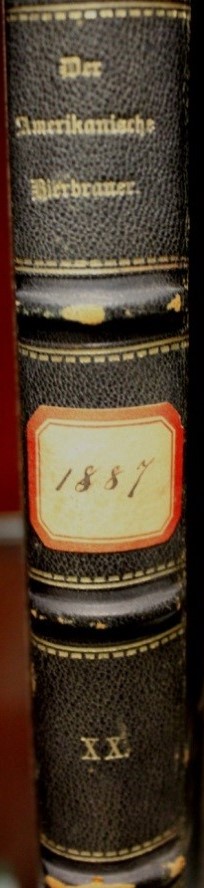 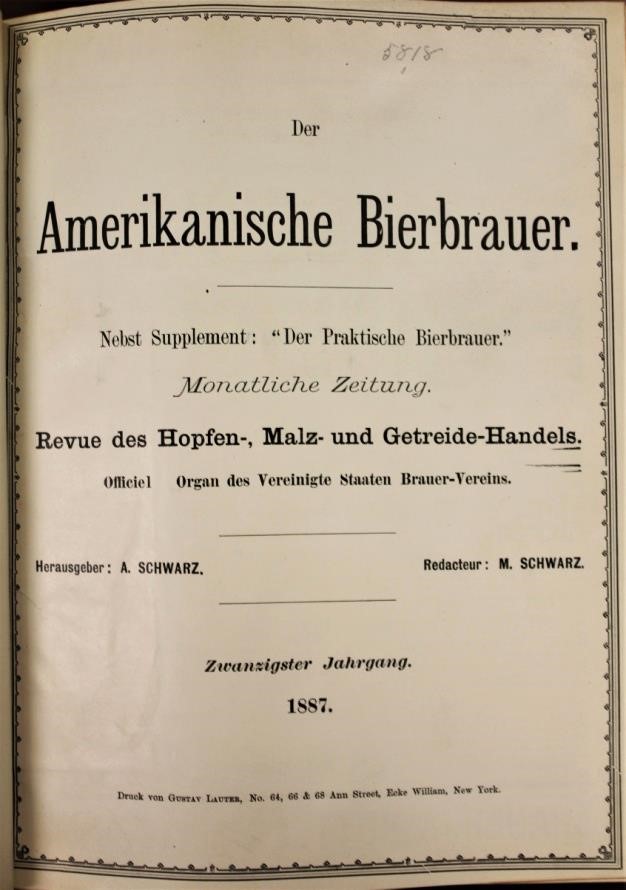 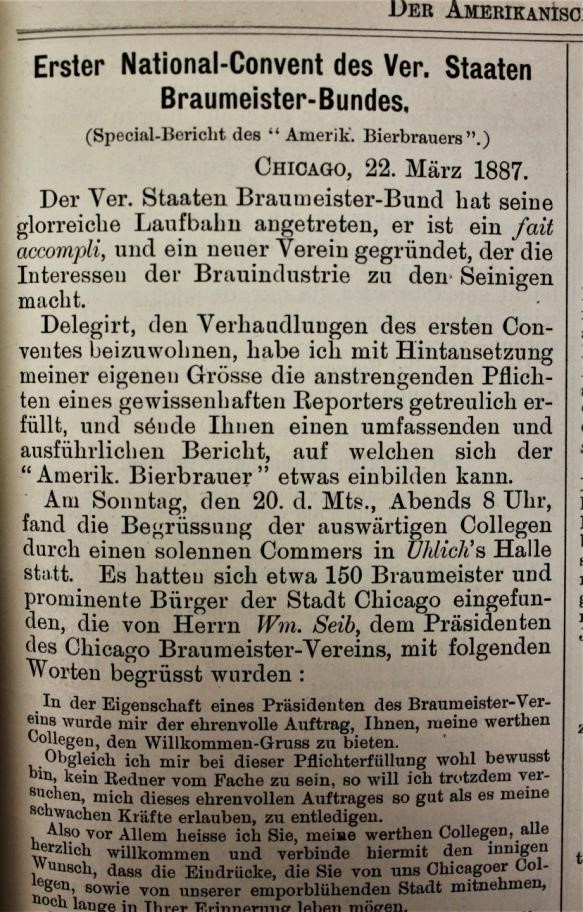 Translation of title of image in center: “First National Convention of the United States Brewmaster Association. Special Report of American Brewer, Chicago, 22 March 1887.” 
An English masthead from The American Brewer Our Founding Father Brewmasters spoke and wrote in an upbeat and beautiful language befitting men who were clearly multi-talented, often equally skilled in their pursuits of science, mechanics, business, politics, social skills, and communication. Consider Anton Schwarz's first reporting paragraph: "The United States Brewmaster's Association has embarked upon its glorious path; it is a fait accompli. A new association has been founded which will make the aims of the brewing industry its own. Consider the welcoming by W. Seib, the president of the Chicago Brewer’s Association: "In the capacity of president of one of the brewer's associations, it is my honorable task to extend to you, dear Sirs, the welcome greeting. Although I know full well that I am no orator by profession, I will nevertheless try to discharge myself of this honorable task as well as my poor powers allow." Mr. L. C. Huck, after being chosen president of the banquet, offered the following comments: "The honorable task of president of today's banquet has been bestowed upon me. In expressing to the banquet committee my sincere gratitude, I beg those present to make my task an easy one through their fresh humor, and especially a fine thirst." Mr. Huck then offered the following prayer: "In this country, it is usual to open festive meetings with a prayer. We to [sic], from the brewing trade, are good Christians, the well-being of whose neighbors is always in our hearts. So we wish to call with all our strength: Wow! God created water for the good use of men, especially to brew beer! Saving on hops or malt was harmful greed! And brewing beer from fruit or corn, well, was sinful! After reading that prayer, I had no doubts whatsoever of the sheer and absolute sanctity, and the preordained blessedness, of my chosen brewing profession! I can think of no better way to celebrate our 130th anniversary, than to provide some precise detailed examples of the language, hence the minds, of a few of our Founding Father Brewmasters. Their chosen words bring them into focus in a most unique way, shedding light on their mission of our association’s creation. And as sheer coincidence, along with our 130th anniversary, last month's heritage Communicator piece was my 50th. It's hard to believe, but as your Heritage Chair, it represents an enjoyable, personal milestone, nevertheless! MBAA Designated Heritage Brewer AwardOn October 22, 2013, in Austin, Texas, I formally presented to the MBAA Board of Governors the intent of our Heritage Committee to establish an MBAA Designated Heritage Brewer Award. Aspects of preservation, heritage, and history have long been a quest and a priority for many enlightened and forward-thinking nations, professional organizations, and concerned citizens. The Designated Heritage Brewer (DHB) Award is our attempt to join that quest by recognizing selected brewers who actively engage in preserving significant aspects of America's great brewing heritage. At times, our contemporary beer world seems to be obsessed only with extremes. We celebrate either the sheer bigness of the mega-merged brewers and the massive global impact of their product proliferation, or we celebrate the smallness of all things "craft" with a narrowly defined mindset of "no adjunct" use and limited big-brewery ownership. Often, in between these extremes are decades-old regional brewers, some of impressive historic significance. These brewers have often gone above and beyond the call to preserve, celebrate, and even showcase their personal brewing heritage in various ways. Perhaps they have done this through generations of ongoing family ownership, by actively using and preserving significant brewing architecture, or by proudly following age-old recipes that utilized the traditional methods and the local ingredients that were originally available to them. The DHB Award would be open to all brewers, regardless of size, and would not restrict ingredient use. On the contrary: our award would celebrate the ongoing use of whatever was "original" and "traditional" regarding ingredients and process in America's rich brewing heritage. Our award would include the ongoing heritage of the huge conglomerates. It would include the preservation attitude of beer style rediscovery, so prevalent with many microbreweries. And it would include everything in between. MBAA alone, with its 127-year history, is uniquely qualified to facilitate this award. It is a natural reflection and extension of our own rich heritage, if not an outright responsibility for further advocacy in recognizing all aspects of America's brewing heritage. I have already engaged the members of the Heritage Committee for their input in establishing the DHB Award criteria. As a starting point, I have listed some criteria ideas, in no particular order. To qualify for the MBAA Designated Heritage Brewery Award, the brewer/brewery:
More than likely, the DHB Award would involve some combination of these criteria, or some minimum number of them. I see the end result, the award itself, as a beautiful wooden plaque with an engraved brass plate (to be designed) commemorating the event. Each "award story" could be published in the MBAA Communicator and on the MBAA website. Maybe, as we acquire enough, we could publish their stories under one cover, in book form. But this is just a start and just my personal thoughts. I have asked members of the Heritage Committee for their thoughts and contributions as to our acceptance criteria, and now, I am asking for your feedback, as well. One of my favorite Shakespearian quotes comes to mind... from Shakespeare's The Tempest: "What's past...is prologue." In that spirit, I thank you now for your thoughts on what could be MBAA's own ongoing contribution to America's brewing heritage. Cheers! MBAA Proactivity, Now and ThenMBAA continuously demonstrates a very proactive level of involvement on different levels. At the ultimate, top-down level, on Friday, May 8, 2015, our association will hold its spring Board of Governors meeting in St. Paul, Minnesota. With a diligent dedication to our original charter, the Executive Committee, committee chairs, district representatives, and technical directors will convene and willingly donate their time to the ongoing success of MBAA, just as their dedicated predecessors have done for the previous 127 years. There will be a roll call for attendance and we will share a moment of silence for members in memoriam. Then, we will methodically get down to business. A wide range of presentations will ensure that our professional technical organization continues to effectively function. From my personal “heritage mindset,” each BOG meeting is a commemoration. Each BOG meeting is a symbol of indebtedness to the ongoing and rotating membership of our association, which has contributed so generously, for so long. Each BOG meeting is a process of scrutiny of our very purpose and our reason for being. The purposes of MBAA were clearly established at its inception, but the methods we use to achieve them have had to be adjusted with each challenge to our industry. Sometimes those "challenges" took on monumental proportions, including the pressures of politics and the influences of history... two world wars, grain restrictions, recessions, the Great Depression, presidential assassinations, “local option” laws, and outright national prohibition. And yet, year after year, a rotating list of volunteers continued to convene, ensuring MBAA would not only adjust, but would always remain a good "Association Citizen," even to the communities that support our industry.  Case in point...the image to the right depicts how, at the 38th MBAA Convention in 1941, on the eve of World War II, our association presented an exact replica of the Star Spangled Banner to the City of Baltimore. (photo from MBAA Archives) So, as we sit for another BOG meeting, we members can revel in the fact that this semiannual event continues to serve us preciously... from the top-down level, as our founders intended. At a far different, hands-on level... I continually marvel at how often heritage-minded people are so forward-thinking. An individual recently contacted us with the following request: "I am contacting this organization because I would like to donate or return to a family member a rare Budweiser can printed with William von Minden's image celebrating his Brewmaster career at the Anheuser-Busch Brewery in Houston Texas. We have in place an action plan to initially deal with such requests. It includes the following initial steps:
Our association has always been comprised of an ongoing rotation of dedicated folks, busy with the work at hand, at all levels... "to promote, organize, advance, improve, and protect the professional interest of brewery and malt house production and technical personnel." Partnering with Outside OrganizationsAt the Board of Governors meeting at the MBAA Annual Conference in Chicago a few weeks ago, District Midwest BOG representative Andy Tveekrem shared our district's "Best Practices Suggestion”: Recognizing the focus and strengths of other organizations, and partnering with them to showcase and advance the interests of all. In that "best practices" spirit, I offer a unique hands-on-heritage experience. My wife and I are members of "PALAM," short for "Palatines to America German Genealogical Society." This is a national organization that exists to promote the study of Germanic immigration to North America. PALAM's membership stretches across several state chapters and is ardently dedicated to assisting researchers in finding their German-speaking ancestors and their place of origin. Germany, Austria, Alsace, Switzerland, Luxembourg, Liechtenstein, Poland...really any German-speaking area is ripe for their support. The term "Palatine" originally referred to someone who came from along the Rhine River in the Palatinate of southwestern Germany. However, the term now generally applies to all German immigrants who arrived in America. Debbie and I attended the annual PALAM national conference that took place in our hometown of Columbus, Ohio, the weekend of June 27–28, 2014. As always, they offered an impressive list of speakers and topics, including "Germans in the American Civil War," "An Introduction to the German Phonetics of Personal and Place Names," "German Historical Events and Developments that Family History Researcher Should Understand," and much more. This has been especially meaningful to me, as I reflect upon the fact that our original 1887 MBAA constitution stipulated that all meetings and records were to be held in German. It was not until the 12th Annual Convention in 1901 that it was recognized that meetings could be conducted in either German or English! One of the highlights of the conference for me was a day-long tour of the Ohio portion of the National Road. Lager-drinking Germans quickly populated the river towns of Pittsburgh, Cincinnati, Louisville, and St Louis. They also quickly populated the Great Lake towns of Cleveland, Chicago, and Milwaukee. But the interior, the non-river and non-lake brewing traditions were made possible by the canal systems and the National Road.  The historic "National Road" was originally conceived by Albert Gallatin, Secretary of the Treasury under President Thomas Jefferson. It was the very first federally-funded interstate highway. Beginning in Cumberland, Maryland, it crossed six states: Maryland, Pennsylvania, Virginia (now West Virginia), Ohio, Indiana, and Illinois, stretching over 700 miles to the Mississippi River. Construction of the road began in 1811, It reached my hometown of Columbus in 1833. It continued westward, opening the nation's interior and providing a non-river means to move goods, materials, supplies, livestock, and people. It was responsible for much of our young nation's "interior" commercial success, supporting and growing existing communities, platting new towns, and providing travelers with a seven-state string of inns and taverns. And it made possible the building of breweries to support them. The Acts of Congress authorizing the National Road required recognizable "milestones” to appear at regular intervals along the road. Many of these remain to this very day. In Ohio, these milestones stood about three feet tall. Each one indicated the distance to Cumberland, Maryland, where the National Road began. Each one also indicated the distance to the nearest villages for both eastbound and westbound travelers. Many were pointed out to us, such as the milestone pictured right.  To carry goods and travelers across the many streams and rivers along the route of the National Road, gorgeous and graceful stone bridges were built in the Roman arch-with-keystone style. Many still exist to this very day. We were able to visit several, such as the gem pictured left. For me, the MBAA Heritage Chair, the PALAM Conference underscored the undeniable German connection of our own organization showcasing the many contributions of our German heritage. It also provided numerous sources for possible answers to history/heritage questions that we might have, especially regarding our local districts. In a spirit of "best practices," I encourage all of you to be open to other professional organizations whose strengths and focus might run parallel to your local MBAA district's interests, as possible sources of shedding new light in ways you may have never imagined! What’s in a Name? Preserving a District’s Heritage The term “heritage” has different meanings to different people. Invariably, most folks see “heritage” as involving some form of “historic preservation.” This is probably the result of one of the most obvious forms of preservation in most people’s lives—attempts at the preservation of historically significant buildings and unique architecture. In 1956, President Eisenhower signed into law the National Interstate and Defense Highways Act, which established the interstate highway system. Due to considerable new demolition and construction requirements, many unique, historic properties met their fate with the wrecking ball. Then, in the 1960s, the Kennedy administration launched an ambitious urban renewal program. Hoping the program would rejuvenate our inner cities, it further encouraged the destruction of many historically significant structures. Growing public disapproval festered into a firestorm of protest as protectors of the past finally screamed… “STOP!” They demanded some sort of process to identify and protect America’s historical gems. Congress responded with the National Historic Preservation Act. Signed into law on October 15, 1966, the law established a review process and protection criteria for both parcels of land and historically significant structures. The law also made it clear that the preservation of our history and heritage was a national priority. However, time has proven that, even with the law, the “preservation debate” is rarely an easy one. We have all heard stories about how the development of some industrial park, slated to supply a hundred new jobs, is abruptly put on HOLD because of an archaeological discovery that mandates further study. Hence, we experience the proverbial “fine line” between the costs of preservation and the benefits of progress. Why do I bring this up? I just returned from the Board of Governors meeting in Portland, Oregon. Much of the dialogue centered upon ensuring value and driving relevance to our membership. The very first goal of our new MBAA Strategic Plan and its accompanying five objectives all deal with encouraging more participation in our local districts. More than two pages of verbiage suggest…changes…to better meet local district needs. Answering this call, those of us in District Cincinnati are discussing the possibility of changing the name of our local district from “District Cincinnati” to, well, something else. Some members of our district will certainly want to scream “STOP!” We were, after all, one of the original districts present at that first Chicago meeting where our founders formed MBAA in March 1887, a remarkable claim! Just a few years ago, we even changed our district emblem to better reflect this, by including the words: “Chartered 1887” as shown here. We had shirts made for our district officers that showcased our heritage-inspired logo. So why, after all these 125 years, is a proposed name change even happening? District Cincinnati has grown significantly and actually now includes all of Ohio, eastern Indiana, and northern Kentucky. The label “District Cincinnati” does not serve the vast and growing number of breweries that reside within our boundaries. It is not inclusive of these breweries. In fact, some feel that the label is outright exclusionary! As the heritage chair of District Cincinnati, several folks have already looked to me and asked, “Rick, what do you think about all this?” These changes are never easy. This is, indeed, a “heritage question.” And for heritage issues just like this one, the district heritage chair might be the one individual to facilitate meaningful dialogue, to promote discussion, to express heritage concerns, and to remind all members that MBAA heritage is a priority. For certain, the district heritage chair must be the one individual keenly aware of the proverbial “fine line” between the costs and the benefits of preserving of our heritage. All that said, the name-change issue is to be further discussed with our district membership. And after much thought, I am in favor of a name change. Our most discussed and most logical choice appears to be something like “District Mid-West,” but that is yet to be determined. I remind myself that, in order to drive relevance and better reflect its purpose, even MBAA has changed its name three times since 1887. In like manner, a new name like “Mid-West” also drives relevance and better reflects our purpose. It is far more inclusionary. It acknowledges and receives with open arms the gifts of the separate brewing heritages of the entire state of Ohio, all of eastern Indiana, and all of northern Kentucky. It is the right thing to do. Whatever is finally decided, all this hammers home the need for district heritage chairs. My job as our local district heritage chair will be to encourage meaningful dialogue, celebrate our progress, and enjoy the fruits of moving forward, while ensuring the heritage of our district is not forgotten! Preserving Brewery Heritage: Knowing your StoryMy wife and I just returned from another Germany trip, this time with my daughter and her husband in tow. They both had their respective “must-sees.” My daughter's list included seeing her great-grandmother’s home in Lichterfelde (SW Berlin), and the house my father was born in, in Ensingen (between Karlsruhe and Stuttgart). My son-in-law's list was more beer-focused, centering upon Germany's centuries-old beer culture. And immerse ourselves in that wonderful beer culture, we did! He was a joy to be with. He sampled numerous classic styles across dozens of brands as we worked our way through Berlin... Cologne... the Rhine Valley... Rothenburg... and finally to Munich and Fussen. The trip culminated with a couple of festive visits to Munich's Oktoberfest. While in the Munich leg of the trip, we visited Kloster Andechs and Weihenstephan. I can still see his widened eyes when he figured out what was meant by: “Weihenstephan seit 1040...Andechs seit 1455…” Our festive immersion into Germany's beer culture came right home with me, serving as a reminder of our own fervently evolving American beer culture. Never has the American interest in its beer been greater and so mainstream. In the space of one beer making career—mine—I have watched American breweries move to create and offer the very lightest tasting beers in the world. Then, I watched us come full circle to offer some of the most creative and assertive beers in the world. While in Germany, more than one (usually younger) German told me how much they admired our American beer culture. The number of U.S. breweries is at an ALL TIME HIGH. And overwhelmingly, the driving force behind those very creative and assertive beers within the American beer culture has been Master Brewers' younger and newer members. In that spirit, I want to encourage our younger and newer members to take steps now, to preserve your own brewery's history. Your brewery's history is really your personal story. Your taproom is an outward manifestation of your story. You are influencing a way of life in your immediate community. Your story is the sum total of your outlook and attitude. Your repeat customers embrace your story, because it resonates with them. It becomes part of how their own lives speak. It is so easy to misplace... to lose... to inadvertently destroy... even just forget some of the significant early chapters that unfold as your story. Consider how it all began: that early dream of opening a brewery, those hilarious giggle and back-slap moments, the notes and sketches on beer coasters and bar napkins, the notes and photos into your mobile phone. These become those "rare documents" and "rare photographs" that you will celebrate with when you approach a milestone event. Posterity will request them; you will be unable to provide them. The big, century-old breweries have known this for years, and they have certainly made it a priority to have their story very well known. But I recently experienced a more contemporary, forward-thinking company that serves as the very model for preserving your story. I visited the Sierra Nevada Chico, CA, and Mills River, NC, breweries. While being escorted on tours in both facilities, I witnessed firsthand how Sierra Nevada proudly celebrates their heritage by displaying brewing tools, equipment, and “rare” photos throughout their hallways. President and Owner Ken Grossman has even written a book about it in, Beyond The Pale: The Story of Sierra Nevada Brewing Co., published in 2013. The book is loaded with many of those same rare photos. Sierra Nevada is a poster child for heritage preservation and awareness. I am grateful for the trip to Germany that awakened this awareness of individual brewery heritage within me. It drives home the wisdom of knowing your story and knowing it well. As a part of our American beer culture, you will not regret it. Next month we will explore what specifically might be of value to preserve. Preserving Brewery Heritage: Prompts to Get You StartedThis is the third of three Heritage Chair Communicator pieces touting the merits of preserving your brewery's history. The article focused upon helping you:
After spending time in the trenches, here are some archiving questions that address topics that are personal, pertinent, and meaningful:
Preserving Brewery Heritage: The Art of ArchivingThis is the second of three Heritage Chair pieces on the merits of preserving your brewery's history. Last month I shared how my recent autumnal immersion into the carefully preserved German beer culture served to remind me of the growing uniqueness of our own American beer culture. I made the case for encouraging our younger and newer members to take steps now to preserve their own brewery's history. Our industry has shown that if a brewery is successful, posterity will, in time, request its story. And with just a bit of forward-thinking, brewers will be able to fulfill the request for their story. I'd like to take this preservation thinking to the next level by providing a brief glimpse into deciding just what to preserve and how to preserve it. An article of tremendous value was published in the September/October 2015 issue of The New Brewer entitled, “The Art of Archiving: Preserving Your Brewery's History,” by Erika Goergen. The spirit of the article is that “... there's never been a better time to start archiving your brewery's history.” Yet the practicality of the article includes: “While ideally you should keep documents and objects from the inception of your brewery, sometimes this is just not spatially feasible.” That balance sets the stage for some great heritage considerations. To illustrate her preservation message, Erika uses the example of the Heurich Brewing Co. in Washington, D.C. Besides the U.S. government, brewer Christian Heurich was once the area's largest employer. Heurich's former home is now the Heurich House Museum in the DuPont Circle area of Washington, D.C. Erika is the collections manager at the Heurich House Museum, so her unique, hands-on perspective offers some solid and practical advice. She approaches the preservation process from a “Think-Of-Your-Brewery-As-A-Museum” methodology, and leads the reader through a few big areas to think about before archiving. These big areas involve: 1) defining the scope of your collection, 2) deciding what to keep, and 3) deciding how to store the items that are kept. A brief summary of Erika's suggestions follow: 1) Define the scope of your collection. What do you have... paper, photos, objects? And how are you willing to organize them? These could include organizing primarily by subject matter as well as by date and year. “Subject matter” might include more specific areas such as:
“Date and year” is self-explanatory... organizing whatever category you choose in a more chronological manner. 2) Decide what to keep. This might be the most challenging endeavor as the possibilities seem endless. But Erika suggests that this exercise allows you to clarify your vision. Staying consistent with your perceived scope, individual categories included might be as follows:
3) Storing items. Erika provides advice for physical objects as well as digital materials. The traditional acid-free boxes and file folders are discussed for physical materials, and she doesn't shy away from scanning the more fragile materials. The merits of cloud-based storage and multiple storage sites are considered. My attempt here is to whet your appetite enough to read Erika's full article for yourself. Read it once as an overview to absorb the big-picture message. Then read it again to digest those aspects that speak to you, your brewery, and your unique situation. As I said, this article deserves exposure because it provides some fabulous first steps to start the thinking process toward preserving your own history. In our third article in this series, we will have fun going down memory lane... with brewer-provided questions, designed to jog your preservation memory. Progress Copying Historical Special EditionsIn the October 2013 edition of the Communicator, I asked our entire membership for help in locating two very important MBAA publications. Both are "special edition" publications that I consider to be critical for establishing baseline histories for most of our local districts. Last May, my wife and I made the 10-hour journey from our home in Columbus, Ohio, to Iowa State University, which houses our MBAA archives and historical documents. Generally, I wanted to get a sense of what we had there. Specifically, I wanted to find both of these special edition publications. Much to my horror, neither were archived in our collection. Toward the end of last year, longtime MBAA member and past president Ray Klimovitz (1997–1998) responded to my request and promptly sent me BOTH publications from his personal collection. The first is a 1962 special edition of our “Communications” (which evolved into our “Communicator”). It celebrates MBAA's 75th anniversary, includes a short, succinct history of each local district, and is pictured to the right. The second document was self-published by MBAA in 1987. It celebrates MBAA's 100th anniversary, also includes an updated short, succinct history of each local district, and is pictured to the left. I am happy to report that I have created copies of each district's history from both the 1962 and 1987 documents. This endeavor was a labor-of-love...and far from professional...utilizing my digital camera, a macro lens, manipulation of natural light and reflective white poster board. The end result is a legible digital image of each history. The pages for my home district are displayed below. On the left is the history written by our 1962 District President George Rubey. On the right is the history written by our 1987 District President Mark Phipps. 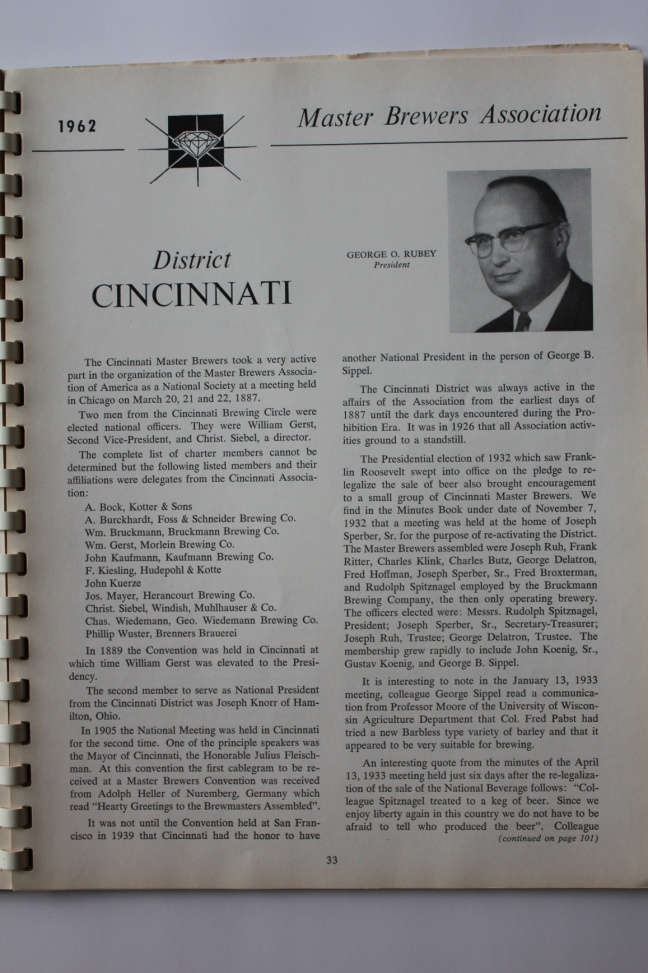 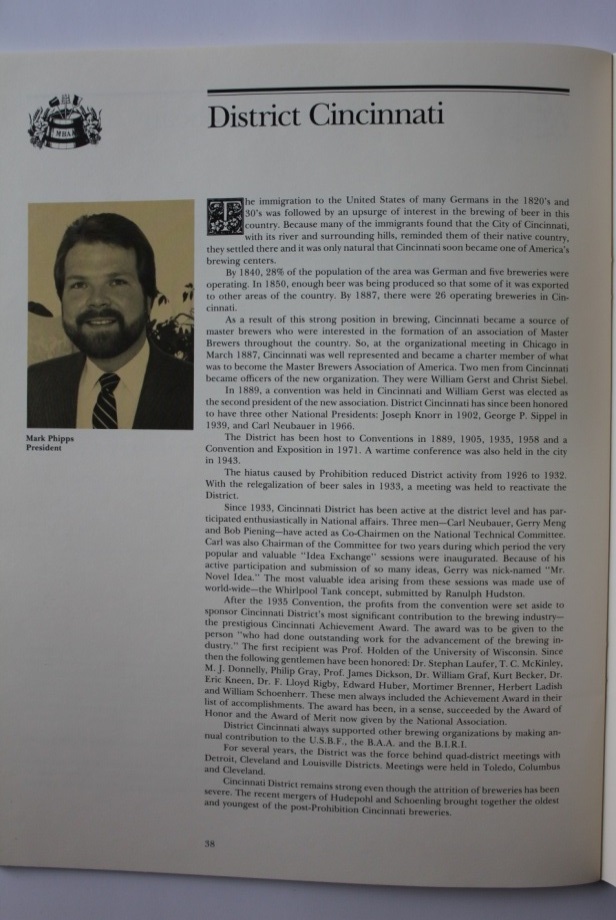 Combining the information from the two anniversary documents provides a beginning, baseline history for my home district. I will post both of these, combine them into a single history, and update that as best I can. My hope is that other local districts will be able to do the same. In an upcoming Communicator, I will list the district histories that we have available from these two treasured publications. Once again, a big THANK YOU to Ray Klimovitz for making this possible! Cheers! Recording History from Day OneOn Monday, October 20, 2014, your Board of Governors and committee chairs joined together for their annual WebEx meeting. We normally have two "get-togethers" per year, one of which is the MBAA Annual Conference. It is inspiring to see folks from around the world finding precious hours to donate and dovetail into their busy schedules. The agenda is always aggressive, yet well-thought-out and provided ahead of time for review. Occasionally, certain agenda items jump out to this heritage-minded soul in a special way. That happened to me when discussion turned to the ongoing formation of a brand new MBAA local district: District Northern Rockies. A new local district! Wow! The last time I felt this surge of excitement was when my home district officially changed its name from its 125-year old designation of “District Cincinnati” to “District Midwest.” This was a two-year endeavor, often involving spirited discussion as the name change was considered by some to be quite controversial. Changing a 125 year-old name is not something to be taken lightly. Ultimately, the vote fell in favor of the new name, which much better reflects who we represent and who we have become. Given that reflection, it occurs to me that soon-to-be anointed District Northern Rockies has the rare opportunity to start capturing its heritage, beginning from its day-one inception. Knowing how quickly days become weeks, weeks become months, then years and decades, and knowing how quickly involved MBAA members can disappear from the district scene, the details of many treasured moments can become forgotten and lost forever. It would take only one responsible individual to begin the process of overseeing the recording pertinent details of district events, maybe photographing district meetings, writing down the names of office holders, etc. This is the perfect time to consider establishing a District Heritage Chair. The role of District Heritage Chair would not have to be complicated. It might be chaired by someone who is just a bit historically minded. Perhaps they simply enjoy reading history. Or perhaps they enjoy genealogical research, already pursuing their own family roots and individual memories. When attending their district events, perhaps they are just a bit more aware of the importance of meeting minutes and photo archives. I have written about this before, but never from the perspective of appreciating the establishment of a brand new district. I know I speak for many in offering my heartfelt congratulations to the good folks dedicated to the success of District Northern Rockies! Your heritage… begins today! Resource Retirees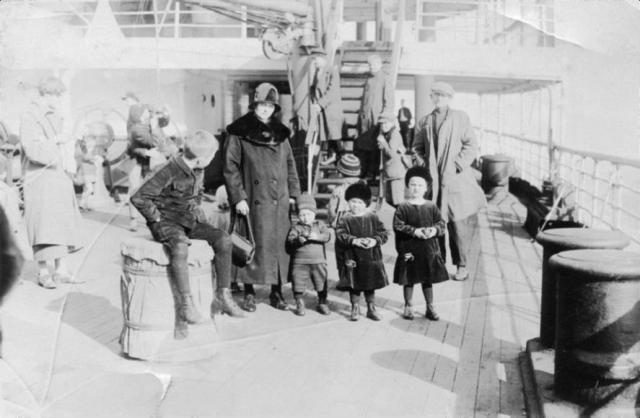
This photo was taken on the ship in transit from Germany to Ellis Island. My grandmother is in the center with my father next to her on the right. Continuing right are my two aunts. (I do not know who the young lad is, sitting, head turned, and looking at my grandmother.) My father and his family immigrated to the United States from the Baden-Württemberg area of Germany. The entire family took their very first footsteps in the United States at Ellis Island. Afterward, they made their new home with numerous other Germans in central Ohio. Little English was spoken in my grandparents’ Columbus, Ohio, household, but the German culture was showcased front and center. Abundant gardens, both edible and ornamental, were part of their daily routine, as was cooking in the very German tradition. Sunday card games while drinking locally produced lager was a “can't-wait” weekly event. My grandmother would use her milk can to get the lager. (I have that milk can to this very day.) She would wipe butter along the inside rim of the milk can. With the can in hand, she would send my two aunts off to the corner tavern to have it filled with draught beer for the upcoming Sunday card games. "Why would you wipe the milk can with butter, Grandma?" I remember asking her when she shared that story. "Die Butter gibt mir wenigen Schaum un mehr Bier...less foam...and more beer," she replied with a smile. I miss the opportunity to hear more stories like this one. By the time I was serious about hearing family stories and learning more about my genealogy, many family members were gone. In that spirit, I want to create every opportunity for others to hear treasured stories like this one. Those stories can only come from the folks who lived them or heard first-hand accounts. In MBAA, more often than not, those folks are the association’s retirees. Our retirees are a valuable but underutilized resource for helping provide answers to the growing number of heritage inquiries that we receive from scholars, writers, researchers, and genealogists. I am working with MBAA Headquarters to establish “Resource Retirees.” Our Resource Retirees will consist of a retiree email list of those who are willing to receive occasional communications containing inquiries on heritage. If a Resource Retiree happens to know something about an inquiry—if they can help shed a bit of light or perhaps provide a lead—we will have been successful. This month, I will be sending an email to all listed MBAA retirees, asking them for permission to be included as an MBAA Resource Retiree. My hope is that through their willingness to participate, we can further offer researchers the benefit of our 127 years of excellence in the brewing industry. Feel free to let me know your thoughts. Wishing everyone a safe, healthy, joyous, and prosperous New Year! Searching for the First TQAs Heritage Chair, one of my main responsibilities is overseeing the content of our archives housed at Iowa State University. I am on a perpetual quest to find appropriate items that might be ripe for inclusion. Yet I must always be mindful to meet Iowa State's Special Collections Mission, part of which is “...creating access to, providing reference assistance for, and promoting the use of...” their Special Collections rare and unique materials. While recently perusing some of our last “print-edition” issues of Technical Quarterly (TQ), I came across the “Technical Director’s Notes” written by past MBAA Technical Director Ray Klimovitz. In Volume 45, No. 2 (2008), Ray wrote a thoughtful piece about the very first print edition of the TQ. That very first edition was printed the winter of 1964, the year before Ray became an MBAA member. Upon reading Ray's piece, I was struck by the not-so-obvious reasons for the creation of the TQ in the first place. In that very first TQ issue, Volume 1, No. 1, our 1964 MBAA President, Ruben Schneider commented: "This, the first issue of the MBAA Technical Quarterly represents the continuing progress of the brewing industry in technical advancement ... There has been a need for a more sophisticated manner with which we could record and communicate the technical activities of our Association. This has been expressed by practically all of the past National Technical committee chairmen … The Technical Quarterly will specifically cover full length articles on scientific, technical and production problems related to brewing. The issues are to be published in January, April, July, and October. This is a great step forward, and an undertaking requiring the full cooperation of all Districts and all members." “Continuing progress... communicate technical activities… articles on scientific, technical, production problems related to brewing...” Schneider's description of the reasons behind the creation of the TQ, couldn't be a more fitting description of the primary reason behind the creation of MBAA itself; as the brewing industry's resource for technical information. Ray’s piece also included a guest editorial that was included in TQ Volume 1, No. 3., written by Jim Fitzsimmons, the advisory co-chair of the 1964 MBAA Technical Committee. Fitzsimmons shares his concerns about our industry's image and the potential for the TQ to improve it: "In defining the need for a Positive Posture at the U.S.B.A. Convention in Miami this year (1964), Henry King asked the following questions of those in attendance: ‘Why is the industry repeatedly on the defensive? Why is it that we are in the role of firemen?’ I believe the same questions should be asked of the Master Brewers (MBAA). Because of its very nature, our Association is susceptible to attack by some groups outside and, unfortunately, within our Industry. Impregnable defensive measures must be utilized to correct obvious misconceptions. One ameliorant might well be a Positive Technological Posture." The TQ as an outward manifestation of a “positive posture”... as “one ameliorant for a positive technical posture”... all interesting heritage aspects! Now, armed with the bliss of 52 years of look-back, we can see that there were a couple of different underlying motivations behind our TQ’s creation. And that gets me back to my original point, that I am always in a perpetual quest to find appropriate items that might be ripe for inclusion in our archives in Iowa State’s Special Collection of rare and unique materials. Does anyone in our membership have that first TQ issue that they would be willing to donate? Or better yet, does anyone have the entirety of Volume One consisting of the first four TQ issues for donation? I think these volumes would be very appropriate, even necessary for archiving, and thus preserving for future generations of researchers. Even though the TQ peer-reviewed papers and MBAA papers are all available online at our website—a tremendous membership benefit—each TQ also offers lots of other industry, district, and association information that could prove quite valuable to researchers. Maybe we don't stop with just Volume 1, maybe we should consider archiving ALL of our TQs! Thanks to Ray Klimovitz for penning a thoughtful piece eight years ago in our TQ Volume 45, No. 2, prompting me to all this “possibility thinking” in the first place! Let me know your thoughts. Seeking More HistoryIn a previous piece, I shared the story of how my wife and I made the 10-hour trip from our home in Columbus, Ohio, to Iowa State University, where the MBAA archives are housed. It was a wonderful experience to see what was there. However, I was horrified to see what was...not there. In Iowa State’s descriptive summary of our archives, they mention that our first 60 years are only “sparsely documented.” I have been told by some of our more senior members that this is due to a combination of flood, fire, theft, and even malicious behavior. My mission to Iowa State included finding and scanning two very important publications that I believe are critical to MBAA’s heritage. One publication celebrates our 75th anniversary year in 1962. The other celebrates our 100th anniversary year in 1987. They both include brief, yet wonderful histories of each of our MBAA local districts. For my home district, District Cincinnati, that means a 1962 piece written by then district president George Rubey. It also means a second, updated 1987 piece written by then district president Mark Phipps. Together, they provide a historical foundation, upon which, to continue to build. I have heard many of our members refer to both elusive volumes as “special editions.” Some point to our own Technical Quarterly. Others point to the Brewer’s Digest and Modern Brewery Age. Yet, no one seems to remember exactly who published them. Sadly, neither volume was included in our Iowa State archives. But I know...I KNOW that some of our more senior members have these volumes stashed away in some box in the basement or stored with other treasures in the attic. My primary goal as the heritage chair is to locate both volumes and scan them. Then I hope to combine the historical information contained within each by writing a “base” history for that district. This would provide a historical foundation, upon which, to continue to build. Please!!! Give this a bit of thought. If you have these volumes, contact me. I will scan them for MBAA and I will ensure that they find their way to Iowa State. And I will begin the daunting task of writing and combining the material from both volumes into a readable, useable history for each of our districts! In a Spirit of Hands-On Heritage....Cheers! Special Edition Publications Found!In the October 2013 issue of our Communicator, I asked our entire membership for help in locating two very important MBAA publications. Both are “special edition” publications quite critical for establishing a baseline history of each of our local districts. One celebrates MBAA's 75th anniversary, and the other celebrates our 100th anniversary. Both publications include short, summary histories of many of our local districts. You might recall that my wife and I made the 10-hour journey from our home in Columbus, Ohio, to Iowa State University, which houses our MBAA archives and historical documents. I was hoping to view the content of each of these elusive gems. After an exhaustive effort, and much to my horror, I found neither publication included. Hence, my frantic plea for help! I am thrilled to report that longtime MBAA member and Past President Ray Klimovitz (1997–1998) responded to my request and promptly sent me BOTH publications. I have them, on loan, from his personal collection. I now know that the 1962 document was a special edition of our Communications (which evolved into The MBAA Communicator), and the 1987 document was a specially published centennial booklet. The front cover of each of these treasures is shown below. Now home from the MBAA Annual Conference in Austin, Texas, I will begin the combined process of scanning and photographing both documents. They will be preserved. I will also reach out to Iowa State University and solicit their advice on how to include both publications in our historical archives. And finally, I can begin the process of combining each available 1962 and 1987 district history into a single, viable whole. This begins the daunting task of attempting to provide a baseline history from which each district can begin, and continue, to build. Cheers! The American Brewing History InitiativeAt the Craft Brewers Conference and BrewExpo in Philadelphia this past May, the Smithsonian Institution's National Museum of American History announced the launch of the American Brewing History Initiative. This will be a three-year effort to “collect, document, and preserve the history of brewing, brewers, and beer industry—with the goal to explore how beer and beer history connect to larger themes in American history.” This program will dovetail with and be part of the Smithsonian's Food History Project. It is made possible through a donation from the Brewers Association and will focus primarily upon the craft beer experience of the past 30 years. The National Museum of American History website explains the initiative: “Brewing has a long and deep connection to our country’s history, and the museum’s collections explore the history of beer from the late 19th to early 20th centuries,” said John Gray, the director of the museum. The support of the Brewers Association allows our staff to collect the more recent history, including the impact of small and independent craft brewers who continue to advance the U.S. beer culture and inspire brewers worldwide. Museum staff...will work with the Brewers Association, American brewers, and beer historians to document and collect the stories and history of modern American brewing. The American Brewing History Initiative is truly a home run for heritage! Having the Smithsonian and the Brewers Association join forces to promote our industry's heritage underscores its importance. It gives our product tremendous credibility. Those of us in the brewing industry have always known this. Your Heritage Chair has been writing about the importance of heritage awareness in the Communicator for over 4 1/2 years now. In these pages we have featured numerous examples of “hands-on heritage.” We have lobbied for Heritage Chairs at the district level. We have profiled MBAA member brewers who take their heritage very seriously. We have provided how-to advice for preservation and archiving. We have showcased the value of going digital. We have featured our MBAA archives at Iowa State. But now, America's brewing heritage truly goes mainstream. The National Museum of American History will take it directly to the nation through its world-class exhibitions, ongoing research, digital collecting efforts, online offerings, and public programs. Whenever I visit the local tap room of one of our many fine Ohio craft breweries, I can't help but smile at the historic irony of the craft beer movement and how it has come full circle. The history of the evolution of craft beer-making 30 years ago, in the 1980s, is a reflection of craft beer-making 400 years ago. In the 1980s, most of those first commercial craft brewers started out as home brewers. They brewed small batches in readily available household items that they owned... buckets, pails, and carboys. They brewed primarily for home consumption and to share with their friends. Similarly, in the Massachusetts and Virginia Colonies, beer-making was often just another household chore. Much of the brewing was done by housewives. They brewed at the fireplace hearth, in readily available household items that they owned... wooden buckets and cast iron kettles. They brewed, primarily, for home consumption. And similarly, many of those “home brewers” ultimately turned “drink into business.” The National Museum of American History's website further explains: “The craft brewing revolution in America has had a profound social, cultural, and economic impact on this country,” said Bob Pease, president and CEO of the Brewers Association. “America is a beer destination. We are honored to support this effort and work with the National Museum of American History to chronicle and showcase the significant achievements small and independent brewers have made throughout this nation's history.” Clearly, historians, researchers, scholars, and the general public all stand to benefit from these efforts. But perhaps most importantly, this unique partnership and its mainstream efforts serve to drive home the importance of preserving and archiving the histories of each of America’s almost 4,300 breweries! Brewing heritage awareness just got better! The Anheuser-Busch Corporate Library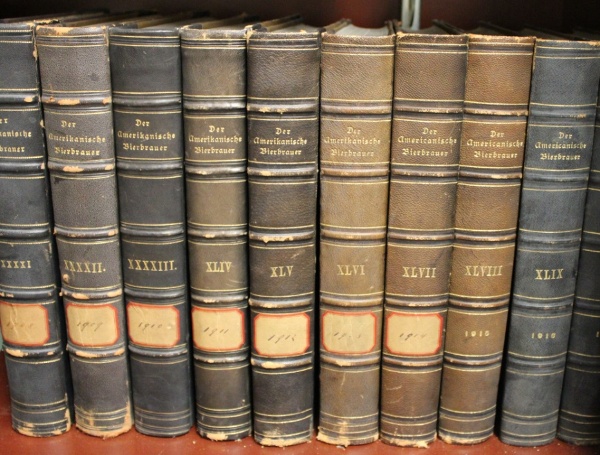 
Bound collection of Der Amerikanische Bierbauer As an MBAA heritage-minded individual, can you even imagine discovering a primary resource that would provide reporter-like “I was there” details of our very first National Convention that was held in Chicago in 1887? Can you image finding the roll call detailing the delegates and their guests? Quotes from speakers? Lunch menu items? Can you imagine finding the same information for MBAA's first BOG meeting that took place in October 1887 in Cincinnati? All these heritage gems, and much, much more, are exactly what I found when I recently paid a visit to the Anheuser-Busch Corporate Library in St. Louis, Missouri. Fellow Heritage Committee member Bill Weisenburger and I made the trip for the sole purpose of acquiring a general understanding of what the iconic brewery had housed in its historical archive collection over its 164-year history. We were certainly not disappointed. What we found there was nothing short of humbling and awe-inspiring. We were welcomed and assisted by Erica Flanagan, archivist at Anheuser-Busch. She provided us with an overview tour of their treasures. While everything is housed under glass, lock, and key, heritage-minded Erica provided us access to anything we wanted to see up close and personal. Her enthusiasm for her work was contagious. 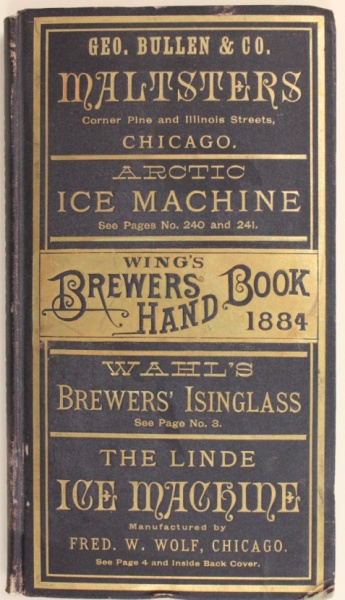
Wing's Brewers Handbook 1884 My eyes must have popped from their sockets when I gazed upon collections of:
Perched upon those shelves were dozens of other individual treasures, such as:
Many of these priceless volumes I had only seen as part of online digital collections such as those at OCLC or the Hathi Trust Digital Library. Now, here they were, sitting right in front of me, exuding the very splendor of their timeless antiquity. 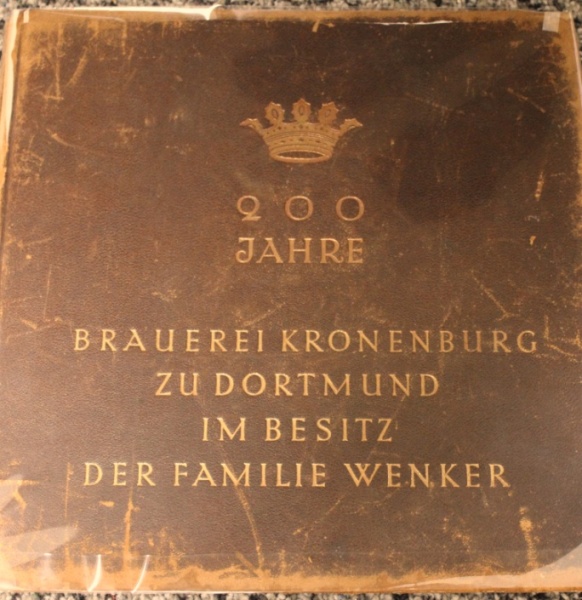
Kronenburg Brewery's 200 Year Celebration 1729-1929 Bill and I were able to spend two days studying these treasures for the priceless information they contained. Many of the journals were in German, and Bill was able to translate these on the spot. We carefully digitized several pages that were pertinent to MBAA history specifically, such as the details of our first MBAA Convention and first BOG meeting. These might be appropriate for inclusion within our own MBAA archives at Iowa State University. Also of interest were bound copies of the AB Ink, the company's monthly newsletter that was available to its employees. Issues of the AB Ink were filled with information about the company, its beer brands, industry news, and various government and political reporting. AB Ink issues published during the world wars reported extensively on AB employees who had either enlisted or had been drafted into the U.S. Armed Forces. Those issues included photos of those employees, the progress of their training, their deployment, and even those who had been captured and listed as POWs. The March 1941 AB Ink reported on a two-car moveable first-aid post that Anheuser-Busch had generously donated to Great Britain, even before American involvement in the war. This hospital on wheels will “...take care of civilians injured at the scenes of bombings. It will carry physicians, nurses, and emergency surgical equipment,” the AB Ink reported. 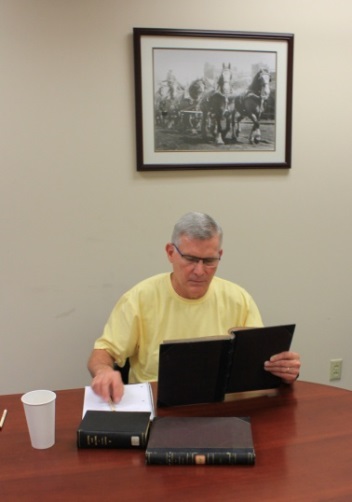
Your Heritage Chair, totally immersed at the AB Archives The AB archives are a historical gem of a collection. As MBAA Heritage Chair, I am truly grateful for the opportunity to visit the AB Corporate Library. I appreciate and am inspired that the company continues to preserve their amazing treasures. I am also extremely grateful to Erica Flanagan, who so graciously offered her vast experience as a museum curator and archivist, answering any questions that we had. The collection is in good hands! The Historical Practical BrewerIn our May Communicator, we talked about one of the major dedications running through MBAA from its inception 125 years ago: an unwavering commitment to education. In 1888, a recommendation was adopted regarding the training of apprentices. The Brewer’s Digest’s 1987 Salute to MBAA—100 Years states, "After finishing his term satisfactorily, the apprentice was to be given a ‘brewers’ book’ which was to equal a diploma." Fifty-six years later, in 1944, a “brewer’s book” was deemed necessary by four MBAA master brewers. Edward H. Vogel, Jr., Griesedieck Bros. Brewery; Frank H. Schwaiger, Anheuser-Busch; Henry G. Leonhardt, assistant master brewer at Anheuser-Busch; and J. Adolph Merten, vice president and general manager of the Columbia Brewing Co., jointly lamented the lack of hands-on, practical information for those employed in the brewing industry. They approached the president of MBAA and volunteered to write such a practical manual…if…MBAA would publish it. Two years of preparation, aided by a 21-member MBAA Editorial Board led to the completion of the first edition of The Practical Brewer. The new book was formally presented to MBAA President B. A. Poelhuis at a St. Louis MBAA business dinner meeting on December 7, 1946. From the Preface to the 1946 edition: "The purpose of this book is to outline in a simple and readable manner the essentials of practical brewing. […]We have prepared this practical treatise from the best sources available for the express purpose of […] the training of competent employees." In a nontechnical, question-and-answer format, Chapter I, question 1 begins: "What is water?" Fourteen chapters, roughly 230 pages, and 360 questions-and-answers later, the book ends with a presentation of “The Brewer’s Code of Practice." That original 1946 edition has been out of print for many years and is a much sought after collector’s item. In 1977, a revised and updated 2nd edition was published. It enjoyed 11 subsequent reprintings. I still remember our resident brew master at Anheuser-Busch, Columbus, presenting me with a copy of the 1977 edition. A 3rd edition was again significantly updated and published in 1999. It included new chapters on pertinent, new topics, such as low calorie/low alcohol beers, environmental issues, brewing control systems, and craft brewing (written in part by MBAA Technical Director Karl Ockert, then of Bridgeport Brewing Co.). Members of our AB Columbus Start-Up Team received copies of that 1999 edition for completing our brewery’s modernization in 2000. We were thrilled to receive it as the volume contained an architect’s rendering of our new Columbus brewhouse control room. In 2003, it was suggested that an even newer adaptation of The Practical Brewer be written. The new rendition would be useful to all brewers, whether they worked at large brewing companies, smaller microbreweries, or even as home brewing hobbyists. The new work returned to the original question-and-answer format. Karl Ockert became its editor-in-chief. The result was our three-volume MBAA Practical Handbook for the Specialty Brewer. Its Forward reads, in part: “the MBAA Practical Handbook for the Specialty Brewer, … is ready to stand alongside The Practical Brewer as an exceptional resource of practical brewing fundamentals.” All three editions of The Practical Brewer and our three-volume MBAA Practical Handbook for the Specialty Brewer continue to showcase MBAA’s 125-year commitment to training excellence. The Huebner-Toledo Brewing Archives—The REST of the StoryRemember Paul Harvey? Along with many other Americans, we heard his familiar “The REST...of the Story” for what seemed like forever. As the Heritage Committee chair, I have the distinct pleasure of standing relatively close to Mr. Harvey. I have the opportunity to offer MBAA’s very own heritage follow-up. Quite literally, in the spirit of a tip-of-the-hat to Mr. Harvey, from time to time, we can offer our very own version of “The REST...of the Story.” In the December 2012 issue of The MBAA Communicator, I shared my journey to Toledo, Ohio, to research that city’s Huebner-Toledo Brewery. You might recall that the Huebner-Toledo Brewery was a post-Civil War era brewery that was forced to close its doors with the onset of Prohibition. It never reopened. While researching aspects of the brewery in the archives of the Alice Huebner manuscript collection at the University of Toledo, we discovered a pre-Prohibition pilsner-style recipe. Although quite tattered, and barely legible, fellow Heritage Committee member Bill Weisenburger and I spent considerable time deciphering the various components of the recipe; its grist bill, various rests, fermenter profiles, etc. The result of our endeavor was that we were able to enjoy one of the ultimate aspects of hands-on heritage. WE ACTUALLY BREWED THE RECIPE! The recipe had to be retrofitted from the “ingredients per bbl” to “ingredients per gallon” to accommodate my 5-gallon (semiretirement) home brewing system. We had a target of 13°Plato (P), having to back calculate our grist mix of malt and grits, which are true “legacy” ingredients and were very common with Midwest brewers in 1919. We filled in what few aspects we did not know with those that were considered traditional in that period, as well. I know this might be construed as hand-on heritage for the brewing geek, but for those interested, our final recipe included the following procedural highlights:  
A GREAT TIME was had by all. And, as shown by the accompanying photos, I think that Johann would be proud. But... One Big Mystery Remains: the recipe refers to the act of running boiling water through the “pfaff” before a grist addition. We have no idea what this is. The “pfaff” is actually referred to twice in the recipe, but as of this writing, we are unable to find any explanation of it. We have found references to Pfaff sewing machines, but we have found no other explanation relating to the brewing process. We do have alerts out to our friends in Germany, and we are still awaiting a possible reply. Maybe one of you are able to shed some light on what this “pfaff” is. This particular story really does get just a little bit better. This past January, I had an old friend call me out of the blue, an old teaching colleague who I have not seen in decades. He wanted to meet for lunch. We met. We reconnected. We exchanged the obligatory “how has life been...what have you been up to..,” etc. After lunch and some discussion, I shared with him my Huebner-Toledo Brewery experience. “Heeb-ner,” he said. “Johann’s last name is actually pronounced Heeb-ner, with a long e.” I had been pronouncing it Huub-ner, with a long u. I was a bit surprised, but my old friend sounded so certain. “Heeb-ner? Really? How do you know that?” I asked. “It’s my family,” he explained proudly. “I come from the Toledo Brewing Huebners. I have been studying our genealogy for years. I can tell you anything you want to know.” POW! Here we go again. History and Heritage finding its way right back to me. I spent a lot more time than I originally anticipated with my old teaching colleague. And more importantly, I came away from this particular experience with the fun of yet again experiencing hands-on heritage. So, there it is. In the familiar Paul Harvey version of “The REST...of the Story.” The Life of Louis Pasteur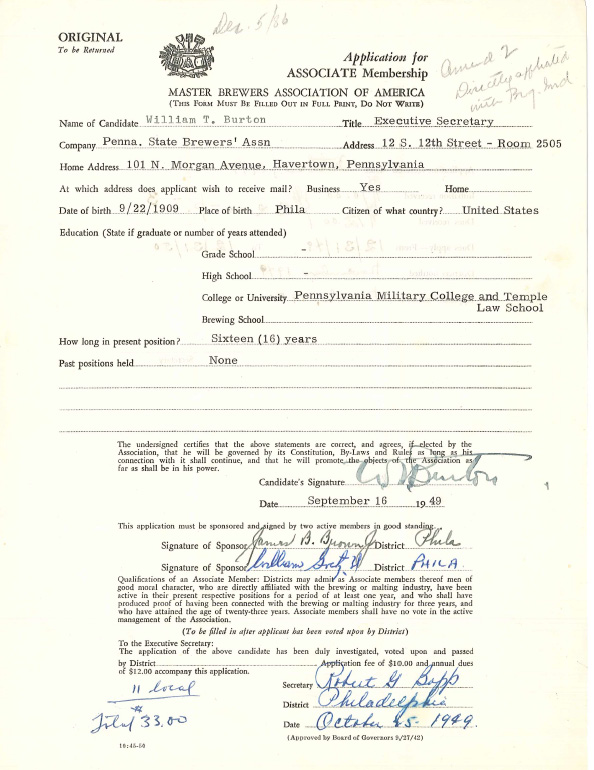 Last month I was able to share with you some interesting aspects of closure. In a tip of the hat to Paul Harvey, our very own “REST...of our story” detailed the finding of the historic Huebner-Toledo Pre-Prohibition pils recipe and our careful recreation. This month, hands-on heritage has rocked my world, once again. You might recall that I wrote in the February 2013 MBAA Communicator about an e-mail contact from Floridian Jennifer Valdivia. She was cleaning while preparing to move and rediscovered a book that she had purchased at a flea market many years ago. The book was about the life of Louis Pasteur written by René Vallery-Radot, a French writer and the son-in-law of Pasteur. It was published by Garden City Publishing Co., complete with an MBAA cover, emblem, and title page, specifically for the 33rd MBAA Annual Convention. That convention was hosted by District Philadelphia in 1936 and dedicated to Pasteur. Jennifer saw the historic value in the book. She contacted MBAA, carefully bubble-wrapped it, and sent it to me “priority mail” just a few days later. In that original MBAA Communicator piece, I included several photographs of the volume, including a photo of a penned signature in the front of the book, presumably indicating its owner; W. Burton of the Pennsylvania State Brewers Association. I included that photo (seen again below) thinking that maybe someone in District Philadelphia would be able to shed a bit more light on Mr. Burton. Shortly before the piece appeared in The MBAA Communicator, I got an e-mail from our own MBAA Member Relations Specialist Cheryl Kruchten: “I have had the opportunity to read your piece for next week’s Communicator in advance,” Cheryl wrote, “and found the attached membership application for William T. Burton in our files. I too hate to throw anything that might be ‘historic’ out.”  Here we go again! Our very own Cheryl, with an ever-alert eye, quickly connected these hands-on heritage dots, recognizing the same calligraphy-like Burton signature on a 1949 MBAA associate membership application, written fully 19 years after that 1936 convention. Based upon the 1949 application, we now know that this is William T. Burton, the executive secretary of the Pennsylvania State Brewers Association. At the time of this application, he had been in that position for 16 years. Mr. Burton was born in Philadelphia on September 22, 1909, and attended college at Pennsylvania Military College and Temple University Law School. He lived in Havertown, PA, and was applying for a renewal of his associate membership in MBAA. Here is yet another heritage gift, the result of the concerns and efforts of different people, from different parts of the country, in different stages of life who simply care. Their combined synergies collected separate pieces of a heritage puzzle, arranging them into a more recognizable whole. In this case, a book purchased years ago at a flea market in Florida, led someone to archived records in Minnesota, to shed light on an MBAA member who was active more than three quarters of a century ago...in Philadelphia. Hands-On Heritage at its very best! That...is how it happens. Thanks again to Jennifer and Cheryl. The Life of William Gerst Sr.Last month I shared how Master Brewers was contacted by Scott Mertie, a Nashville-based brewer, brewing historian, memorabilia collector, and author. After seeing an image of a brewing diploma on our website, Scott shared a digital image of another, identical Master Brewer's Diploma: that of William Gerst Jr., who received his diploma in 1904. Scott's sharing of Gerst Junior's diploma was exciting in its own right. But it was particularly exciting as Gerst Junior was the son of William Gerst Sr., who played a major role in the creation of the Master Brewers. In fact, he was one of the original officers elected at the very first convention in March 1887. As I indicated last month, this story just gets better. I was again contacted by Scott. He generously shared with me yet another heritage gem... this one of absolutely unbelievable proportions. Scott sent me a digital image of William Gerst Sr.'s Master Brewer's Diploma! 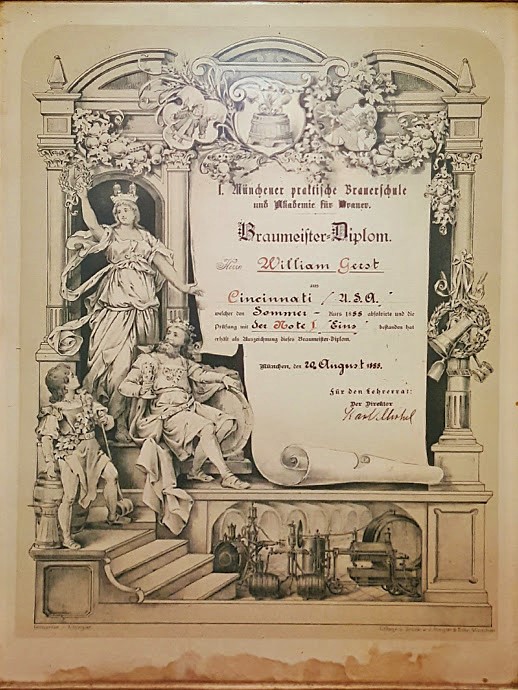 Scott also provided a translation of the diploma, complete with some explanatory notes. It reads: Munich Practical Brewing School and Academy for Brewers Notes:
Gerst received this diploma on August 20, 1888. At that time, he worked at the Christian Moerlein Brewery in Cincinnati. When the Chicago Brewers Association hosted the organizing effort that became the Master Brewers’ first convention, they welcomed brewing representatives from around the country. William Gerst Sr. represented the brewing association from Cincinnati, Ohio. That group evolved into District Cincinnati (1887–2014) and ultimately District Midwest (2014), my home district!  Gerst was instrumental in offering his input into the new national organization. He took part in discussions, shared his concerns, and debated the appropriate issues. His presence was impactful enough that he was elected as one of Master Brewers’ original national officers, which included President L. Frisch (Chicago), 1st Vice President H. Guenther (New York), and himself as 2nd Vice President. Gerst was voted as the second president of the Master Brewers Association of the Americas, a position he served from 1889–1891. According to Scott's Mertie's book, Nashville Brewing, one of the “Images of America” volumes, Gerst moved to Nashville in 1890 and purchased the Nashville Brewing Company along with Christian Moerlein. The brewery's name was changed to the Moerlein–Gerst Brewing Company. Finally, in March 1893, Gerst purchased the controlling interest of the brewery from Moerlein and renamed it the William Gerst Brewing Company. He built his brewery into a Nashville icon and established himself as a prominent local businessman. In the 27 years he was at the helm of his brewery, Gerst was a creative master at producing and distributing a vast array of clever, creative, and outright beautiful marketing materials, all of which helped to ensure that “William Gerst Brewing” remained a household name in Nashville. Some of these marketing items included:
Scott Mertie’s book contains dozens of images of Gerst marketing artifacts. It also provides expanded descriptions and fascinating background stories of Gerst’s advertising items, many from Scott’s private collection. Gerst’s other passion was horse racing. According to Nashville Brewing, Gerst maintained horse stables in south Nashville and raced several horses in the Kentucky Derby. In 1910, a Gerst horse named “Donau” actually won the Kentucky Derby. William Gerst Sr. retired from his brewing business with the onset of U.S. Prohibition. He returned to Cincinnati where he lived until his death in March of 1933, the very year Prohibition was repealed. The brewery was run by his sons until it ultimately ceased operations in February 1954. We at Master Brewers are especially grateful for Scott Mertie. His alert eye and his heritage mindset both led to his generous sharing of the William Gerst Sr. story. Scott's timing was perfect. Between the time that you read this March, 2017 issue of the Communicator and the upcoming April 2017 issue, Master Brewers will celebrate its 130 anniversary! Sharing William Gerst Sr.’s story, and his contributions to the development of Master Brewers, is a noble tribute! The Master Brewers LogoAn organization's insignia—its logo—is the visual, outward manifestation of its very essence. It is the daily reminder to the people you serve, to those folks you most connect with, of just who you are and what you are all about. It nurtures an instant parade of expectations. No small effort goes into the creation of any logo. Our logo is a 130-year-old heritage heirloom that has evolved in much the same manner as our organization has evolved. The elements central to our logo date back hundreds, if not thousands, of years. It proudly displays the primitive tools of an ancient brewing craft. Central to it is a wooden mash tub, tightly coopered with detailed wooden staves and metal hoops. Rising straight up from the mash tub's center is the timeless “brewer's paddle.” (The venerable volume, 100 Years Of Brewing, published in 1903 refers to it as a “mashing oar.”) The paddle is accompanied on either side by a thick mash ladle, and a hot wort dipper, all laced with turning and twisting wreath-like barley and hop images These basic, primitive brewing tools and utensils celebrate the excitement of the beginning a brew and initiating the mashing process. And in a more general sense, they serve to showcase our marvelous high-tech industry’s very humble beginnings! 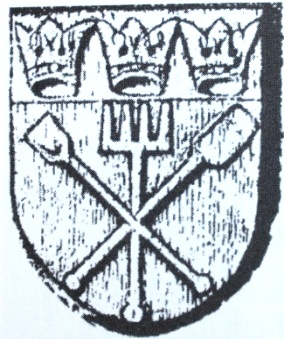 The Master Brewers logo shares its core look with numerous brewing logos around the world. For centuries, brewing guilds and organizations have used similar versions, most displaying brewing tools and barley/hop wreaths. That general look lent credibility to the quest of the brewing craft. To this very day, the Belgians still celebrate the “Knighthood of the Brewer's Paddle.” (Yep...KNIGHTHOOD! Move over Sir Lancelot! The Brewer's Paddle does NOT play second fiddle to Excalibur!) Consider the 13th century crest of The Brewer's Guild of Cologne, pictured right. I first saw this image in the book Prost! The Story Of German Beer by Horst Dornbusch. I was humbled by our common “logo heritage.”  Back in the 1970s, Anheuser-Busch, my employer of 38 years, decided to inspire their brewers by initiating the “Reach For Excellence” program. They gifted us the belt buckle pictured left. Does anything look familiar? The buckle was to inspire us to live up to the task of brewing our beers in the tradition of the centuries of brewing excellence before us. Each day as I slid into my Carharts and pulled on my brewing boots, that belt buckle beckoned me to pay attention to detail and to do all the right things. Even then, some 40 years ago, I was impressed that AB chose the images of primitive brewing tools over their many iconic symbols such as the Clydesdales, to inspire us. As you can see on the buckle itself, even the famous A & Eagle plays a small role in the intended message of excellence. As I said, our Master Brewers logo has changed over time, but has always retained those ancient core elements. Below is an image of our Constitution & By-Laws printed from the New York Convention in 1934. Our logo, enlarged on the far right, displays the mash tub, paddles, and dippers all enclosed within a structured crest. Instead of a barley/hops wreath, it appears to display two “bock-style goats,” so characteristic of German bock beer labels.   Over time, the Master Brewers logo assumed several different renditions, but always maintained the core look that included the primitive brewing tools:    The printed program for the 1937 MBAA Convention put a bit of a different twist on our logo. The program featured a kind of “embossed” logo that included the traditional core elements. But to the front of the mash tub, a crest was added with an “MBAA” symbol, tightly and creatively arranged within it. This particular logo endured through the late 1930s and 1940s, at least until 1955. Examples are illustrated as follows. 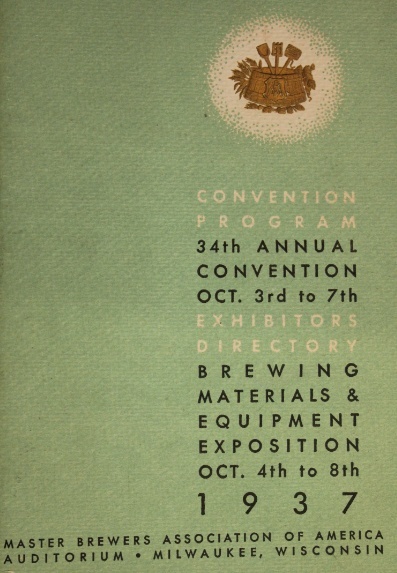    The printed Constitution and ByLaws from the 75th Anniversary Diamond Jubilee Convention in 1962 shows a logo without the “MBAA crest” on the mash tub:   The printed program of our 100th Anniversary gave us our most recognizable logo. In fine detail, it superbly illustrates the wood of the mash tub and brewing utensils. Even the malt shafts and hop leaves display crisp details and a multitude of color. “MBAA” is “carved” onto the front of the mash tub. It became the "base logo" for associated events and designations such as our 125th anniversary and the Beer Steward Program. These are pictured below. 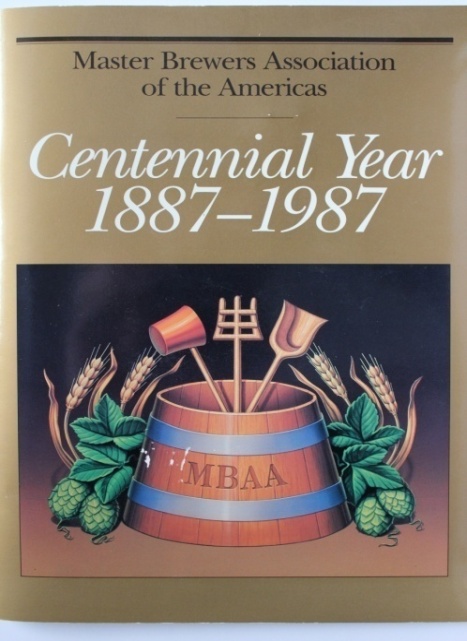    Enter 2016 and another major re-working. The colors are much more simple, in a three or four color format. The primitive utensils continue to prevail, although more subtle. A crest aspect has returned. The words "Master Brewers" are obviously the marquee message. But what strikes your Heritage Chair the most is that in our new logo that we have embraced our historical bragging rights. We are finally celebrating what sets us apart from many of the world's brewing organizations... the fact that our heritage goes back to 1887! As we embrace the 2016 rendition of our logo, appreciate it as the heirloom that it is. Its core look has endured and has been shared around the world by numerous brewing organizations for centuries. I will be taking a month off from our Communicator in October. A return trip to Deutschland, to include Munich for Oktoberfest will require all of my conscious thought! Traditions Live OnIn March of 1887, a group of forward-thinking master brewers first convened in Chicago to form what would become the Master Brewers Association of the Americas (MBAA). Those master brewers convened again the following year, this time in New York City. Thus, the history, heritage, and tradition of our annual MBAA convention were born. A third convention was held in my home district city of Cincinnati. A fourth was held in Philadelphia, a fifth in St. Louis…and on it went, year after year, as those master brewers continued to convene, wisely rotating among America’s great brewing cities. MBAA’s annual conventions served primarily as forums to discuss and deal with the pressures of politics and the influences of history. The national economy, two world wars, grain restrictions, recessions, the Depression, presidential assassinations, “local option” laws, outright national Prohibition, labor issues, and the ever-present “lesser concerns” were all topics of discussion. And yet, year after year, those master brewers continued to convene. Now, fast forward to the present day. I just returned home from the World Brewing Congress (WBC), held at the Oregon Convention Center in Portland, Oregon. I was quite the “newbie,” but so very thrilled to be there 125 “convening” years later. The Portland Hilton was full…totally sold out; quite the omen of success! The Saturday before the WBC, we presented our Beer Steward Certification Program to a vibrant, engaged group of 42 attendees, each of whom was quite serious about their beer education. I was thrilled to be part of one of the “kick-off” events. I also attended the annual Board of Governors (BOG) meeting in Portland. I took my assigned seat in Room C123, where we all sat somewhat “Camelot” style, facing one another in a big rectangle-ish arrangement. As I settled in and watched other BOG members file in and make their way to their seats, I couldn’t help but feel the decades of dedication, the ongoing spirit, the sheer passion exuded by those hundreds of brewers who sat here before me. Some of those original names hovered over me: Frish, Guenther, Gerst…I smiled remembering that the original constitution had actually stipulated that all meetings were to be held in German! It was not until 1901, as the 12th annual convention in Boston dealt once again with one of those “lesser concerns,” that it was decided that future meetings could be conducted in either German or English. Overwhelming gratification was expressed for our president, Mike Sutton, whose steady hand had guided MBAA throughout the entire year. The BOG then recognized Jerry Hilton with a Distinguished Life Service Award. Wow! How wonderful to witness Jerry’s award first hand. I am, after all, his replacement for the heritage chair. A name like Hilton, I thought, fit right up there with Frish, Guenther, and Gerst. I vaguely heard the roll call begin, after which, we shared a moment of silence for Members in Memoriam. Then we were guided right into the Reports of Officers, the Reports of Committees, Finances, Bylaws, the Strategic Plan, etc. And on it went, similar in fashion, adhering, I’m certain, to a century-and-a-quarter tradition. I was simultaneously humbled, yet “bucket-list” proud to play a very small part in the MBAA activities in Portland, Oregon. Our annual MBAA convention is yet another example of a 125-year-old tradition involving brewers past and brewers present, stemming straight from that original 1887 Chicago meeting. Treasured Reading In these pages over our twelve 125th-Anniversary months, I have shared some wonderful examples of “Hands-On-Heritage:"
Already I have learned that sometimes you travel from place to place, intensely focused on a mission to “uncover and discover”. Other times, those “discoveries” literally come to you, and in the most serendipitous ways. That is exactly what happened to me just two weeks ago when one very special individual recognized a potential slice of MBAA history and went way above and beyond the call of duty to preserve it.  On Monday, January 7, 2013, I received an e-mail from Dawn Vukson at MBAA Headquarters. Someone had e-mailed the contact form at MBAA and, as Dawn said, “...it looks like something the Heritage Chair might be interested in!” The contact e-mail was from Floridian Jennifer Valdivia. It read: “Hi, I was recently cleaning out my bookshelves when I found a book I bought at a flea market years ago. It is The Life of Pasteur by Radot that was given at the 33rd Annual convention of the Master Brewers Association of America in Philadelphia. It was signed by someone with (what looks like) the last name Burton of the Pennsylvania State Brewers Association. 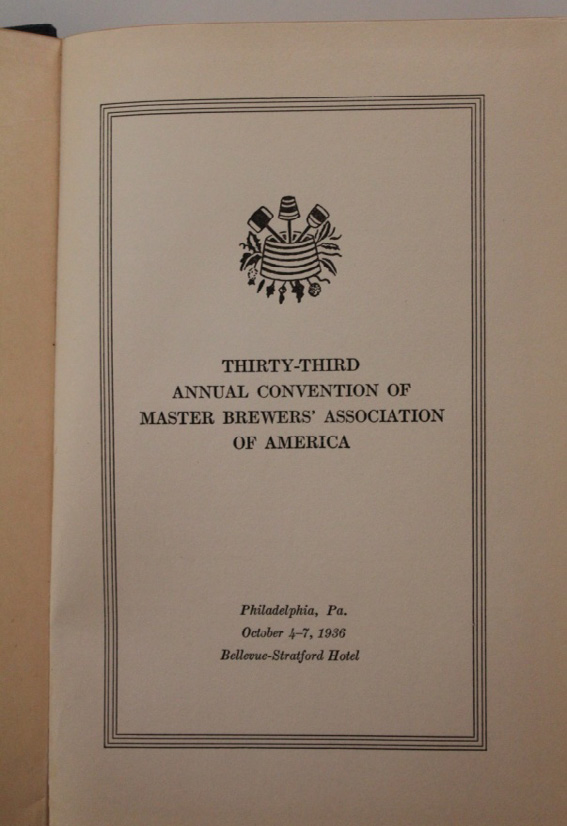 Would we like it!!?! Wow!! I responded to Jennifer that our organization would love the volume. She carefully bubble-wrapped the book and sent it to me priority mail just a few days later. As it turns out, MBAA’s 33rd Annual Convention was indeed hosted by District Philadelphia and held in that city October 4–7, 1936, at the Bellevue-Stratford Hotel. The convention was entirely dedicated to Louis Pasteur. The dedication was complete with a “...fitting ceremony developed commemorating Louis Pasteur.” On a humorous note, the MBAA president in 1936 was Herman Rosenbusch. Mr. Rosenbusch had a reputation of being a “stickler for proper procedure”. According to Phil Berkes, then president of District Philadelphia, Mr. Rosenbusch turned “thumbs down” the very idea of in-room entertainment, believing it to be improper. In response, District Philadelphia “inaugurated a plan” to have a separate entertainment center where all delegates could gather. 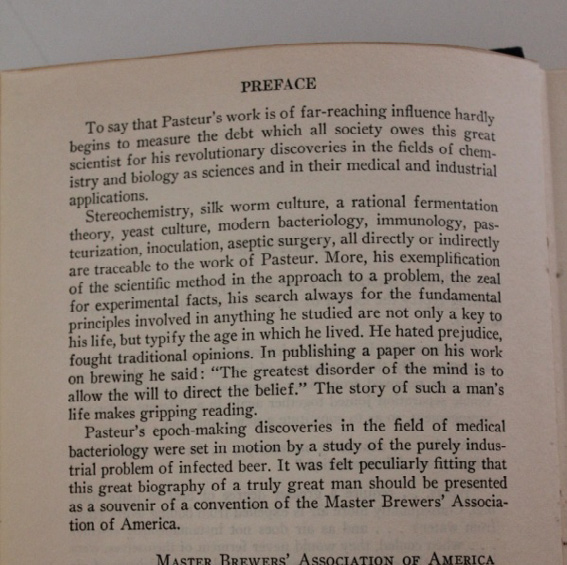 The volume that Jennifer sent to us is titled The Life of Pasteur. It was written by René Vallery-Radot, a French writer. I have since discovered that he was born in Paris on October 1, 1853, and died in Paris on January 24, 1933. René was also the son-in-law of Louis Pasteur, whose first biography he wrote. The volume was translated from the French by Mrs. R. L. Devonshire and was published by Garden City Publishing Co. specifically for that 33rd MBAA Annual Convention, complete with an MBAA cover, emblem, and title page. I have included a photograph of the signature that Jennifer alluded to, which, as she said, appears to be “W. Burton.” Maybe someone with District Philadelphia would be able to shed a bit more light. Jennifer has since written to me: “I bought this book when I was in the 3rd grade at a flea market in Orlando during a family vacation. For years I was interested in Pasteur, which is why I chose this book. There was a series of children’s books called “The Value of Learning”. One book in the series featured Pasteur’s discovery of the rabies vaccination. My parents read that book to me frequently and became the force that prompted me to read all I could about Pasteur. I am glad you and your organization can enjoy the book.” There it is, yet another example of someone who recognizes the value in preserving heritage, even when that heritage belongs to someone else. Maybe it is also time for MBAA to recognize, in some small way, forward-thinking folks like Jennifer, who take the time from their busy lives and make the gallant effort to preserve such items. For MBAA, our 125-year heritage is just a bit stronger because of Jennifer Valdivia. 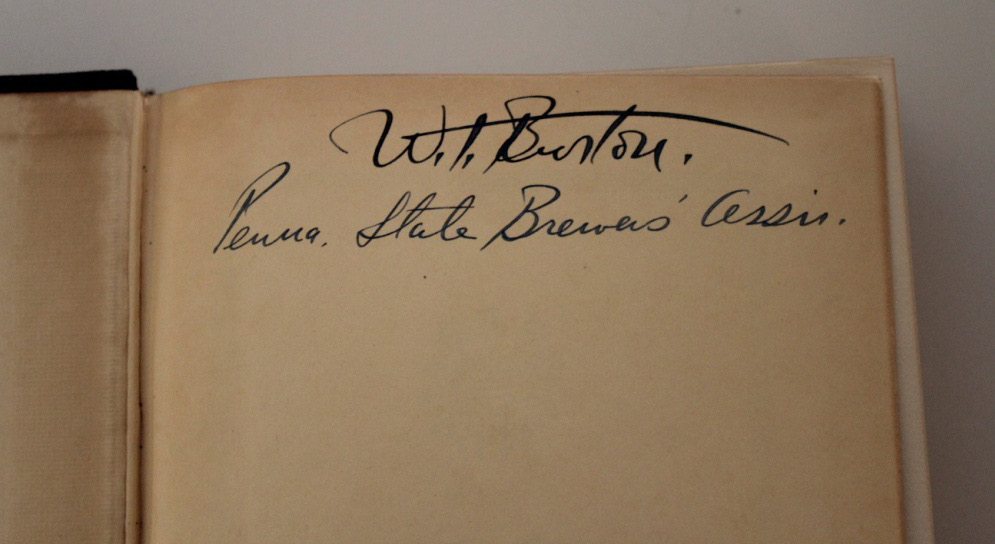 UNESCO and the Reinheitsgebot"Heritage is our legacy from the past, what we live with today, and what we pass on to future generations. Our cultural and natural heritage are both irreplaceable sources of life and inspiration." Wow. That is one of the most powerful quotes I have ever read depicting the sheer importance and enduring value of "heritage." It is a direct quote from the official website of UNESCO, a specialized agency of the United Nations. "UNESCO" stands for United Nations Education, Scientific, and Cultural Organization. It is known as the "intellectual" agency of the UN. It is dedicated to developing global education strategies for the 21st century, adhering to scientific objectives for a sustainable future, and fostering intercultural understanding through the protection of... heritage! According to its website, UNESCO is keenly aware that "heritage" constitutes a source of identity and cohesion for communities disrupted by "bewildering change." To this end, the UNESCO World Heritage Committee catalogues a "World Heritage List" of places and items that meet their identification and protection criteria. They quarterly publish World Heritage, the official UNESCO publication from the World Heritage Centre, featuring in-depth articles on cultural and natural World Heritage Sites. It is produced in English, French, and Spanish. They even provide a 138-page manual entitled: Preparing World Heritage Nominations for the purpose of assisting those who are interested in or actually involved in the process of nominating an important place or cultural aspect to be considered one of their heritage treasures. So...what does this have to do with beer? A whole lot, if you take into consideration the remarkable heritage of beer. And the German Brewers Association is doing just that. In 2013, they began the exhaustive process of studying and following the UNESCO guidelines to formally nominate the original text of the Reinheitsgebot to be considered a cultural treasure by UNESCO. They want the Reinheitsgebot included on UNESCO's World Heritage List. “Reinheitsgebot”, is, of course, commonly known as the “Bavarian Purity Law.” Written in 1516, it mandates that only water, barley, and hops can be used to brew German beer. Yeast was added to the list of ingredients when scientists discovered yeast's fermenting contributions centuries later. Reinheitsgebot has been synonymous with the pure, outstanding, high-quality German beer that the world has grown to love and expect. Thousands upon thousands of German and even American craft brewers see tremendous value by claiming to abide by its centuries-old mandates. It is popular with the general beer-drinking public. Translations of its original text are everywhere. And there are hundreds of images of it available...even sold on t-shirts!! To be included on UNESCO's World Heritage List, the nominee must be of “Outstanding Universal Value” by meeting one or more of ten selection criteria. After a bit of study, it appears to me that the Reinheitsgebot meets UNESCO's criteria #3, that the nominee must “bear a unique...exceptional testimony to a cultural tradition or to a civilization which is living or which has disappeared.” The attempt to make the Reinheitsgebot a UNESCO Cultural Treasure is not without its critics. Some contend that the law only ensured that crops necessary to make bread could not be used on brewing beer. Others claim that the purity law lingers from a long-bygone era and that Germany would be free to create a wider variety of more diverse beers better able to compete in the world beer market without adhering to its ongoing constraints. I first learned about this "World Heritage List" effort through a quarterly newsletter that my wife and I receive. We are members of the Palatines to America German Genealogy Society, Ohio chapter. The April 2015 edition of their newsletter, Palatine Heritage, included a small piece entitled: “German Brewers Push for UNESCO Status of 500th Anniversary of Bavarian Purity Law.” It piqued my interest, and I spent some time researching it further and studying UNESCO's guidelines for inclusion. As MBAA's Heritage Chair, I love the idea! The timing couldn't be better as 2016 marks the 500th anniversary of the Reinheitsgebot's writing and implementation. To me, the Reinheitsgebot's cultural public perception is firmly associated with the ongoing worldwide recognition that so many German beers have attained. Regardless of style, the list of German classics rolls off the educated tongue: Munich Helles... Marzen... Dunkel... Hefeweissen... Kolsch... Alt Bier... Berliner Weisse... Rauchbier... just to name a very few. The German Brewers Association's effort in attaining UNESCO World Heritage Status is commendable. It represents yet another example of Hands-On-Heritage, this time extending beyond international borders. If successful, it could certainly help to create more awareness of UNESCO's World Heritage Mission and its enduring recognition of heritage as an..."irreplaceable source of life and inspiration." Using the Internet to Find the PastNow, well into my second year as MBAA’s heritage chair, one of my greatest sources of joy has been experiencing the degree to which this position nurtures the give-and-take of a two-way street. Items of historical interest flow from me to the world at large. And items of historical interest flow from the world at large right back to me. The Internet plays a significant role in this give–take relationship, offering uncountable resources. For example, a few weeks ago, we received an e-mail from former MBAA President Jaime Jurado (2005–2006), alerting us to the wonderful story of Hans Timmermann, also a former MBAA president (1972–1973). The story was written by his son, H. R. (Tim) Timmermann Jr. It beautifully chronicles his father’s brewing career, beginning with his emigration from Germany in 1933, the unique challenges of life during WWII, and his desire to always give back to his community. I was particularly moved by Tim’s comment: “After the war broke out, Hans and all other German born Brewery workers (80 in total) were dismissed because they were said to be ‘born in the wrong country’.” This little gem is near and dear to my heart as my own father, Richard August Seemueller, a right-off-the-boat German, endured much the same. I won’t retell Tim’s story here. You can read it for yourself at this link: http://local2.ca/ssm/viewarticle.php?id=9802. And that link is the point of this month’s heritage piece. I am exploring the possibility of offering a page on our MBAA website that includes a listing of links such as this one. Each listing would link to a specific site or a single article that showcases items of heritage/historical interest, just like the story of Hans Timmermann. I see the page as something that would build upon what members send us, providing an opportunity for all to share the rich tapestry of their local brewing history, prominently displayed right on our national website. Later perhaps, as the number of links grows with newer, additional offerings, those older links that are deemed pertinent enough might find a permanent home on the appropriate local district web page. I see it as another opportunity to showcase Local Hands-On-Heritage. Please let me know what you think about this. And please, don’t forget to read Tim Timmermann’s wonderful piece. Visiting the MBAA ArchivesOn May 1, 2013, I presented the Beer Steward Certificate Program in Waterloo, Iowa. My wife and I decided to go a bit early and drive the 10 hours to Iowa from our home in Columbus, Ohio. I wanted to take advantage of Waterloo’s proximity to the City of Ames, home to Iowa State University. MBAA’s surviving records, papers, documents...anything of historical significance are archived there. As the Heritage Chair, visiting MBAA’s archives was a “bucket list” item for me. I wanted to spend the necessary time there to get a sense of what was archived and how accessible the archives were. Making that decision, we made the pilgrimage to Iowa State University via Dyersville, Iowa, of...”If you build it...they will come” fame, home of the “Field Of Dreams” movie set. We then continued on, right past Waterloo, and onto Ames. MBAA’s papers are at the Parks Library in their Special Collections Department. The library’s own “descriptive summary” of our collection, reads as follows:
"The collection (1887-[ongoing]) includes administrative records, committee records, constitutions and bylaws, convention materials, correspondence, meeting minutes, scholarship and award information, and St. Paul-Minneapolis District records. Committee files can include agendas, correspondence, minutes, and other related meeting materials. Convention materials can include Board of Governors meeting minutes, annual business meeting minutes, newsletters, and financial reports, and other supplemental reports. 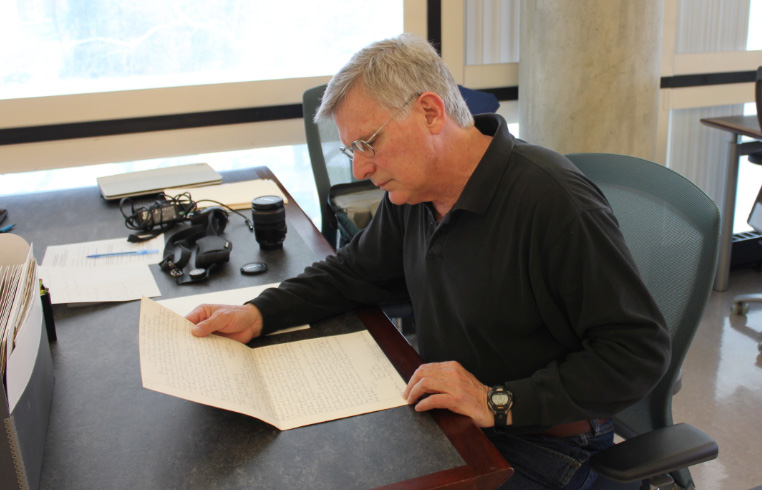 Wow, 18 document boxes, and one “oversized” box totaling 8.86 linear feet. And, unfortunately as noted in the descriptive summary, our first 60 years is only “sparsely documented.” I am told by some of our more senior members that this is due to a combination of flood, fire, theft, and even malicious behavior. The mere fact that these items are now professionally archived ensures that they are better protected and should never be exposed to such fates again. We arrived April 29 for our morning appointment. Laura Sullivan and her Special Collections staff were extremely helpful. In an attempt to maximize my time there, I had requested certain archival boxes and folders be pulled in advance. They had been pulled and were available when we arrived. I was most interested in Box 1, Folders 1-24, which are some of the oldest items archived, including copies of the original, hand-written charter. I also discovered that the claim of sparse documentation for our first 60 years to be quite true. Box 1 Folders 1 and 2 yield items from 1887, while Box 1 Folder 3 jumps straight to 1934. 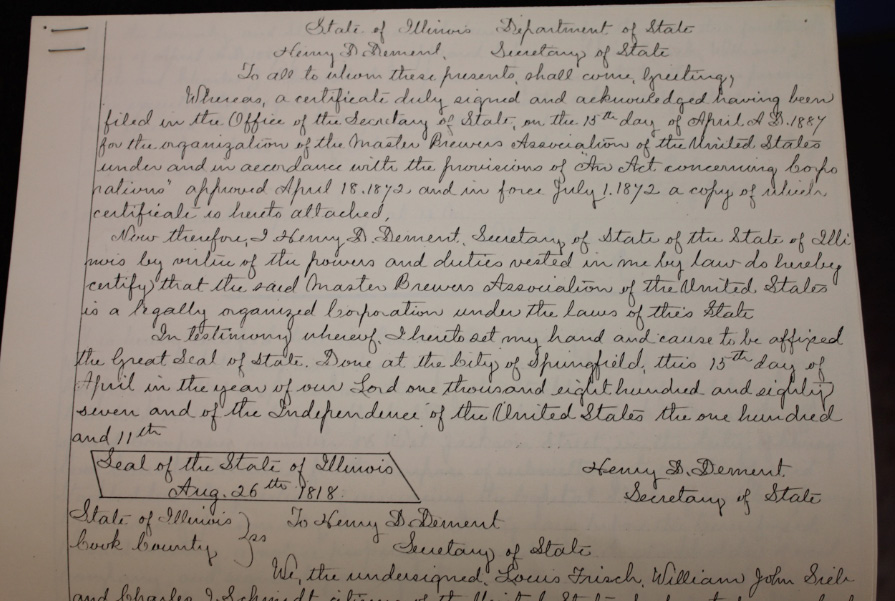
The first half of page one of the original, hand-written charter. It was a full and fascinating day. I found many of the items I wanted. I also found that I could probably spend another whole week there, just perusing the collection, even in a general way. As the Heritage Chair, the staff was comfortable with me taking many of my own digital photographs, but they also offer a range of photocopying and digitizing services. I had them digitize a copy of our original charter. I am also very interested in collecting historical information from each individual district. Hopefully, this will be the focus of future visits to the collection. Many thanks to Laura and the helpful staff at the Iowa State Parks Library Special Collections Department. And, your Heritage Chair checks off a “bucket list” item, while thinking about a return visit. Volunteer and Help Dig Up The PastIn the February edition of The MBAA Communicator, I offered the idea of establishing a heritage chair within each MBAA local district. The interest shown has been limited, and the most common question asked is, “Just what are the expectations in establishing and managing a district heritage chair?” As far as expectations or responsibilities are concerned, I see a district heritage chair as being very self-directed, a do-it-yourself project, entirely up to the individual volunteer. I would imagine, though, that any volunteer would probably be the type of person who is somewhat historically minded and has an awareness, attitude, outlook, and perspective that all leans toward “heritage” and “history”. Perhaps the person likes to read history. Or perhaps the person enjoys genealogical research, already pursuing his or her own family roots and memories. Three possible areas of participation might include capturing and preserving the memories of district events, archiving district memorabilia, and maintaining a district “heritage tab.”
Once again, the district heritage chair is a position that would not have to be something complicated, overwhelming, or all-consuming. Volunteers could be minimalist, doing as little as necessary or they could be as aggressively involved as they wanted. But in this digital, iPodded, BlackBerried, over-committed, multitasking, hectic world, the deck is stacked against all things “heritage” and “history.” Establishing a district heritage chair would be an important step in ensuring MBAA’s legacy for another 125 years! Why We Should Care About Our HeritageI always love the month of January. More than any other month, January epitomizes the spirit of renewal and resolutions for self-improvement. For MBAA, we begin the departure from our milestone 125th anniversary year and commit to, well, a milestone 126th year! We have never been healthier. Membership is up significantly. We have launched our new website. The Beer Steward Program (among many others) continues to be a phenomenal success. And on a more personal “heritage note”, I have had five districts express interest in establishing district heritage chairs. For me, the spirit of renewal ironically conjures up renewed thinking about the past…about heritage. Now, understandably, one might ask, “Why should we care about our heritage? Why do history and heritage even matter? After all, on a day-to-day basis, our members live and work in the present, and they spend a significant amount of their precious productive time worrying about and preparing for the future. The “present” and the “future” are their primary concerns. So, why does “heritage” matter at all?” Our national heritage offers a window into our origins, allowing us to glimpse the original intentions of our founders. It is about our very reason for existence. Those founders offered us a firm foundation of principles on which to build. Like any proud pedigree or honorable family genealogy, awareness of that heritage bestows upon us a sense of who we are and how we got to be what we are. Those historical and enduring core values have guided the thinking and steered the actions of each ensuing generation of leadership. They have reminded us, generation after generation, that there are many sides to every question and to any issue or concern that has faced our industry. It is also enormously fulfilling to participate in your local district. Beyond serving to remind all of us of the importance of bigger-picture citizenship, hands-on local heritage is especially rewarding. In an ever-changing, smartphoned, iPadded, instant-access, future-obsessed world, there is solace in all things “local”. Local heritage is the patchwork quilt of everything we call “home”. It celebrates our home landscape, our skyline, that one particular river meandering through town, that nearby mountain, the hometown university, an enduring city landmark, a prominent church steeple. And of course, local heritage celebrates our local breweries, their beers, and…their brewers! This past year, the hands-on heritage of our local breweries has been a source of tremendous joy for me personally. Some of these experiences I shared in The MBAA Communicator. Now I am exploring how MBAA can perhaps be of some additional help in offering local support. Looking ahead to a “next level” local recognition program, I believe there are many breweries throughout our local districts that have earned the right to some sort of designation as an MBAA Heritage Brewery. This possibility was actually suggested to me by fellow committee member Andy Tveekrem, and I thought the idea was brilliant. The new designation could be earned based upon several possibilities: perhaps celebrating the sheer age and upkeep of historically unique structures, rewarding the unwavering and ongoing dedication to a timeless brewing recipe, or recognizing the importance of continuous family ownership over multiple generations. I am certain that we could create much more criteria for recognition. But what better way to extend the uniqueness of our 125-year MBAA heritage than by establishing an MBAA Heritage Brewery designation. Again, I loved the idea, especially for what it brings to the local districts. I think that it is something to explore further. Let me know what you think. Like I said, I always love the spirit of renewal that January brings. Resolutions, possibility thinking, and heritage awareness all go equally hand-in-hand. |
MBAA
201 E Main St. Ste 810, Lexington , KY 40507© Copyright 2025. All rights reserved.
Privacy Policy